
Croatia has a reputation for being pricey — the Adriatic coast markets itself on yachts and Michelin-starred konobas, and a lot of “places to visit in Croatia” lists read like a shopping receipt: forty euros here, twenty-three there. But spend a week actually walking the country and you notice something else. The best hour of most days costs nothing. The stone streets, the swimming spots, the sunset over the Adriatic — none of that is behind a turnstile. This guide goes through Croatia’s six most-visited places — Dubrovnik, Plitvice Lakes National Park, Hvar Island, Split, Rovinj, and Zadar — and separates what’s genuinely free from what only looks free until you’re standing at the ticket booth.
We’re not going to pretend everything is free, because that would be useless to you the moment you arrive. Instead: here’s exactly what costs nothing, what’s a near-miss (free to look at, paid to go inside), and what’s worth paying for anyway.
- What “free” actually means once you’re there
- Dubrovnik: free things to do (and the walls, honestly)
- Plitvice Lakes: what’s actually free nearby
- Hvar Island: free things to do
- Split: free things to do
- Rovinj: free things to do
- Zadar: free things to do
- Free vs. paid, at a glance
- Mistakes people make with “free” in Croatia
- Frequently asked questions
What “free” actually means once you’re there
Croatia’s free experiences fall into three honest categories. First, genuinely free and always will be — walking a street, sitting on a public bench, watching a sunset. Second, free to approach but paid to enter — a fortress you can hike up to for nothing, then pay to walk inside. Third, the near-miss that trips up almost every first-time visitor: something so photographed and central to a place’s identity that people assume it must be free, when it’s actually one of the pricier tickets in the country. Dubrovnik’s City Walls are the textbook case, so we’ll deal with those first.
One more thing before we get into it: this isn’t a budget-backpacker roundup, and the point isn’t to skip the paid stuff to save money. Walking the walls, riding the Plitvice boats, climbing a bell tower — these are worth paying for. The point is honesty about which price tags are optional and which aren’t, so you spend on what matters to you and skip what doesn’t.
Dubrovnik: free things to do (and the walls, honestly)
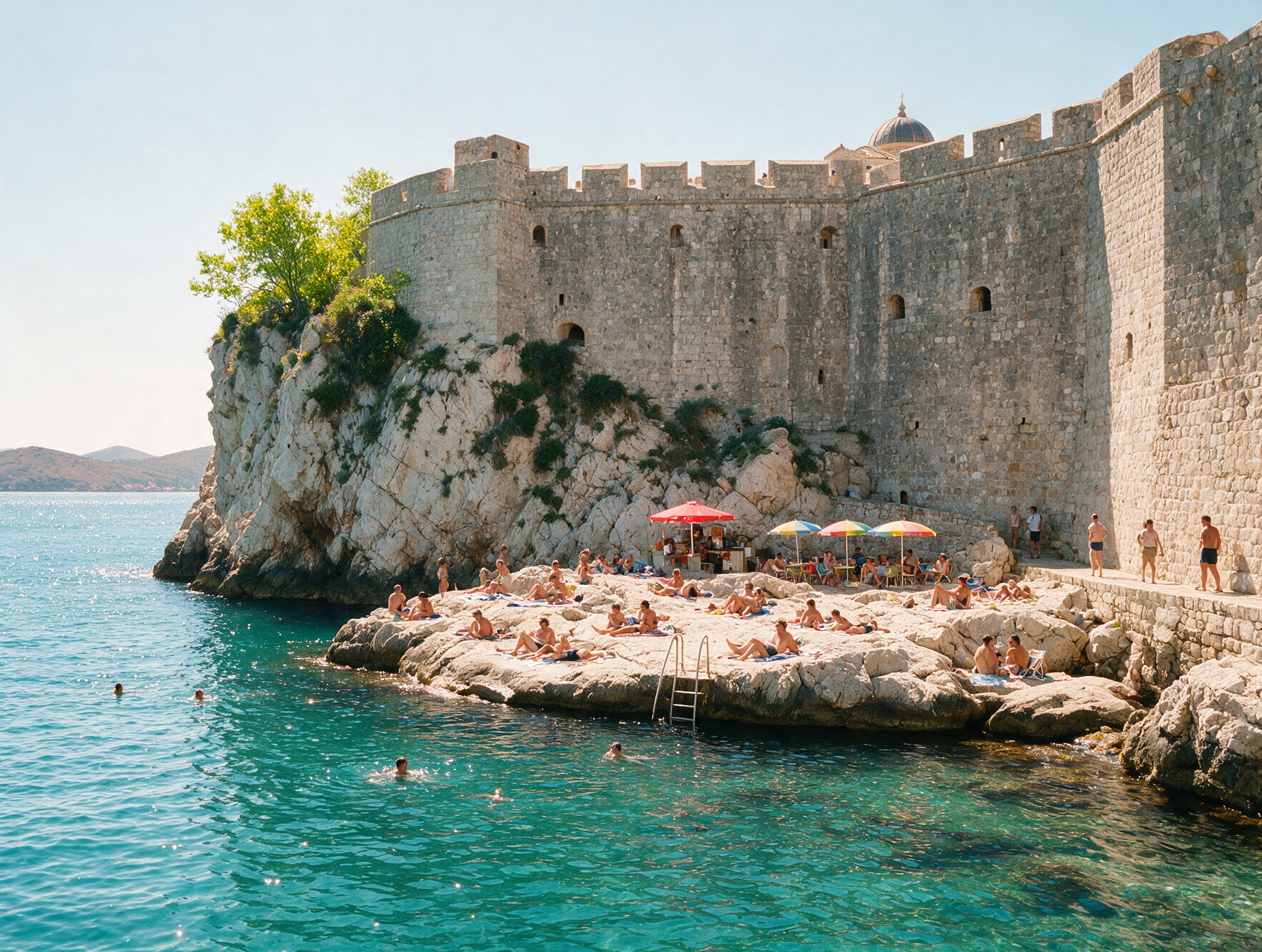
Start with the caveat, because it’s the one people get wrong most often: walking Dubrovnik’s Old Town is completely free. Walking on top of the City Walls that ring it is not. As of 2026, an adult ticket to walk the walls costs around €40 in high season (roughly March through November) and drops to about €20 in the off-season winter months, with children under seven let in free and youth/student tickets priced lower. That’s genuinely one of the most expensive city-wall walks in Europe, and it’s non-negotiable if you want the classic postcard view down over the terracotta roofs. Pay it once, do it early morning before the cruise-ship crowds arrive, and you’ll understand why people keep recommending it despite the price.
But the walls are maybe 20% of what makes Dubrovnik worth a full day, and the rest of it is free. Things to do in Dubrovnik without spending a cent:
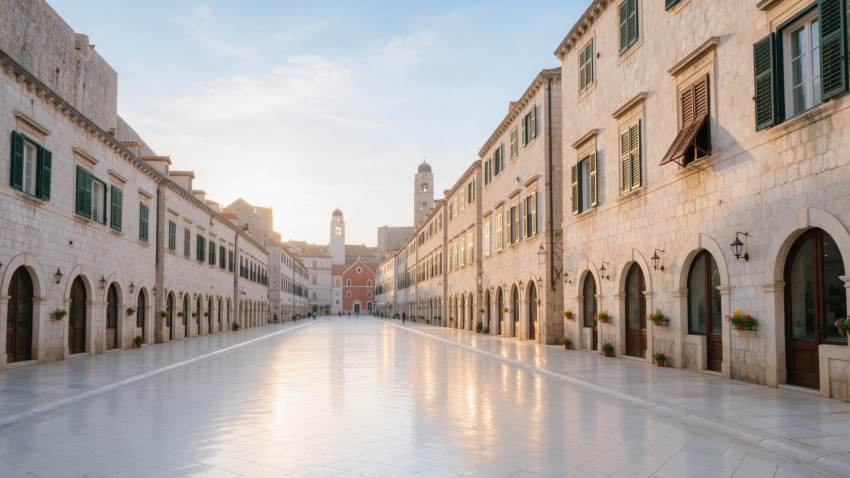
- Walk the Stradun. Dubrovnik’s main limestone street, polished to a shine by about eight centuries of foot traffic, runs from the Pile Gate to the old harbor. Go at 8am before the tour groups arrive and it’s just you, a few cats, and someone hosing down a café terrace.
- Buža Bar’s cliffs. Technically Buža (“hole in the wall”) is a bar built into a gap in the seaward walls, and yes, a drink there costs money. But the cliffs and rocks around it — where locals and travelers alike jump into the Adriatic all afternoon — are free to sit on, free to swim from, and arguably the best free view in the city. You don’t have to buy anything to be there.
- Hike Mount Srđ instead of taking the cable car. The cable car to the top of Srđ hill costs a return fare and gets crowded at sunset. There’s also a free hiking trail — a switchback path that starts near the Old Town walls and takes about 45–60 minutes uphill — that gets you the exact same panoramic view of the Old Town and the Elafiti Islands for nothing but sweat. Bring water; there’s no shade and it gets hot fast.
- Browse Gundulić Square market in the morning, when it’s a working fruit-and-flower market rather than a photo backdrop. No obligation to buy, though the strawberries in early summer are worth the exception.
Small moment worth mentioning: on a free walking tour here, the guide spent twenty minutes on Game of Thrones filming trivia to a group wilting in the sun, and most people looked like they’d rather have been swimming at Buža. Free tours are genuinely useful for day-one orientation — tip your guide, they work for tips only — but skip the ones leaning harder on TV trivia than on the city’s seven centuries as an independent maritime republic.
Plitvice Lakes: what’s actually free nearby
Let’s be straight about this one, because a lot of “free things to do” content dodges it: Plitvice Lakes National Park is not free, and there’s no legitimate way around the entrance fee if you want to walk its wooden boardwalks and see the turquoise lakes and waterfalls up close. As of 2026, the official adult one-day ticket runs about €10 in the low season (November through March), €23 in the shoulder months (April, May, October), and €40 in peak summer (June through August, entry before 4pm). Here’s the tip that most guides skip: in summer, a ticket bought after 4pm (or after 3pm in September) drops to around €25, and the park stays open late enough that you can still walk two or three of the main lake circuits and catch the golden-hour light on the water — which is arguably prettier than midday light anyway.
So what’s actually free? If you’re driving between Zagreb and Plitvice (or Plitvice and the coast), the waterfall village of Rastoke, near the town of Slunj, is genuinely free to wander. It’s a cluster of old watermill houses built directly over small cascades of the Slunjčica and Korana rivers — smaller and gentler than Plitvice’s big waterfalls, but the setting is nearly as pretty, and there’s no ticket booth. It makes a good detour if you want a waterfall photo without the park’s crowds or cost.
Around the park itself, the honest answer is that the good viewpoints are inside the ticketed zone — this isn’t a park you can peek into for free the way you can glimpse a cathedral through an open door. If your Croatia trip cost from India is already tight after flights and hotels, treat Plitvice as one splurge day rather than trying to see it around the fee, and build free days around it in Zadar or Split instead.
Hvar Island: free things to do
Hvar gets marketed as the glamorous stop on any Croatia itinerary — yacht harbor, rooftop bars, the sunniest island in the Adriatic — and it’s easy to assume everything here costs resort prices. Most of what makes Hvar Town worth a day is free.
- Walk up toward Fortica (the Spanish Fortress). The path itself, a steep 15–20 minute climb of stone steps from the main square, is free, and you get real views over Hvar’s rooftops and the Pakleni Islands on the way up. Going inside the fortress costs around €10; the walk alone gets you most of the view for nothing.
- Swim from the town’s rocky shoreline east of the harbor, near the Hotel Amfora area — no entrance fee, though sunbeds and umbrellas are rented separately if you want them.
- Walk (or cycle) the Stari Grad Plain, a UNESCO World Heritage-listed agricultural landscape a short drive or ferry-hop away, near the older town of Stari Grad. Greek colonists laid out this grid of stone-walled fields and vineyards over 2,400 years ago, and remarkably, the same field divisions are still farmed today. It costs nothing to walk or cycle through — it’s open countryside, not a fenced museum.
- Sit in St. Stephen’s Square, one of the largest old town squares in Dalmatia, and watch the evening passeggiata — locals and visitors doing slow laps of the square before dinner. Free, and honestly one of the better people-watching spots on the entire coast.
Fun fact worth knowing before you go: Hvar Town claims the most recorded hours of sunshine of any spot in the Adriatic — the tourist board says around 2,700+ hours a year — which is why the lavender fields nearby do so well and why the harbor cafés never seem to run out of customers even in shoulder season.
Split: free things to do
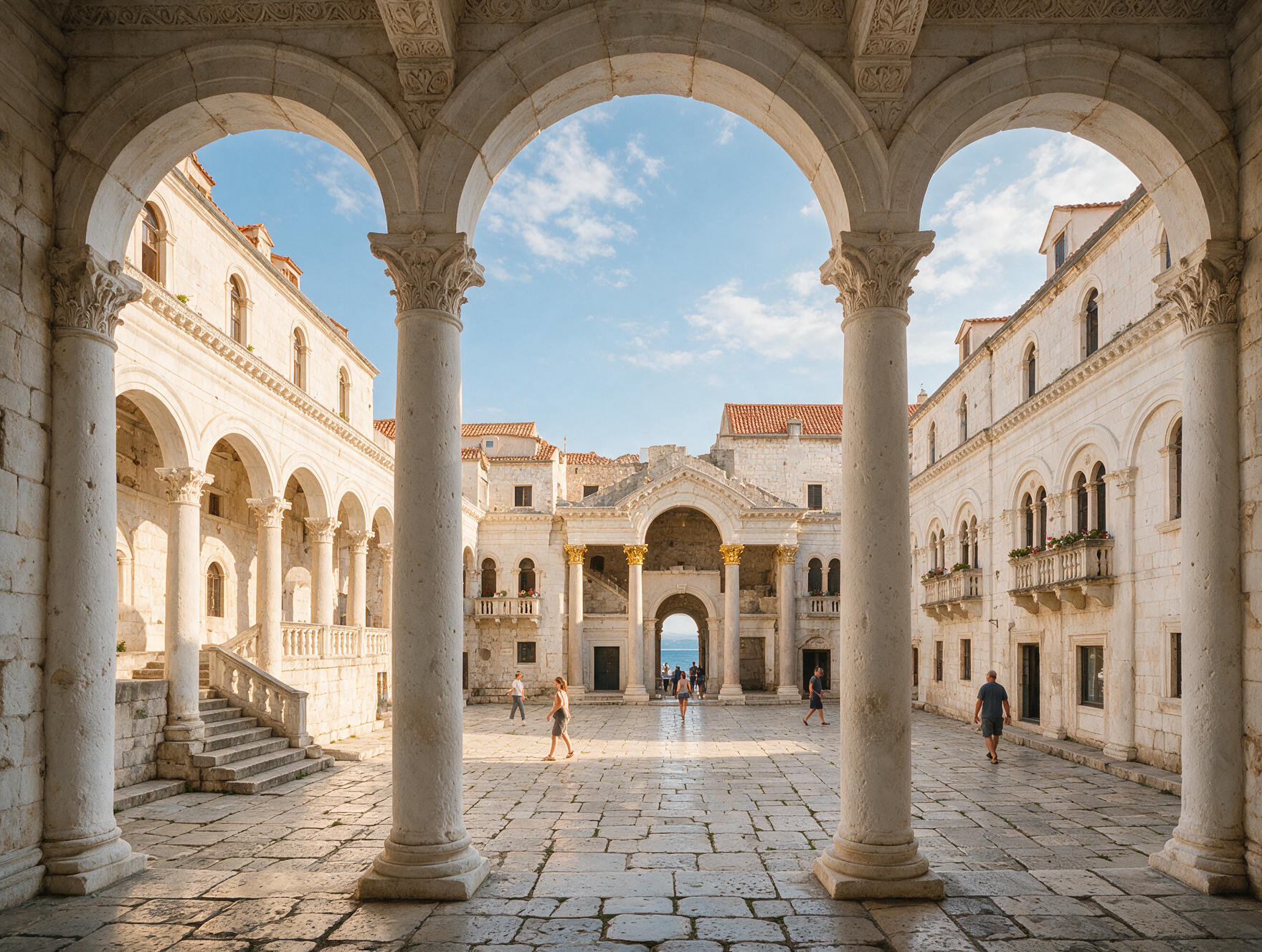
Split is the one place on this list where the headline attraction is, refreshingly, actually free. Diocletian’s Palace isn’t a monument you visit — it’s a functioning neighborhood people live and run shops inside, built inside the shell of a Roman emperor’s retirement palace from around 305 AD. All four Roman gates stand open 24 hours a day, and walking its narrow stone streets, the central Peristyle courtyard, and the domed Vestibule costs nothing at any hour.
Where it gets paid is specific: climbing the Cathedral of St. Domnius bell tower (roughly €7), entering the cathedral interior itself (also roughly €7), walking through the developed sections of the subterranean cellars (around €6), and stepping inside the small Temple of Jupiter (around €3). If you want to do all four, a combined ticket usually works out a few euros cheaper than paying separately — but you can also just skip all of them and still say you’ve seen Diocletian’s Palace, because you genuinely have.
Beyond the palace walls:
- Walk the Riva, Split’s palm-lined waterfront promenade, at golden hour when the light hits the palace’s stone facade from across the harbor.
- Hike Marjan Hill, the forested peninsula that forms Split’s green lung — free trails wind up through pine forest to several viewpoints (Telegrin is the highest) looking back over the city and the islands. There are also small free-to-visit hermit chapels tucked into the hillside.
- Swim at Bačvice Beach, a sandy cove a short walk from the center — free public access, though the beach bars charge for sunbeds if you want one.
- Walk out to Sustipan Park at the western end of the harbor, a quiet clifftop garden that most tour groups skip entirely. Locals go here for sunset instead of fighting the crowds on the Riva — same view, a fraction of the people.
Honest opinion: the bell tower climb is the one paid attraction here worth ranking as skippable. It’s 183 narrow, exposed stone steps with no railing for long stretches, and Marjan Hill gets a comparably good elevated view for free, with better footing.
Rovinj: free things to do
Rovinj is the one stop on Croatia’s coast most people describe as their favorite, and it’s also the easiest to enjoy without spending money, because its whole appeal is atmosphere rather than ticketed sights.
- Walk the waterfront and the old fishing quarter — the tightly packed, pastel-colored houses that seem to rise straight out of the Adriatic are Rovinj’s signature image, and seeing them costs nothing beyond the walk.
- Wander Grisia Street, the steep cobbled lane leading up to the church, lined with small artist studios and open-air galleries. Browsing is free; on the third Sunday of most months an open-air art exhibition takes over the whole street.
- Enter the Church of St. Euphemia at the top of the hill — general admission to the church interior is free, though climbing the 60-meter bell tower for the view over the Istrian peninsula carries a small separate fee.
- Walk (or cycle) through Zlatni Rt (Golden Cape) Forest Park, a wooded peninsula just south of the old town with shaded paths, rocky swimming coves, and sea views — entirely free and a genuine break from the summer heat.
Local tip that doesn’t make the generic lists: skip the crowded main harbor for your evening drink and walk five minutes north along the coastal path past the marina — there are a couple of unmarked flat rocks locals use for an evening swim and sunset-watching, with none of the restaurant markup you’d pay for a “sea view” table on the Rovinj waterfront.
Zadar: free things to do
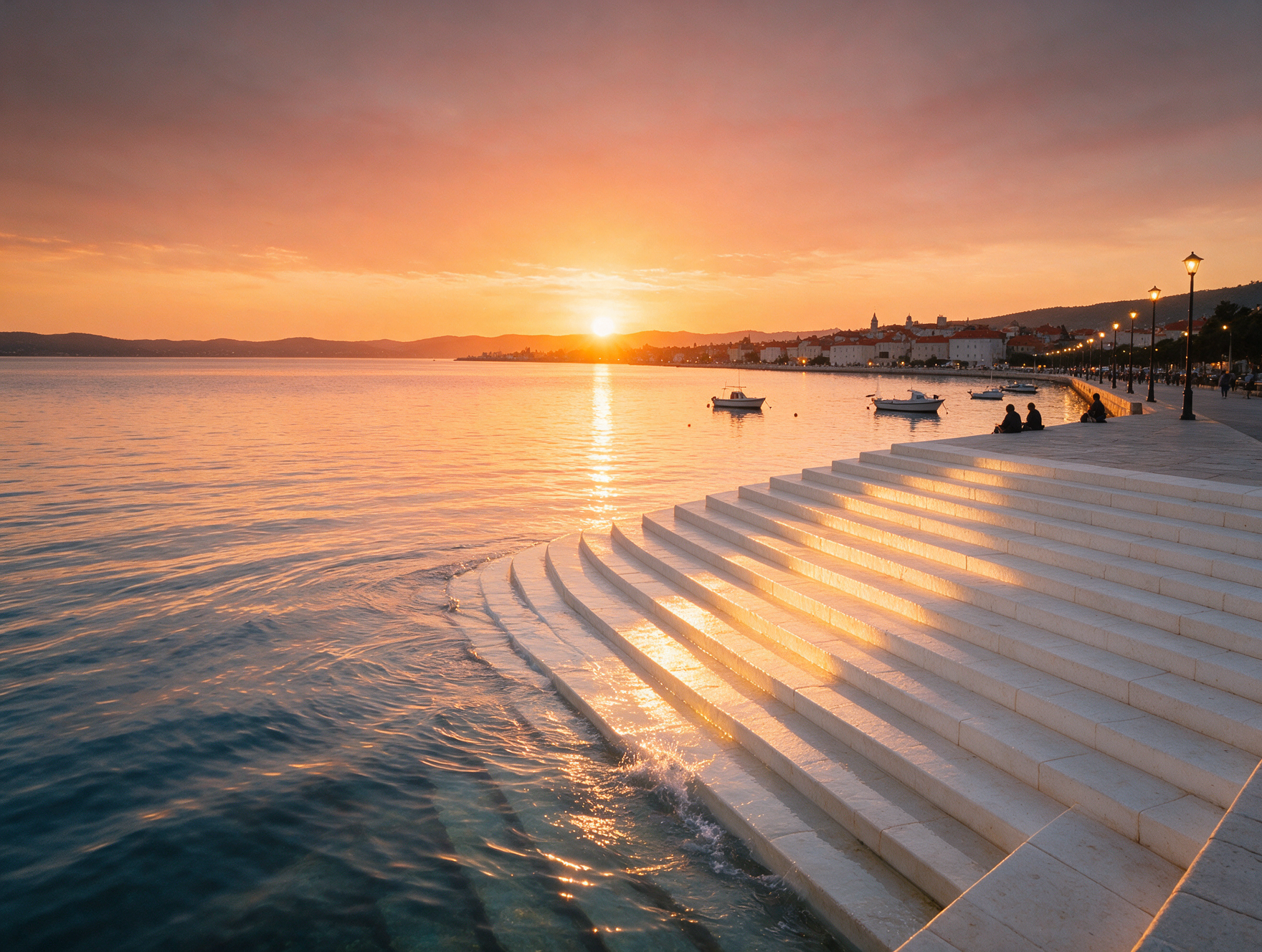
Zadar is arguably the most underrated stop of the six, and it’s also the one where nearly everything that matters is free. The Sea Organ — a set of stone steps built into the harbor wall with hidden pipes underneath that turn the motion of the waves into ambient, slightly haunting musical tones — costs nothing to sit at, day or night. It was designed by architect Nikola Bašić and completed in 2005, and it’s genuinely one of the more original pieces of public infrastructure anywhere on the Adriatic. Right next to it, the Greeting to the Sun is a 22-meter circle of glass panels embedded in the pavement that collects solar energy all day and puts on a slow, colorful light show synced with the Sea Organ’s rhythm after dark. Both are permanent public installations — free at any hour, no ticket booth in sight.
Also free in Zadar:
- Walk Kalelarga, the main pedestrian street through the old town, and duck into the side alleys where laundry still hangs between buildings above your head.
- View the Roman Forum from ground level — the exposed columns and foundations of Zadar’s 1st-century Roman forum sit in an open square you can walk around freely; only the small Church of St. Donatus standing at its edge charges a modest entry fee to go inside.
- Sit at Five Wells Square (Trg Pet Bunara), a Renaissance-era square built as a water reservoir, now a quiet spot mostly skipped by day-trippers.
- Watch the sunset from the harbor promenade. According to local lore, Alfred Hitchcock once called a Zadar sunset the most beautiful in the world — whether or not he actually said it, watching the sky go orange over the Sea Organ while the tones drift up from the water is a genuinely good way to end a day, and it doesn’t cost anything.
Mistake to avoid: people often show up at the Sea Organ at midday expecting the light show from the Greeting to the Sun and are confused when nothing happens. The light installation only really performs after dark — plan to be there in the thirty minutes after sunset, not before it.
Free vs. paid, at a glance
| Place | Genuinely free | Commonly mistaken as free |
|---|---|---|
| Dubrovnik | Old Town streets, Buža cliffs, Mount Srđ hiking trail, Gundulić market | City Walls (~€40 high season / ~€20 low season) |
| Plitvice Lakes | Rastoke village nearby | The park itself — no free entry exists (~€10–€40 by season) |
| Hvar Island | Fortica walking path, town beaches, Stari Grad Plain, St. Stephen’s Square | Inside the Fortica fortress (~€10) |
| Split | Diocletian’s Palace (all public areas), Riva, Marjan Hill, Bačvice Beach | Cathedral interior, bell tower, cellars, Temple of Jupiter (each individually ticketed) |
| Rovinj | Waterfront, Grisia Street, St. Euphemia’s church interior, Zlatni Rt park | St. Euphemia’s bell tower climb (small fee) |
| Zadar | Sea Organ, Greeting to the Sun, Kalelarga, Roman Forum exterior, Five Wells Square | Church of St. Donatus interior (modest fee) |
Mistakes people make with “free” in Croatia
A few patterns come up again and again when travelers plan a budget-conscious day around Croatia’s coast, so it’s worth flagging them directly:
- Assuming the Dubrovnik Walls are included in general Old Town admission. There’s no such thing as Old Town admission — walking in is always free — the walls are a separate, and expensive, ticket.
- Turning up at Plitvice in peak summer without a timed ticket booked ahead. The park caps daily visitor numbers, and walk-up tickets in July and August often sell out by mid-morning — book ahead if your visit falls in the busiest window, June through September.
- Not carrying cash for the small “paid extras.” Sights like a church bell tower or a fortress interior often charge €3–€10 at a small on-site booth, not always through a pre-bookable website. Carry a little cash so a €3 ticket doesn’t turn into a wasted trip back down the hill.
- Overpacking the coast into too few days to actually use these free spots. A rushed Croatia 7 days travel itinerary treating Dubrovnik, Split, Hvar, and Plitvice as one-night stops leaves no time for a free sunrise walk or an unhurried swim — the things that make a trip memorable tend to happen in the slow hours, not the scheduled ones.
Frequently Asked Questions
Is Croatia expensive to visit overall?
It depends on how you structure the trip. Restaurant meals, boat tours, and headline paid attractions (the Dubrovnik Walls, Plitvice, guided excursions) add up quickly in peak summer. But because so much of what makes Croatia worth visiting — walking, swimming, old town streets, sunsets — costs nothing, a genuinely full day without spending on tickets is entirely possible. Whether it feels expensive usually comes down to how many paid extras stack on top of the essentials.
Is it worth paying to walk the Dubrovnik City Walls if I’m trying to save money elsewhere?
Most first-time visitors say yes — it’s the one paid Croatia experience that consistently gets described as worth the price, because the view over the Old Town’s terracotta roofs and the Adriatic simply isn’t available from anywhere else. If budget is a real constraint, do it once, early in the morning, and skip other paid extras in Dubrovnik instead.
Can I see Plitvice Lakes without paying the entrance fee?
Not really, no — the park’s boardwalks, viewpoints, and lakes all sit inside the ticketed zone, and there’s no legitimate free entrance or free viewpoint that gives you the actual lake views. Rastoke village near Slunj, about 45 minutes away, is a free alternative if you want a waterfall experience without the fee.
What is the Sea Organ in Zadar and does it cost anything?
It’s a set of stone steps built into the Zadar harbor wall with pipes underneath that turn wave motion into soft musical tones. It’s a public installation, free to visit at any time, and pairs well with the nearby Greeting to the Sun light installation after dark.
What’s the best time to visit Croatia if I want to do a lot of free outdoor stuff?
Late spring (May–June) and early autumn (September) tend to be the sweet spot — warm enough to swim and hike comfortably, without the peak-July crowds that make free spots like Buža Bar’s cliffs or Zadar’s Riva feel packed. Winter (November–March) is quieter still and even cuts the Dubrovnik Walls and Plitvice entrance fees roughly in half, though swimming is off the table and some island ferry schedules thin out.
Do I need a visa from India to visit Croatia?
Croatia is part of the Schengen Area, so Indian passport holders typically need a Schengen visa arranged in advance — not something you sort out on arrival. Requirements and documents shift, so check current rules close to your travel dates rather than relying on older information.
Are the free beaches in Split and Hvar actually clean and swimmable?
Yes — Bačvice in Split and the rocky shoreline stretches in Hvar Town are public, free, and part of regularly monitored EU bathing water sites, which tend to score well for water quality. You’ll pay only if you want a rented sunbed, umbrella, or a spot at a private beach club.
Is it rude to swim at Buža Bar in Dubrovnik without buying a drink?
No — the rocks and cliffs around Buža are public coastline, and plenty of people swim there without ordering anything. That said, if you do want to sit at a table or use their steps into the water for an extended stretch, buying at least one drink is the polite unwritten rule.
If reading through six cities’ worth of free walks, free viewpoints, and free swimming spots has you wanting to actually go, that’s the easy part — the harder part is fitting Dubrovnik, Plitvice, Hvar, Split, Rovinj, and Zadar into one trip without rushing any of them, working out ferry timings between the islands and the mainland, and knowing which paid extras are genuinely worth it versus which ones you can skip guilt-free. That’s exactly the kind of planning Get Tripped’s Croatia trip planners handle for a living — building a route, a pace, and a mix of free days and splurge days that actually matches how you want to travel, rather than a generic copy-paste itinerary. If you’re weighing a custom Croatia trip against an off-the-shelf package, it’s worth a conversation before you book flights.