
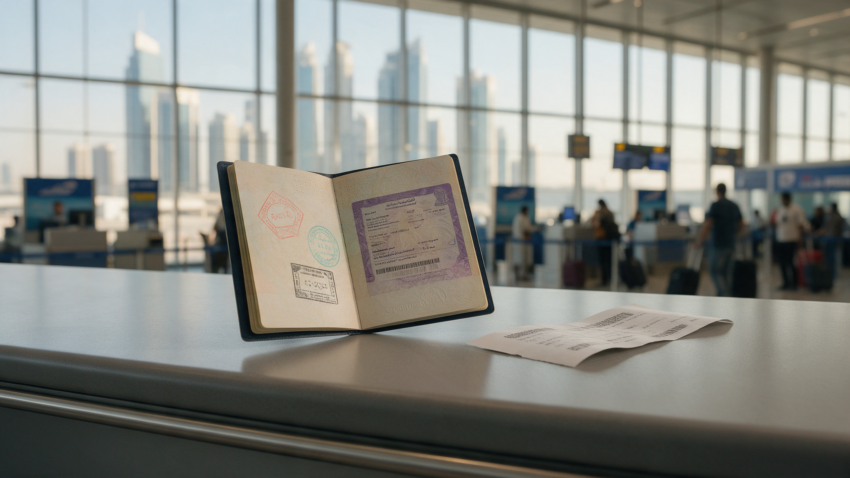
Dubai Visa for Indians 2026: Types, Fees, Process and Mistakes to Avoid
The immigration line at Dubai International’s Terminal 3 splits into two the moment you land off an Emirates flight from Mumbai or Delhi — one queue for UAE and GCC passports, a much longer one for everyone else. Stand in the second one long enough and you’ll hear the same question in three different Indian languages: “bhai, aapka visa kaunsa type hai?” Nobody quite agrees on what kind of Dubai visa for Indians is the right one, and that’s the honest starting point for this guide. There isn’t one single Dubai visa for Indian travelers — there are several, and picking the wrong one, or filling in the right one badly, is the single biggest reason trips get delayed at the airport counter instead of at the pool.
This is the visa guide we wish existed before our own first Dubai trip: current 2026 fees, who actually qualifies for visa-on-arrival (spoiler: it’s not most Indian passport holders, contrary to what half the travel forums claim), and the specific documentation mistakes that get applications kicked back. If you’d rather skip the paperwork altogether, Get Tripped’s Dubai trip planning page has our curated itineraries and we handle visa filing as part of the package — more on that at the end.
Table of Contents
- Do Indians Need a Visa for Dubai?
- Visa Types and Who Needs What
- How to Apply: Step-by-Step
- Documents Checklist
- Fees and Processing Time in 2026
- Visa-on-Arrival: Who Actually Qualifies
- Common Mistakes and Rejection Reasons
- Tips for a Smooth Arrival at Dubai Airport Immigration
- Frequently Asked Questions
- Conclusion
Do Indians Need a Visa for Dubai?
Yes. Every Indian passport holder needs a visa to enter Dubai or anywhere else in the UAE — there’s no visa-free entry for ordinary Indian passports, full stop. What changes is how you get that visa and how long it takes. If you already hold a valid, used US visa, a UK visa, a Schengen visa, or residency in a handful of specific countries, you may be able to get a visa stamped on arrival at the airport instead of applying in advance. Everyone else applies for an e-visa before flying, which is genuinely the more common path for Indian travelers headed to Dubai for a family holiday or honeymoon.
A fun fact that surprises most first-timers: Dubai is one emirate within the UAE, but the visa itself is a federal UAE visa issued through the General Directorate of Residency and Foreign Affairs (GDRFA Dubai), not a Dubai-specific document. It lets you enter through any UAE airport or land border, not just Dubai.
Visa Types and Who Needs What
For Indian leisure travelers, four visa types cover almost every situation:
14-day visa-on-arrival (VOA)
A single-entry, 14-day visa stamped at the airport, available only to Indian nationals who hold a valid US visa, US Green Card, UK visa or residency, or EU residency (with specific expansions covered below). No advance application, no e-visa portal — you land, show the qualifying document, and immigration stamps you in. It cannot be extended past 14 days.
30-day single-entry tourist e-visa
The most commonly used option for Indian tourists who don’t hold a qualifying US/UK/EU document. Applied for online before departure, valid for a single entry, and good for a 30-day stay from the date of entry. This is what most families booking a standard 5-6 night Dubai holiday end up using.
60-day single-entry tourist e-visa
Same process as the 30-day version but gives you double the stay — useful if you’re combining Dubai with Abu Dhabi, Ras Al Khaimah or a broader UAE road trip, or if you have family based there and want a longer visit without filing a second application.
30-day and 60-day multiple-entry visas
Worth knowing about if your trip involves a side hop to Oman or another neighbouring country and back into the UAE, or if you’re combining a Dubai stopover with onward travel. These cost more than the single-entry versions but let you exit and re-enter as many times as you like within the validity window, each stay capped at 30 or 60 days respectively.

One honest caveat: transit visas exist too, for layovers over 8 hours, but they’re a different product entirely and not something to confuse with a tourist visa if you’re actually staying in Dubai for your holiday.
How to Apply: Step-by-Step
There are three practical routes, and which one suits you depends mostly on how much hand-holding you want.
- Airline visa-assist services. Emirates, Air India, and IndiGo all offer visa processing tied to your ticket booking. On Emirates, once you’ve booked, go to “Manage my booking” on emirates.com, click the visa application link, and you’re routed to the Dubai Visa Processing Centre’s online portal (run with VFS Global). Air India and IndiGo have similar visa-assistance pages linked from their booking confirmation or a dedicated visa-information page. This is usually the fastest route if you’re already flying that airline, since your PNR is linked directly to the application.
- Apply directly through an approved e-visa channel or your travel agent. Dubai tourist e-visas are issued through accredited tourism establishments and travel agencies registered with GDRFA — not something you file yourself on a generic government portal the way you might for, say, a Schengen visa. This is where a lot of first-time applicants get confused; there’s no single public “apply here” button run directly by GDRFA for tourists the way there is for residents renewing an Emirates ID. A registered agent, tour operator, or the airline portal above is how the paperwork actually reaches the system.
- Go through your tour operator. If you’re booking a package anyway, most operators (including us) file the visa as part of the booking, matching your passport details, photo, and travel dates to avoid the mismatches that cause delays.
Whichever route you pick, apply at least 7-10 working days before departure. Processing is officially fast — often 24 hours to 4 working days — but UAE government offices don’t work Fridays and Saturdays, so an application filed on a Thursday evening effectively loses two days before anyone even looks at it.
Documents Checklist
Keep this list next to your application form; missing or mismatched documents are the single most preventable rejection cause.
- Passport with at least 6 months validity remaining from your date of entry into the UAE, and at least two blank pages
- A recent passport-size photograph, plain white or light background, no glasses or headwear (unless religious)
- Confirmed return or onward flight ticket
- Hotel booking confirmation or, if staying with family, an invitation/host letter
- Proof of sufficient funds — recent bank statement is the most commonly accepted form
- Valid travel/medical insurance recognized in the UAE (increasingly asked for, and genuinely worth having regardless of whether it’s checked at your specific entry point)
- A filled application form with your name and passport number matching exactly, including middle names as they appear in your passport — a mismatched spelling between your flight ticket and your visa application is a very common, very avoidable snag
Fees and Processing Time in 2026
Fees are set in AED by GDRFA and typically converted to INR by whichever agent or airline portal processes your application, so expect the INR figure to shift slightly with the exchange rate. As of 2026, the official GDRFA single-entry tourist visa fees are:
- 30-day single-entry tourist visa: AED 200 + 5% VAT
- 60-day single-entry tourist visa: AED 300 + 5% VAT
- 30-day multiple-entry visa: roughly AED 650
- 60-day multiple-entry visa: roughly AED 900
Add service charges if you’re applying via an airline portal or agent — these are usually modest but not zero, so ask for an all-in quote rather than assuming the government fee is the final number. Children under 18 travelling with a parent are typically exempt from the visa fee itself under the multiple-entry categories, though this varies by processing channel, so confirm at the time of application.
Processing time: standard applications typically clear in 24 hours to 4 working days, and the vast majority of clean applications are approved within 2 days. Express processing (for a higher fee) can bring this down to within 24 hours if you’re booking last-minute. The one thing that reliably blows past these windows is applying right before a UAE public holiday or a high-volume Indian travel period like Diwali or year-end — file earlier than you think you need to during those windows.
Visa-on-Arrival: Who Actually Qualifies
This is the part travel forums get wrong most often, so it’s worth being precise. Indian nationals get visa-on-arrival in Dubai only if they hold, alongside their Indian passport, one of the following, valid and already used at least once:
- A valid US visa (any category), or a US Green Card
- A valid UK visa, or UK residency
- A valid Schengen/EU visa, or EU residency
Since February 2025, this eligibility expanded to also cover Indian nationals holding a valid residence permit (not just a visa) from Australia, Canada, Japan, South Korea, New Zealand, or Singapore.
If you qualify, Emirates runs a pre-approved visa-on-arrival scheme in partnership with VFS Global at the Dubai Visa Processing Centre: you book your Emirates flight, submit your qualifying document through “Manage my booking,” and get pre-cleared before you even leave India, then simply get stamped in at Dubai airport. It’s issued as a 14-day single-entry visa and, like every UAE visa decision, remains at GDRFA’s discretion — approval isn’t guaranteed just because you meet the paper criteria.
If none of that applies to you — and for most first-time Dubai travelers from India, it doesn’t — you’re applying for the standard e-visa in advance, and that’s completely normal. Don’t let anyone tell you a pre-arranged e-visa is somehow the “backup” option; for the majority of Indian travelers, it’s simply the only option, and there’s nothing wrong with it.
Common Mistakes and Rejection Reasons to Avoid
A few patterns show up again and again in rejected or delayed applications:
- Wrong visa category selected for the actual purpose or length of the trip
- Incomplete or inconsistent forms — name spelling, date of birth, or passport number not matching the passport exactly
- Weak proof of funds — a bank statement showing large, unexplained recent deposits raises more questions than it answers
- Not declaring a previous UAE visa refusal or overstay, which is checked against records and treated far more seriously than the original issue itself
- Vague or missing return travel and accommodation proof — a one-way flight with no hotel booking is a near-automatic flag
- Photo issues — wrong background colour, sunglasses, or a photo that’s simply too old to resemble the applicant
A mistake we’ve seen trip a surprising number of otherwise well-prepared travelers: applying with a passport that has less than six months validity at the date of travel, not at the date of application. Check the return date of your actual trip against your passport expiry, not today’s date.
Tips for a Smooth Arrival at Dubai Airport Immigration
Dubai International (DXB) processes an enormous volume of passengers through Terminals 1 and 3, and immigration queues genuinely do swing between fifteen minutes and well over an hour depending on how many wide-bodies land in the same twenty-minute window. A few things that make the difference:
- Keep your visa printout (a physical or clearly saved digital copy) and hotel confirmation easily accessible, not buried in email you’ll need Wi-Fi to open
- Fill in the UAE’s advance passenger declaration if your airline requests it, rather than doing it queued at the counter
- If you qualify for visa-on-arrival, use the dedicated VOA counters rather than the general queue — they move noticeably faster
- Have your qualifying document (US/UK/EU visa or residency, if that’s your route) on the same passport you’re travelling on, and physically present, not just a photo on your phone as backup only
Once you’re through, an eSIM or airport SIM is worth sorting immediately — du and Etisalat counters are right past immigration, and an eSIM bought before you fly means you land already connected, which matters more than it sounds like when you’re trying to find a Careem or confirm a hotel address at midnight. The UAE dirham (AED) is pegged to the US dollar, cards are accepted almost everywhere including taxis, and carrying roughly AED 500-1000 in cash for smaller vendors, tips, and the metro is a sensible habit rather than a necessity.

Frequently Asked Questions
Do Indians get visa-free entry to Dubai?
No. There’s no visa-free entry for Indian ordinary passport holders. Some Indians qualify for visa-on-arrival if they hold a valid US, UK, or EU visa/residency (or residency from a few other specific countries), but that’s not the same as visa-free, and it’s not available to most travelers.
How many days before travel should I apply for a Dubai visa?
7-10 working days is a comfortable buffer even though processing is often faster. Avoid applying in the week immediately before a UAE public holiday or a peak Indian travel season if you can help it.
Can I extend my Dubai tourist visa once I’m there?
Single-entry 30-day and 60-day visas can sometimes be extended through registered typing centres or your sponsoring agent before expiry, for an additional fee, but it’s not guaranteed and shouldn’t be assumed as a backup plan. Overstaying attracts daily fines and can affect future visa applications.
Is a hotel booking mandatory if I’m staying with relatives in Dubai?
You can usually substitute a formal invitation or host letter from your relative (often needing to be an Emirates ID holder or resident) instead of a hotel booking, but requirements vary by processing channel, so confirm with whoever is filing your application.
What’s the difference between a Dubai visa and a UAE visa?
None, practically speaking. Dubai is an emirate within the UAE, and tourist visas are issued federally through GDRFA (for Dubai specifically) or the ICP, valid for entry anywhere in the UAE, not just Dubai.
Do children need a separate visa?
Yes, every passport holder including infants needs their own visa application, though fees for children under 18 are often waived or reduced, particularly on multiple-entry categories, when travelling with a parent.
Can I apply for a Dubai visa without booking through an airline?
Yes — registered travel agencies and tour operators (accredited with GDRFA) can file tourist visas independent of your flight booking. This is the more common route if you’re not flying Emirates, Air India, or IndiGo, or if you’d rather have one operator handle visa, hotel, and itinerary together.
Is travel insurance compulsory for a Dubai visa?
It’s increasingly required as part of standard documentation and is a smart idea regardless of whether it’s strictly enforced at your specific application channel — medical costs in UAE private hospitals are not low, and insurance is one of the cheapest parts of the whole trip.
Conclusion
The Dubai visa process for Indian travelers isn’t complicated once you know which lane you’re in — visa-on-arrival if you hold a qualifying US/UK/EU visa or residency, an e-visa in advance for everyone else, filed through an airline, a registered agent, or your tour operator. Get the passport validity, the photo, and the name spelling right, apply with a week or two of buffer, and the rest of the process is genuinely routine. The part that actually varies trip to trip — what to see, where to stay, when to go, how to build the days once you land — is the more interesting planning work anyway.

If you’d rather not track fee changes, document checklists, and processing windows yourself, that’s literally what we’re for. Get Tripped handles the Dubai visa filing alongside a custom itinerary — family holidays, honeymoons, or a straightforward long weekend — built around when you actually want to travel and what your trip should look like once you land, not a generic template. Tell us your travel dates and we’ll take the visa admin off your plate along with the planning.
Sources: GDRFA Dubai, UAE Ministry of Foreign Affairs, New Delhi Mission, Emirates visa services, Visit Dubai. Visa fees, eligibility and processing times change without notice — always confirm current requirements before booking non-refundable travel.