
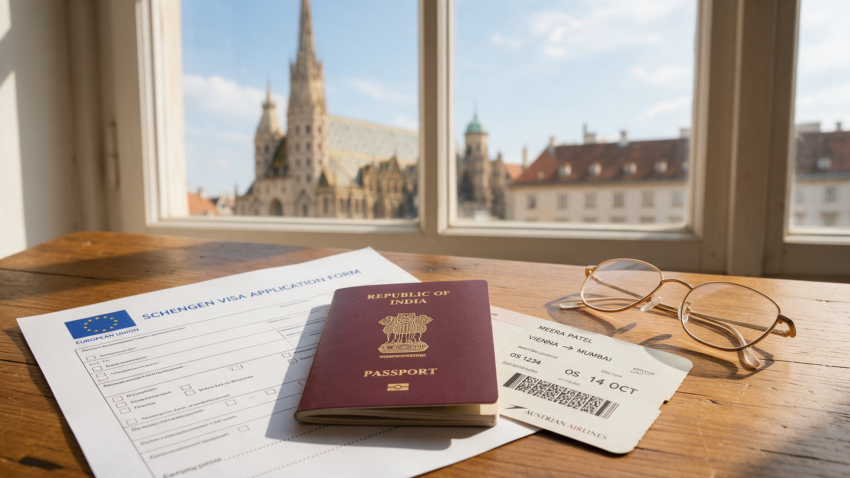
The first time one of our travelers applied for a Schengen visa for an Austria trip, she called us the night before her VFS appointment convinced she’d forgotten something. She hadn’t — she’d just never had to prove, in triplicate, that she had a reason to come home. That’s the real shape of the Austria visa process for Indian passport holders: not difficult exactly, but unforgiving of loose paperwork. Get it right and it’s a fairly mechanical two-to-three week wait. Get it sloppy and you’re looking at a rejection stamp and a wasted booking.
This guide walks through exactly what an Indian traveler needs for an Austria Schengen visa in 2026 — the fee, the document list VFS actually checks, the new insurance rule that catches people off guard, and the mistakes that get applications sent back. We update this from the current VFS Global and Austrian embassy guidance, not from what worked for a friend’s cousin’s trip in 2019.
Table of Contents
- Do Indian Travelers Need a Visa for Austria?
- Which Visa Type You’re Actually Applying For
- Austria Visa Fee for Indians (2026)
- The Document Checklist
- The 2026 Travel Insurance Rule
- How to Apply, Step by Step
- Processing Time and When to Apply
- Why Austria Visa Applications Actually Get Rejected
- A Mistake Worth Avoiding
- FAQs
Do Indian Travelers Need a Visa for Austria?
Yes. Austria is part of the Schengen Area, and Indian passport holders need a Schengen Type C visa before flying in, regardless of whether Austria is your only stop or one leg of a longer Europe trip. There’s no visa-on-arrival, no e-visa shortcut — you apply in advance, in India, through the official visa application partner.
One detail that trips people up: you apply at the consulate of your main destination — the country where you’ll spend the most nights, or your first point of entry if the nights are split evenly. If Austria is genuinely where you’re spending most of your trip (say, five nights in Vienna and Salzburg against two in Munich), you apply for the Austria visa. If you’re doing three nights in Austria against five in Italy, you’d apply through Italy instead. We mention this because we’ve seen travelers apply at the wrong consulate and lose weeks re-filing.
Which Visa Type You’re Actually Applying For
For tourism, the vast majority of Get Tripped travelers need the Schengen Type C visa — a short-stay visa valid for stays up to 90 days within any 180-day period, across the entire Schengen Area, not just Austria. It’s issued as single-entry, double-entry, or multiple-entry depending on your travel history and the consular officer’s discretion; first-time Schengen applicants are usually issued single or double-entry visas, with multiple-entry becoming easier to get on your second or third Schengen trip once you have a clean travel record.
If you’re heading to Austria for a wedding, a work conference, or a longer stay for study, you’ll need a different category (C for business/short visits still applies to conferences, but anything beyond 90 days needs a national D visa) — this guide is written for the tourism case, which is what most of our travelers are booking.

Austria Visa Fee for Indians (2026)
The Schengen visa fee is set centrally by the EU, not by Austria individually, so it’s the same fee whichever Schengen country you apply through:
- Visa fee: €80 for adults (roughly ₹7,300 at current exchange rates)
- Children 6–12 years: reduced fee, roughly half the adult rate
- Children under 6: free
- VFS Global service fee: an additional ₹1,750–₹2,200 on top of the visa fee, since VFS is the outsourced partner handling applications, not the embassy itself
Budget roughly ₹9,500–₹10,500 per adult applicant once both fees are added, and know going in that this is non-refundable — you pay it whether the visa is approved or not. That’s part of why a clean, complete application matters more than people expect; it’s not just time on the line, it’s a fee you don’t get back on a rejection.
The Document Checklist
This is the list that actually matters — not every blog’s generic “passport and photos” version, but what VFS and the Austrian consulate specifically ask Indian applicants for:
- Passport valid for at least 3 months beyond your planned departure from Schengen, with at least 2 blank pages, plus copies of old passports if you have prior international travel stamped in them
- Recent passport-size photographs meeting Schengen photo specifications (white background, no glasses glare, 35x45mm)
- Completed and signed Schengen visa application form
- Cover letter stating your travel purpose, dates, and itinerary
- Round-trip flight itinerary (a reservation, not necessarily a paid ticket — but don’t buy the actual ticket until the visa is approved)
- Confirmed, refundable hotel bookings for every night of the trip
- Day-by-day travel itinerary
- Bank statements for the last 3–6 months, ideally with a branch attestation stamp
- Income Tax Returns for the last 2 years, plus Form 16 if you’re salaried
- Salary slips for the last 3 months
- An employer NOC (No Objection Certificate) confirming your leave dates and that you’re expected back at work
- Travel insurance certificate meeting the minimum coverage requirement (see below)
- If self-employed: business registration proof and recent ITRs; if a student, a bonafide certificate from your institution; if retired, pension statements
The pattern across almost every rejected application we’ve seen isn’t a missing document — it’s a document that doesn’t match another one. A hotel booking for six nights against a flight itinerary that shows eight. A salary slip that doesn’t line up with the bank statement’s monthly credit. Read your own file the way a stranger would before you submit it.
The 2026 Travel Insurance Rule
As of January 1, 2026, Austria (in line with the rest of the Schengen bloc) requires proof of an approved travel medical insurance policy with a minimum coverage of €30,000 (roughly ₹27 lakh), valid across the entire Schengen Area for your exact travel dates — not a generic travel policy with vague “worldwide” wording, but one that explicitly names Schengen coverage and emergency medical repatriation. Buy this from an insurer VFS/the consulate recognizes, and buy it for the dates on your actual itinerary, not rounded dates that leave a day uncovered on either end. This is one of the newer requirements, and it’s worth double-checking against the current VFS Austria page before you submit, since insurance minimums are the kind of detail that gets revised without much fanfare.
How to Apply, Step by Step
- Book your VFS appointment. Austria visa applications from India go through VFS Global centers in Ahmedabad, Bangalore, Chennai, Hyderabad, Kolkata, Mumbai, New Delhi, and Pune. You can book at any of these regardless of where you live, though it’s easier logistically to pick the nearest one.
- Fill the Schengen application form and assemble your document set in the order VFS specifies — a lot of centers reject a file on the spot for being out of order, which is an annoying way to lose a morning.
- Attend your appointment. This is where biometrics (fingerprints and a photo) are collected, so every applicant, including children over 12, needs to appear in person.
- Pay the fee at the center — card and cash are usually both accepted, but confirm with your specific VFS center beforehand.
- Track your application via the VFS online tracker using your reference number.
- Collect your passport once a decision is made, either in person or via the courier option VFS offers.

Processing Time and When to Apply
Standard processing is quoted at 10–15 calendar days, and that’s usually accurate outside peak season. What the official timeline doesn’t always convey is what happens in July and August, when consulates across Europe are swamped with summer applicants and processing can stretch to 3–5 weeks. If you’re planning an Austria trip for the June–August window, apply at the earliest point the rules allow — Schengen applications can be submitted up to 6 months before travel, and we’d suggest applying at least 6–8 weeks out even outside peak season, simply because a request for additional documents (which does happen) eats into your buffer fast.
Why Austria Visa Applications Actually Get Rejected
Approval rates for Indian applicants sit around the high 80s percentage-wise, which sounds reassuring until you’re the one in the rejected minority. The recurring causes we see, in rough order of frequency:
- Unexplained cash deposits in bank statements that don’t match declared income — if you’ve had a large deposit recently, be ready to document where it came from
- Weak employment documentation — a photocopied NOC on plain paper without a company letterhead or HR signature reads as sloppy at best
- Date mismatches between flights, hotels, and the insurance certificate
- ITR-salary discrepancies — declared income on your ITR that doesn’t roughly match your payslips
- Thin travel history combined with a thin cover letter — first-time international travelers aren’t penalized for being first-timers, but the rest of the file needs to work harder to establish that you’ll return
None of these are exotic problems. They’re the kind of thing a careful second read of your own folder catches, which is exactly why we tell every traveler to lay every document out on a table the night before and check it against every other document, not just against the checklist.
A Mistake Worth Avoiding
Don’t book your flights before your visa is approved. We know the temptation — fares climb the closer you get to your travel dates, and it feels safer to lock in the ticket. But paying for a non-refundable flight before approval means you’re either out that money on a rejection, or you’re quietly pressuring the consulate’s timeline by having already committed to dates you can’t move. Use a reservation (most airlines and travel agents, including us, can issue a hold or a dummy itinerary for visa purposes) and buy the actual ticket once the visa is in hand.
FAQs
Can I apply for an Austria visa without a return ticket?
Yes — a confirmed reservation or itinerary hold is enough for the application; you shouldn’t purchase the actual return ticket until the visa is approved.
How far in advance can I apply for an Austria Schengen visa?
Up to 6 months before your travel date. We recommend applying 6–8 weeks out at minimum, earlier if you’re traveling in July or August.
Is a Schengen visa through Austria valid for other European countries?
Yes, a Schengen Type C visa is valid across all 27 Schengen member states, not just Austria, for the dates and entry type printed on the visa.
What’s the minimum bank balance required for an Austria visa?
There’s no single published minimum — consulates look at whether your funds reasonably cover the trip’s cost and reflect stable finances over the statement period, rather than checking against one fixed number.
Do children need a separate visa application?
Yes, every traveler regardless of age needs their own application and passport, though the fee is reduced for children 6–12 and waived under 6.
Can I track my Austria visa application status online?
Yes, through the VFS Global online tracker using the reference number issued at your appointment.
What happens if my Austria visa is rejected?
You’ll receive a rejection letter stating the reason (or a general one, which Schengen consulates aren’t always required to detail extensively). You can reapply with a stronger file addressing the likely cause, though the visa fee isn’t refunded and isn’t carried over to the new application.
The Bottom Line
The Austria visa process isn’t harder than any other Schengen application — it’s exactly as demanding as the rest of them, which is to say it rewards a complete, internally consistent file and punishes a rushed one. Budget your ₹9,500–₹10,500 per person, start 6–8 weeks ahead, and treat the document checklist as a cross-check exercise rather than a box-ticking one.

If the document list feels like a lot to manage on top of actually planning the trip, that’s exactly the kind of thing Get Tripped’s Austria travel planning handles for our travelers — from itinerary-backed cover letters to hotel bookings that satisfy the exact refundability VFS wants to see. Get in touch and we’ll walk your specific case through it before you book that VFS slot.