
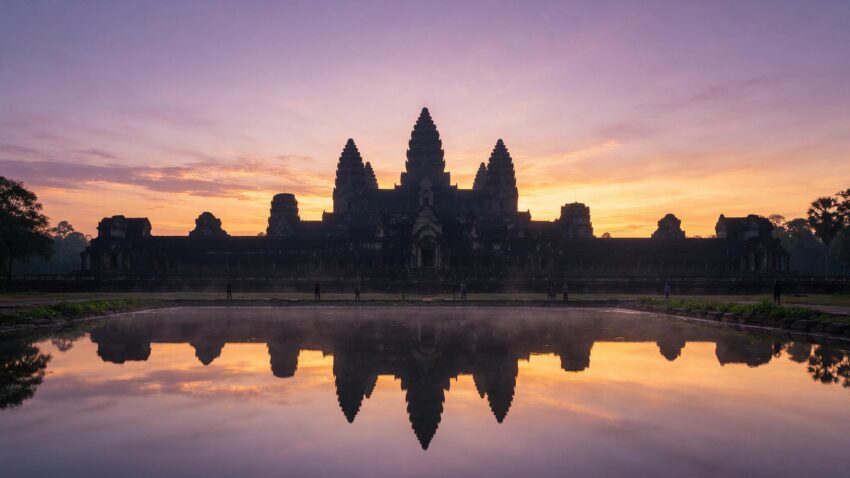
Your driver-guide is at the villa gate at 4:40 AM, engine off, two flasks of Cambodian coffee already poured. The moon is still out. Nobody on the road yet except a few monks on bicycles and the odd tuk-tuk hauling a mattress somewhere. This is the version of Siem Reap almost nobody plans for on purpose — most people book a $15 tuk-tuk off a hostel noticeboard the night before and hope for the best. You didn’t. And in about forty minutes, when the first grey light starts separating the five towers of Angkor Wat from the sky behind them, the difference will be obvious.
Siem Reap has a reputation problem. Search the destination and you get backpacker circuits, $2 Pub Street beer towers, and dorm-bed listicles — which is strange, because this town sits next to one of the most staggering architectural achievements on earth and has, in the last decade, quietly built a genuinely excellent boutique hotel and fine-dining scene to match it. This piece isn’t a checklist of Siem Reap’s “top things to do.” It’s one 36-hour stretch, done properly, from a pre-dawn temple approach to a sunset boat on Tonlé Sap — the version of Cambodia a lot of travelers don’t realize exists until they’re standing in it.
Table of Contents
- Why Siem Reap Deserves More Than a Weekend Off a Backpacker Forum
- When to Go: Reading the Dry Season Properly
- Getting There From India: Visa, Flights, and the Route Nobody Tells You
- 4:40 AM: The Drive Before the Gate
- Where to Actually Stand for Sunrise
- Two Hours Inside Angkor Wat Before the Buses Arrive
- Reordering the Temple Circuit: Preah Khan, Then Ta Prohm
- Late Morning: A Khmer Food Trail From Psar Leu to Kandal Village
- The Honest Afternoon Lull
- Sunset on Tonlé Sap: Kampong Phluk by Private Boat
- Evening, Reimagined: Dinner Beyond Pub Street
- Morning Two: Banteay Srei at First Light
- Where to Sleep: Boutique Pool Villas and Considered Stays
- What This Actually Costs
- Practical Things Worth Knowing Before You Go
- Notes for Solo Travelers, Couples, and Families
- FAQs
Why Siem Reap Deserves More Than a Weekend Off a Backpacker Forum
Angkor is not a single temple you tick off in an afternoon. The Angkor Archaeological Park spans over 400 square kilometers and holds more than a thousand temple sites, built across roughly six centuries by a succession of Khmer kings who kept outbuilding each other. Angkor Wat itself — the one on Cambodia’s flag — was constructed in the early 12th century under Suryavarman II, originally as a Hindu temple dedicated to Vishnu before it became Buddhist a couple hundred years later. That’s the fun fact people trot out. The more useful one: most visitors see three temples in one rushed morning, get heat-exhausted by noon, and never come back to give the place the time it deserves.
A private car and driver-guide, a paced day, and a plan that isn’t “follow the tour group” changes what the whole thing feels like — a driver who knows which corridor is empty at 9 AM versus which one has forty selfie sticks in it, and a hotel room you actually want to come back to and collapse into by 1 PM.
When to Go: Reading the Dry Season Properly
The dry season, November through February, is when Siem Reap gets its best weather — daytime highs around 28-32°C, mornings cool enough that a light jacket at 5 AM sunrise actually makes sense, and low humidity that makes walking temple causeways in the afternoon bearable. This is also, unsurprisingly, when everyone else visits. December 20 through January 5 is genuinely the worst window to be there if crowds bother you — the north reflecting pool at Angkor Wat can pull 3,000 to 5,000 people for sunrise during this stretch, and Chinese New Year (which shifts year to year) brings a second surge.
March through May flips the equation: fewer people, but the heat climbs fast. March is still manageable; by April, daytime temperatures regularly hit 37-40°C, which is punishing even with a private car shuttling you between temples. June through October is the rainy season, and it’s genuinely underrated — showers tend to come in short, heavy afternoon bursts rather than washing out the whole day, the moats fill up, moss creeps over the sandstone, and Ta Prohm in particular looks better wet than dry. Crowds thin out sharply after mid-March, and May, June, and September are consistently the quietest months, with hotel rates commonly running 30-50% below peak season. If you want Angkor Wat at sunrise without sharing the reflecting pool with a tour bus’s worth of people, aim for late May, June, or September — you’ll trade a few afternoon downpours for near-empty galleries.
Getting There From India: Visa, Flights, and the Route Nobody Tells You
There’s no non-stop flight between India and Siem Reap, and that’s unlikely to change soon — you’re routing through a hub. The three realistic options are Bangkok (Thai Airways or Thai AirAsia), Singapore (Singapore Airlines), or Kuala Lumpur. Air India, VietJet, Cambodia Airways, and Vietnam Airlines also run one-stop itineraries from Delhi and Mumbai, and Bangkok tends to be the shortest, cheapest connection since it’s a quick 55-minute hop on to Siem Reap–Angkor International Airport (REP) from there. Fares fluctuate with season and how far out you book, but budget roughly $200-450 return from Delhi or Mumbai — Bangkok routings are usually the better value.
Indian passport holders have two legitimate visa options, and both cost the same: US$30 for a single-entry 30-day tourist visa. The e-visa (apply at the official evisa.gov.kh) takes about 3-5 business days and is paid by card online — apply at least a week out. Visa on arrival is available at Siem Reap, Phnom Penh, and Sihanoukville airports and at major land crossings; budget 15-20 minutes at the counter, longer during the November-March peak, and bring exact USD cash, two passport photos, and proof of onward travel. Either way, Cambodia now also requires a separate, free e-Arrival Card at arrival.gov.kh, submitted within seven days before you fly in — easy to miss if you booked a while back.
4:40 AM: The Drive Before the Gate
A mistake to avoid, and it’s a common one: buying your Angkor Pass at the ticket gate at 4:45 AM, in the dark, in a queue, half awake. Buy it online in advance through Angkor Enterprise, or — smarter still — buy it the evening before in person. A 1-day pass purchased after 4:45 PM the previous day is valid for that evening’s sunset and the following full day, which means you get an extra sunset for free and skip the pre-dawn line entirely. The Angkor Pass itself comes in three tiers: 1-day at US$37, 3-day at US$62 (usable across any 3 days within a 7-day window), and 7-day at US$72 (any 7 days within 30). Children under 12 don’t pay, though staff may ask for a passport to confirm age, and kids under 12 aren’t allowed up to Angkor Wat’s Upper Tower regardless. The 1-day pass doesn’t need a photo; the 3- and 7-day passes do.
The drive from most Siem Reap hotels to the Angkor ticket checkpoint is 15-20 minutes, and from there it’s another 10-15 to Angkor Wat’s western gate. This is where a private car or tuk-tuk with a fixed, agreed-upon driver-guide earns its cost several times over — not just for comfort, but because the most common scam in Siem Reap runs through exactly this booking. Drivers who quote a suspiciously low day-rate off a street corner or a random app listing sometimes vanish mid-morning chasing a better-paying group, then show up later demanding more money than agreed. Book your driver-guide through your hotel or a reputable operator, confirm the day’s stops and price in writing before you leave, and you avoid the entire mess.
Where to Actually Stand for Sunrise
Everyone photographs Angkor Wat from the same spot: the north reflecting pool, directly in front of the main entrance causeway. It’s the classic postcard shot, and in peak season it comes with 3,000-5,000 of your closest strangers, tripods jammed shoulder to shoulder before 5:30 AM. The south reflecting pool, a short walk away, gives you the same silhouette-and-reflection composition with a fraction of the crowd — it’s the move nobody tells you about because it’s slightly less obvious to find in the dark.
If you’d rather skip the reflecting-pool scrum altogether, there are two better options your driver-guide should already know: Srah Srang, a royal bathing pool about 3 km east with calm water and almost nobody around, positioned conveniently next to Ta Prohm for a smooth follow-on visit; or Pre Rup, a 10th-century temple-mountain 5 km east where you climb the steep steps in the dark and get a 360-degree view over the jungle canopy as the sky changes color — genuinely one of the better sunrise experiences in the whole park, and one almost no first-timer knows to ask for. Whichever spot you choose, arrive 30-45 minutes before actual sunrise. Fifteen minutes early and you’ll be shuffling for a sightline; forty-five minutes early and you get to watch the whole thing build slowly, coffee in hand, without jostling anyone.
Two Hours Inside Angkor Wat Before the Buses Arrive
Here’s the part almost everyone skips because they’ve already used up their patience getting the sunrise photo: the window between about 6:30 and 8:30 AM, once the sky’s fully lit and the sunrise crowd has thinned but the tour buses haven’t rolled in yet. This is the best time to actually walk Angkor Wat — the third-tier galleries with their 800-metre run of bas-relief carvings depicting the Churning of the Sea of Milk and scenes from the Hindu epics, the steep climb up to the Upper Tower (adults only, strict dress code covering shoulders and knees, and it does close periodically for capacity), and the quieter western and southern libraries that most groups never make it to because their guide is already rushing them to the next temple on a checklist.
Photography tip: the light through the causeway colonnades between 7 and 8 AM, with long shadows falling across the sandstone floor, photographs better than the sunrise shot everyone else is fighting over — and you’ll have the corridor mostly to yourself.
Reordering the Temple Circuit: Preah Khan, Then Ta Prohm
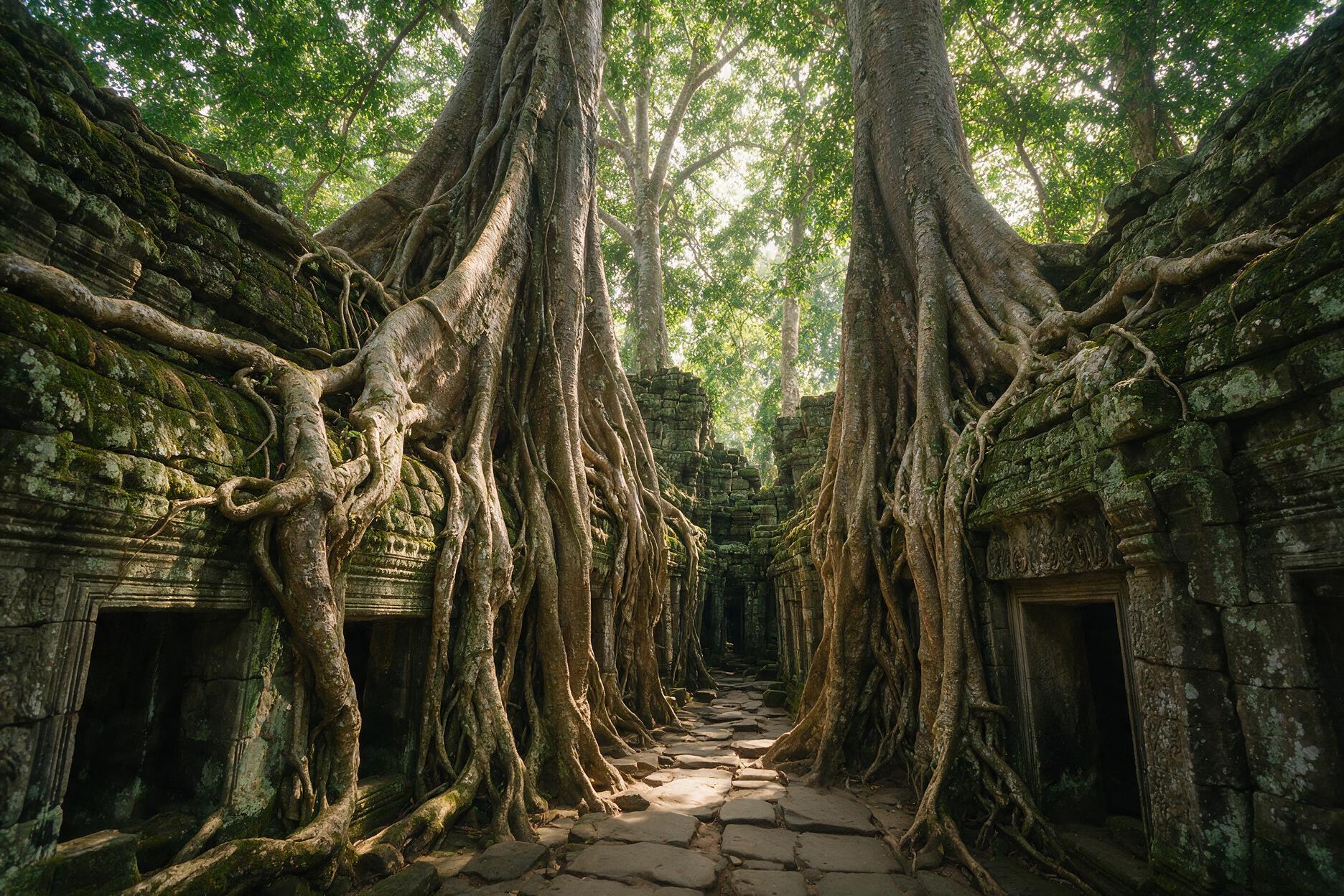
Most day-tour itineraries hit Angkor Wat, then Bayon (the temple with the giant carved faces at Angkor Thom), then Ta Prohm — all in a tight loop that peaks right as every other tour bus in the city is doing the exact same loop, converging on Ta Prohm’s famous root-strangled corridors between 9:30 and 11 AM. If your driver-guide is good, they’ll flip this: head to Preah Khan first, a sprawling, still partly overgrown temple that gets a fraction of Ta Prohm’s visitors even though it has its own tree-root drama and long, atmospheric corridors, then loop back to Ta Prohm slightly later in the morning once the earliest wave has moved on to lunch.
Ta Prohm itself is worth every bit of its reputation — the silk-cotton and strangler fig roots wrapped around collapsing sandstone galleries look like nothing else in the park, and yes, it’s the temple from Tomb Raider, which is exactly why the main root corridor gets a 20-minute selfie queue by mid-morning. Walk 200 metres past the famous shot and there are quieter root formations nearly as dramatic with nobody waiting in line for them. An honest caveat: Ta Prohm at midday, under direct sun with a packed walkway, isn’t the atmospheric ruin you’ve seen in photos — it’s hot, crowded, and a bit of a shuffle. Early or overcast is genuinely better here than any other temple in the park.
Late Morning: A Khmer Food Trail From Psar Leu to Kandal Village
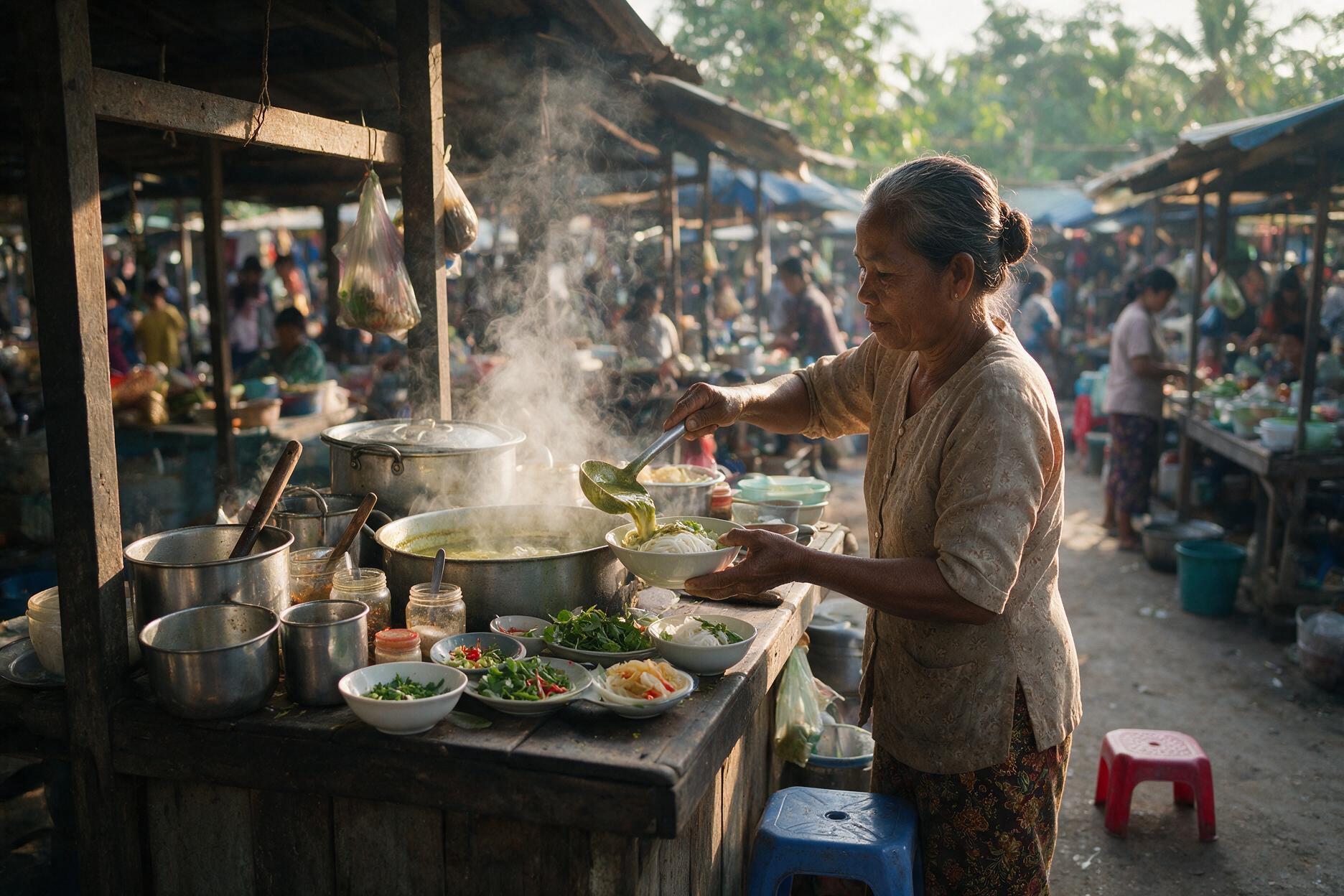
By late morning, temples give way to food, and this is where Siem Reap quietly outperforms its backpacker-bar reputation. Skip Psar Chas (the Old Market) for actual eating — it’s fine for browsing but priced and pitched for tourists — and have your driver-guide route you instead to Psar Leu, the market locals actually shop at, well away from the temple circuit. Between roughly 6 and 10 AM it runs stalls of num banh chok (rice noodles in a green fish-and-lemongrass curry, eaten cold, breakfast-style) and bai sach chrouk (grilled pork over broken rice with pickled vegetables) for $1.50-2 a bowl — the kind of place where the vendor running the noodle stall recognizes regulars and has their order half-made before they sit down.
From there, head into Kandal Village, a compact, tree-lined pocket of Siem Reap that’s turned into the town’s design-conscious food and coffee corner — small-batch cafés serving Cambodian arabica (Brown Coffee is the reliable, well-run option), boutique homeware stores, and a noticeably calmer pace than the market strip closer to the river. For a sit-down Khmer lunch that isn’t dumbed down for tourist palates, Sugar Palm in the Wat Bo neighborhood does an excellent fish amok — the steamed coconut-curry custard that’s the signature Khmer dish — along with samlor korko, a home-style vegetable and pork soup you won’t find on most tourist-menu boards, in a wooden stilt house that used to belong to a Khmer princess. Expect $12-18 a head.
A local tip that isn’t in the top-10 lists: if you’re there on a weekday, ask your driver-guide about Marum or Haven — both are social-enterprise training restaurants employing and training vulnerable youth, serving genuinely good Khmer-fusion food (think fried tarantula done properly, or a well-balanced red tree ant beef stir-fry) at $8-18 a plate, with proceeds going back into vocational training rather than a hotel group’s margin.
The Honest Afternoon Lull
Here’s the caveat nobody puts in a Siem Reap guide: the early-to-mid afternoon, roughly 1 to 3:30 PM, is not worth fighting through at the temples. The light goes flat and harsh for photography, the heat peaks, and most of the well-run boutique properties in town know it — which is exactly why almost every good hotel here has invested in a genuinely excellent spa. This is the natural point in the day to go back, get a two-hour Khmer massage (traditional Cambodian massage draws on the same herbal-compress and pressure-point techniques as Thai massage, but tends to be gentler), float in a private pool, and let the temple heat burn off before the next push. Skip the afternoon at Angkor entirely if you can; it’s the one stretch of the day where doing less is the better move.
Sunset on Tonlé Sap: Kampong Phluk by Private Boat
Tonlé Sap is Southeast Asia’s largest freshwater lake, and it does something unusual: it roughly quadruples in size during monsoon season as the Mekong River’s flow reverses and pushes water back up into it, then shrinks again in the dry months. Kampong Phluk, a stilt-house village about 45 minutes southeast of town, sits right on that seasonal flood line, which is why the houses stand on stilts 6-8 metres high — in the wet season, boats float where you’d otherwise be walking.
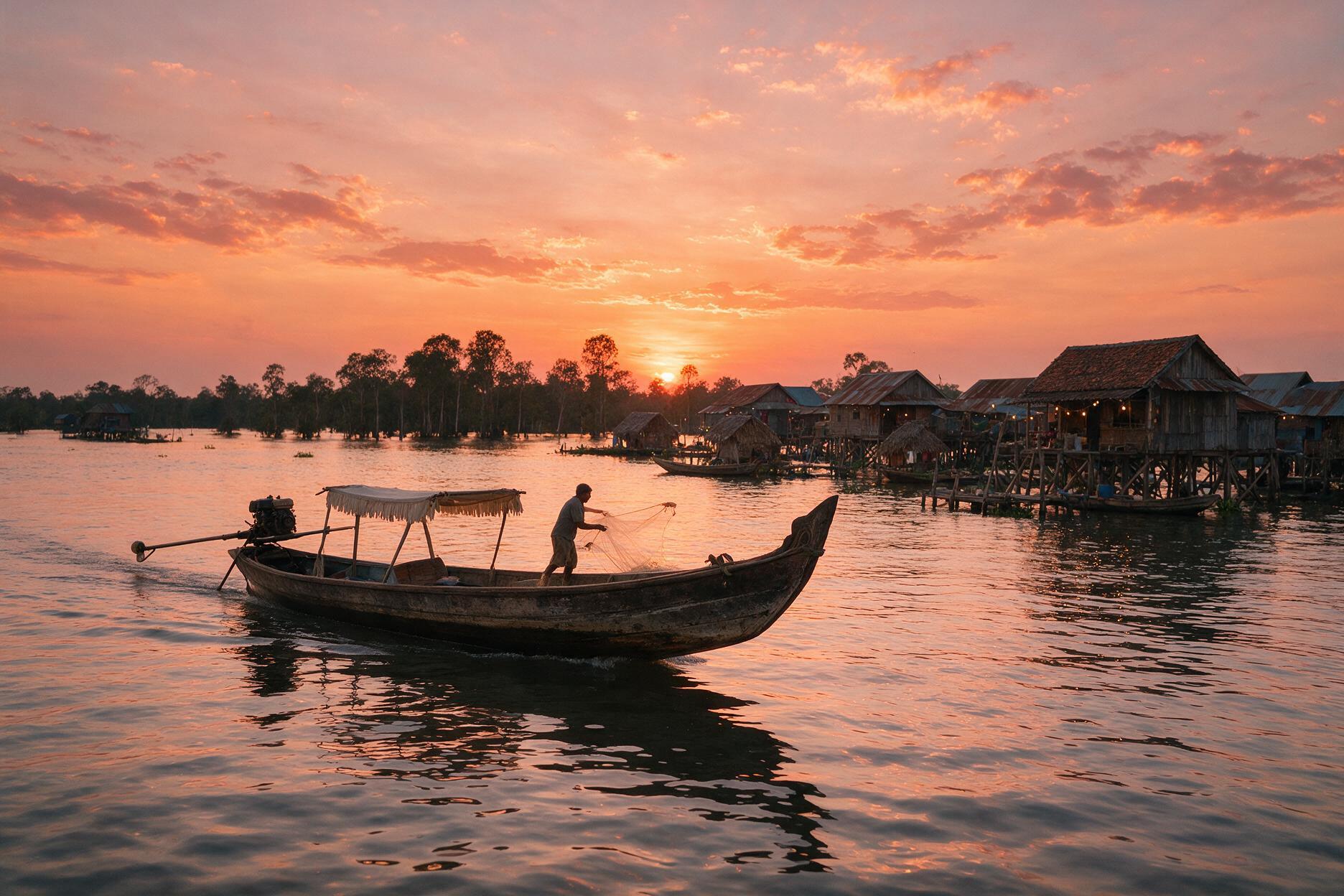
A private sunset boat here, arranged through a reputable operator rather than a mass shared-tour dock, is a genuinely different experience from the group version: your own boat, timed to leave the village and drift out onto open water as the light goes gold, watching fishing families haul in nets against the silhouette of the flooded forest. An honest note on this stop: some floating-village tours route through staged “orphanage” or school visits designed to solicit donations or push overpriced boat-side purchases from villagers paid a cut by the operator — it’s a well-documented pattern here, not a one-off. A good private operator skips this entirely and keeps the visit centered on the village and the water, not a manufactured photo-op.
Evening, Reimagined: Dinner Beyond Pub Street
Pub Street exists, it’s loud, and it’s not really the point of a trip built around it — think of it as something to walk through once out of curiosity rather than the evening’s destination. Siem Reap’s more interesting evening is a few streets over. Malis does refined Khmer cuisine in a shaded garden courtyard, plating classics like lok lak and grilled river fish with more precision than volume; expect $15-25 a head. For something to book ahead and treat as the trip’s one proper splurge, Cuisine Wat Damnak — chef Joannès Rivière’s tasting-menu restaurant — runs a five-course seasonal menu built entirely around what Cambodian markets have that week, changing every few days; reservations fill up, so book before you land, and expect $45-60 per person. It’s the kind of meal that quietly argues Khmer food deserves to be spoken about the way Thai or Vietnamese cuisine already is internationally, and it rarely gets that credit.
Morning Two: Banteay Srei at First Light
If you have a second morning, spend it on Banteay Srei rather than doubling back to the main Angkor Wat-Bayon-Ta Prohm loop. It’s about 32 km northeast of central Siem Reap — roughly 45 minutes by car — which is exactly why most rushed one-day itineraries skip it, and exactly why it’s worth the drive. Built in the 10th century and dedicated to Shiva, it’s a smaller, pink sandstone temple with some of the deepest, most intricate carving in the entire Angkor complex — the stone here is a different, softer material than the grey sandstone used elsewhere, which is what let the artisans carve at a level of detail you don’t see anywhere else in the park. Go early, before 8 AM if you can manage it after the previous day; the temple is compact, and it gets genuinely crowded by mid-morning once the day-tour buses find their way out there.
Where to Sleep: Boutique Pool Villas and Considered Stays
This is a town with a real high end now, not just resort-branded chains slapped on the tourist strip. Shinta Mani Angkor, designed by Bill Bensley, pairs colonial-era architecture with a foundation that funds a local vocational school — book the right room category and you get a private plunge pool. Amansara, Aman’s Siem Reap property, occupies what used to be King Sihanouk’s 1960s guesthouse, built around a central pool with a deliberately understated, almost monastic aesthetic that couldn’t be further from Pub Street. Templation Hotel is a newer boutique option with private pool villas at a slightly gentler price point but the same design-forward sensibility. Belmond La Résidence d’Angkor sits on the riverbank a short walk from the Old Market, colonial in style, quieter than its central location suggests. All of them can arrange the private driver-guide and sunrise logistics for you directly — worth asking at booking rather than sorting out separately once you land.
What This Actually Costs
Rough numbers for two people, mid-range to upscale, excluding the international flight: a boutique pool villa runs $150-350/night; a private driver-guide for a full day is typically $45-70; the Angkor Pass is $37-72 per person depending on how many days; a private Tonlé Sap sunset boat runs $60-120 for two; and meals across two days, mixing a $2 market noodle breakfast with one tasting-menu dinner, land around $80-150 per person total. All told, a considered two-day stretch for two people comfortably runs $700-1,400 excluding flights.
Practical Things Worth Knowing Before You Go
Currency: Cambodia’s official currency is the riel, but US dollars are used everywhere for anything over roughly $10-20 — hotels, restaurants, tours, and the Angkor Pass are all priced in USD. Riel comes back as change for smaller amounts; hand over a $10 note for a $3 noodle bowl and expect roughly 28,000 riel back, since the US doesn’t mint dollar coins for circulation here. ATMs are common and dispense US$100 notes almost exclusively, so break large bills at a hotel rather than a street stall. Cards are widely accepted at hotels and restaurants, and the Bakong/KHQR digital payment system is near-universal now, though less useful on a short visit than for residents.
SIM/eSIM: an eSIM loaded before you land is the easiest option — Cambodia’s main networks (Cellcard and Smart) both have tourist data plans, and most international eSIM providers cover the country. A physical SIM is also easy to pick up at the airport arrivals hall.
Safety: Siem Reap is low-crime and easy for a first-time visitor to Southeast Asia, including solo women travelers — the real risks are the scam patterns covered above, not personal safety. Legitimate Angkor park staff wear blue shirts with a name badge and photo-ID lanyard; licensed guides wear light-yellow shirts with a lanyard and have completed formal, months-long training. Anyone outside those two uniforms asking for money inside the park isn’t legitimate.
Notes for Solo Travelers, Couples, and Families
Solo travelers get more out of a private driver-guide here than almost anywhere else in Southeast Asia — Angkor rewards a flexible, self-paced schedule (linger at Preah Khan, skip a temple that doesn’t interest you, extend the food trail) that a fixed group tour can’t accommodate.
Couples should build in the spa afternoon and the tasting-menu dinner deliberately rather than as an afterthought — the temple circuit is genuinely tiring, and Siem Reap’s boutique hotel scene has built its pool-villa and wellness offerings for exactly this kind of pacing.
Families with kids under 12 get free Angkor Pass entry, though the Upper Tower climb at Angkor Wat is off-limits to that age group regardless of ticket type — plan the family day around Bayon’s face-towers and the Ta Prohm root corridors instead, at a shorter pace than an adult-only itinerary would run.
Frequently Asked Questions
How many days do you actually need in Siem Reap?
Two full days covers the highlights properly at the pace described here — sunrise Angkor Wat plus Preah Khan and Ta Prohm on day one, Banteay Srei and a Tonlé Sap sunset on day two. Three days lets you add Beng Mealea or Koh Ker further afield without feeling rushed.
Is the Angkor Wat sunrise actually worth the early wake-up?
Yes, but manage expectations on where you stand. The classic north-pool photo comes with serious crowds in peak season; the south pool, Srah Srang, or Pre Rup give you a comparable or better experience with far fewer people.
Do Indians need a visa for Cambodia?
Yes. Indian passport holders can get either an e-visa (apply online at evisa.gov.kh, 3-5 business days) or a visa on arrival at the airport, both US$30 for a single-entry 30-day tourist visa. You’ll also need to complete the separate, free e-Arrival Card online before you fly.
Is Siem Reap safe for solo travelers, including women?
Generally yes — it’s a low-crime, tourism-dependent town used to independent travelers. The main things to watch for are the tuk-tuk pricing scam and unofficial “guides” approaching at temple entrances, both easily avoided by booking through your hotel and checking for proper uniforms and ID.
Can you use US dollars everywhere in Siem Reap?
For anything above roughly $10-20, yes — dollars are the default currency for tourism spending. Smaller change comes back in Cambodian riel, so it’s worth carrying some for street snacks and market stalls.
Is Ta Prohm worth visiting if you’ve already seen the photos online?
Yes, but time it right — early morning or an overcast rainy-season afternoon, not midday, when the light is flat, the heat is brutal, and the main root corridor has a 20-minute photo queue.
What’s the best way to see Tonlé Sap without it feeling like a tourist trap?
Book a private boat through a reputable operator rather than a shared group departure, and confirm upfront that the itinerary doesn’t include a staged “orphanage” or school stop — a known pattern designed to solicit donations, not a genuine cultural visit.
Do you need to book restaurants in advance in Siem Reap?
For the tasting-menu places, yes — Cuisine Wat Damnak in particular fills up and is worth booking before you land. Casual spots like Sugar Palm and the Psar Leu market stalls don’t need reservations.
The Version of Cambodia Worth Planning For
Most people leave Siem Reap having seen three temples, eaten one forgettable meal near their hostel, and formed an opinion of Cambodia based on a rushed, budget-tour version of the place that was never really built to show it off properly. Slow the pace down, get the sunrise spot right, eat where the market actually eats, and give the afternoon heat the respect it deserves, and Siem Reap turns into something closer to what it actually is — one of the great architectural and cultural experiences in Asia, done at a pace where you can actually take it in.
If a considered, driver-guided couple of days through Angkor and Siem Reap’s food scene sounds like the trip you’ve been meaning to plan, Get Tripped can build the full itinerary around it — private guides, boutique pool villas, and the sunrise timing sorted before you land. Get in touch with our travel designers to start planning.