Every third travel blog about Morocco runs the same three photographs: a spice pyramid in the Marrakech souk, a blue staircase in Chefchaouen, and a camel silhouette against a Sahara dune at sunset. None of that is wrong, exactly. It’s just that Morocco spent the last decade being reduced to those three frames, and the country underneath them is a lot stranger and better than its own highlight reel.
This is a guide to the parts of Morocco that don’t make the top-10 lists — not because they’re secret, but because they take a little more planning than a group tour bus can be bothered with. We’re talking about a working fishing port an hour and a half from Marrakech, a mountain valley where the day-trippers turn back too early, a quarter of Fes that most visitors never cross the river to see, and a capital city that Morocco’s own tourism machine barely bothers to promote. If you’ve already done Marrakech once, or you’d rather your first trip not look like everyone else’s Instagram grid, this is the version worth building an itinerary around.
Skip the Marrakech Souk Marathon — Go to Essaouira Instead
Marrakech’s souk is worth an afternoon, not three days. It’s loud, it’s built for haggling tourists, and after your second hour of being pulled into carpet shops you’ll start to understand why so many travelers leave the city more exhausted than charmed. Essaouira, two and a half hours west on a smooth toll road, is the version of Morocco that trades chaos for salt air.
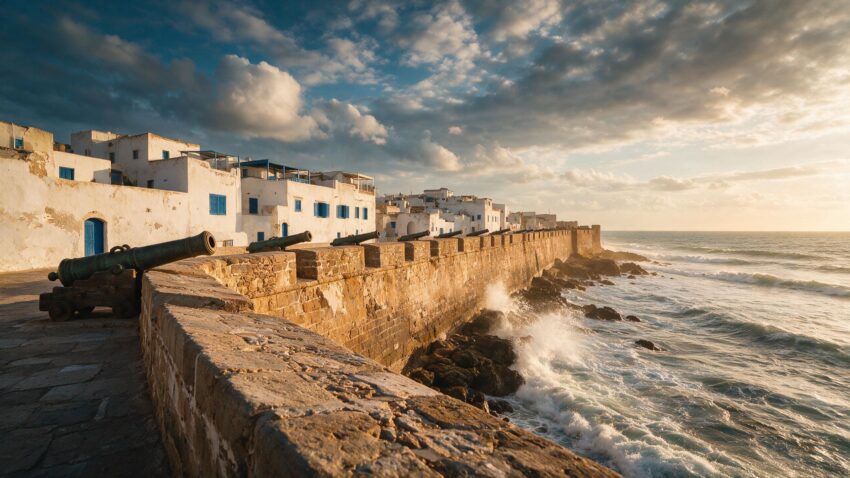
The old town here is walled and whitewashed, with blue shutters instead of Marrakech’s ochre, and it sits right on the Atlantic, which means the light is different — flatter, cooler, more forgiving on camera than the harsh desert sun inland. Start at the Skala de la Ville, the arcaded sea rampart lined with rusting Spanish and Portuguese cannons, where you can walk the wall at eye level with the waves. It’s the same stretch of ramparts used as a filming location for King’s Landing in an HBO series everyone’s watched, which is a decent fun fact to drop if you meet a fellow traveler, and it costs nothing to walk.
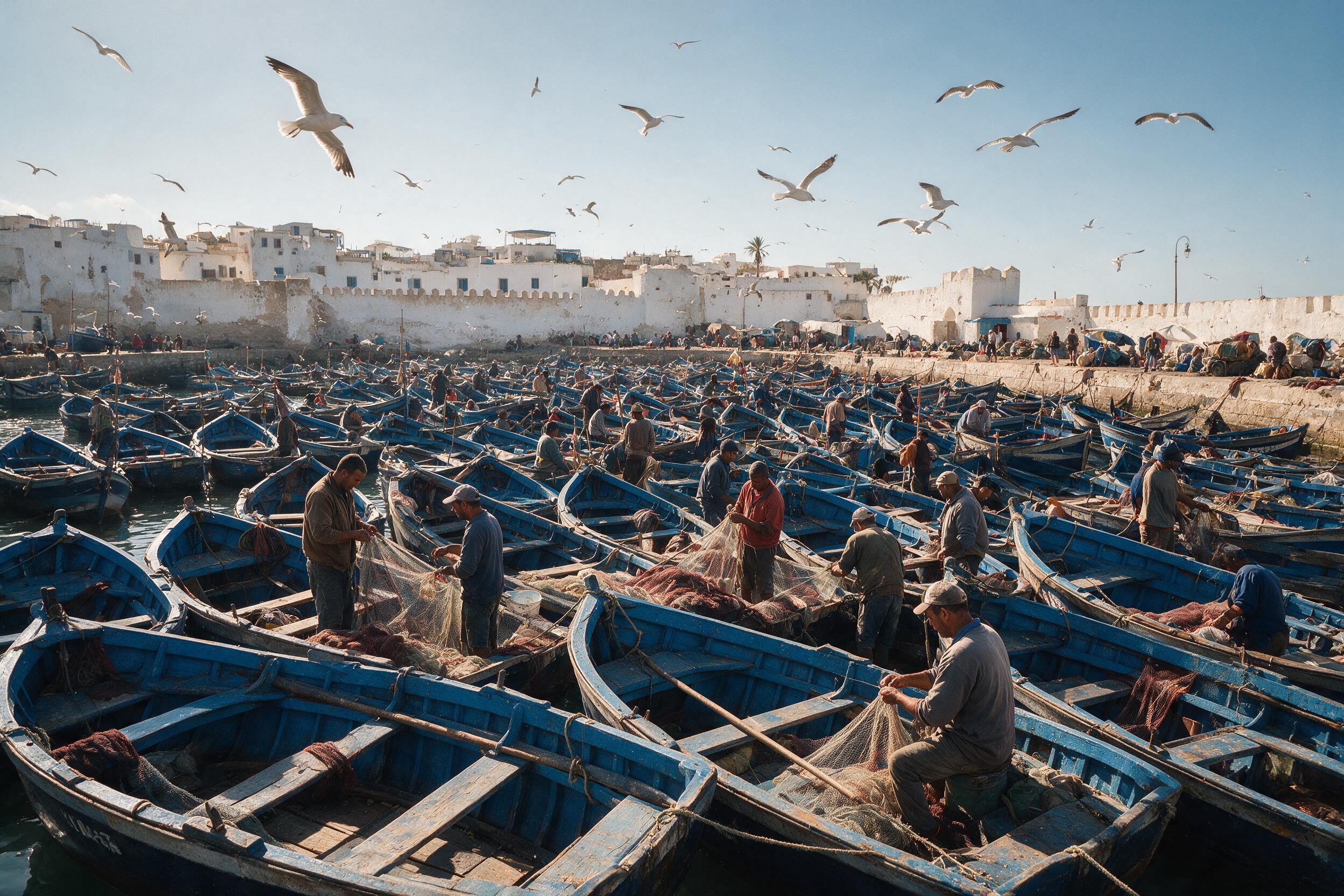
Below the ramparts, the Port de Pêche — Essaouira’s actual working fishing port — is worth timing your visit around rather than treating as a five-minute photo stop. Boats come in around midday, and the harbor fills with blue-hulled skiffs, seagulls working the nets, and a row of small numbered grill stalls right at the port entrance selling whatever came off the boat that morning: sardines, sea bream, sometimes squid, grilled over charcoal and served with bread and a squeeze of lemon at a plastic table three feet from the water. It’s the best seafood lunch you’ll have in Morocco and it costs a fraction of what a Marrakech riad restaurant charges for a fraction of the flavor.
Inside the ramparts, along the streets closest to Skala de la Ville, you’ll find Essaouira’s thuya wood workshops — small, open-fronted studios where craftsmen work root burl from argan forests east of the city on hand-operated lathes, turning it into boxes, chess sets, and inlaid furniture with lemon wood and mother-of-pearl detailing. Unlike Marrakech’s souk stalls, most of these are actual working ateliers, not just retail fronts, and the craftsmen are usually happy to have you watch for a few minutes without any pressure to buy. If you do buy, a small inlaid box runs a few hundred dirhams — a genuinely portable souvenir that isn’t a magnet or a keychain.
For a slower evening, the rooftop terrace at Taros Café overlooking Place Moulay Hassan is where locals and long-stay expats go for a sundowner, not just tourists — live gnaoua or jazz sets happen some nights, and the view over the medina rooftops toward the harbor is the best in town at golden hour.
Photography tip: everyone shoots the port at sunset, when the light is prettiest but every tour group is elbow to elbow with you. Go at midday instead, when the boats are actually working and the light is flat enough to bring out the blue of the hulls without blowing out the sky.
Mistake to avoid: doing Essaouira as a single day trip from Marrakech, which is what most tour operators sell. You’ll spend five hours in transit for two hours in town, and you’ll miss the port entirely because the standard itinerary drops you at 11am and picks you up at 2pm. Two nights lets you catch a sunrise walk on the ramparts before the tour buses arrive.
An Hour From Marrakech, Most Tourists Turn Back Too Soon — the Ourika Valley
Almost every Marrakech tour desk sells a near-identical “Atlas Mountains and Berber Village” day trip up the Ourika Valley, and almost every one of them stops at the same three places: a fixed argan oil cooperative (there’s usually a commission arrangement behind why it’s always the same one), a waterfall viewpoint at Setti Fatma with a 30-minute uphill walk, and a lunch spot. It’s not a bad introduction, but it’s also the exact same day everyone else has.
The valley is worth more than that. Past Setti Fatma, where most groups turn around, smaller hamlets like Aghbalou sit along the same river, framed by walnut and apple orchards that most day-trippers never see because their driver is on a schedule. The Ourika River runs the whole length of the valley, and riverside restaurants built on stilts and platforms directly over the water serve tagines and grilled meat late into the afternoon — a genuinely pleasant way to spend two hours that most one-day itineraries don’t budget for.
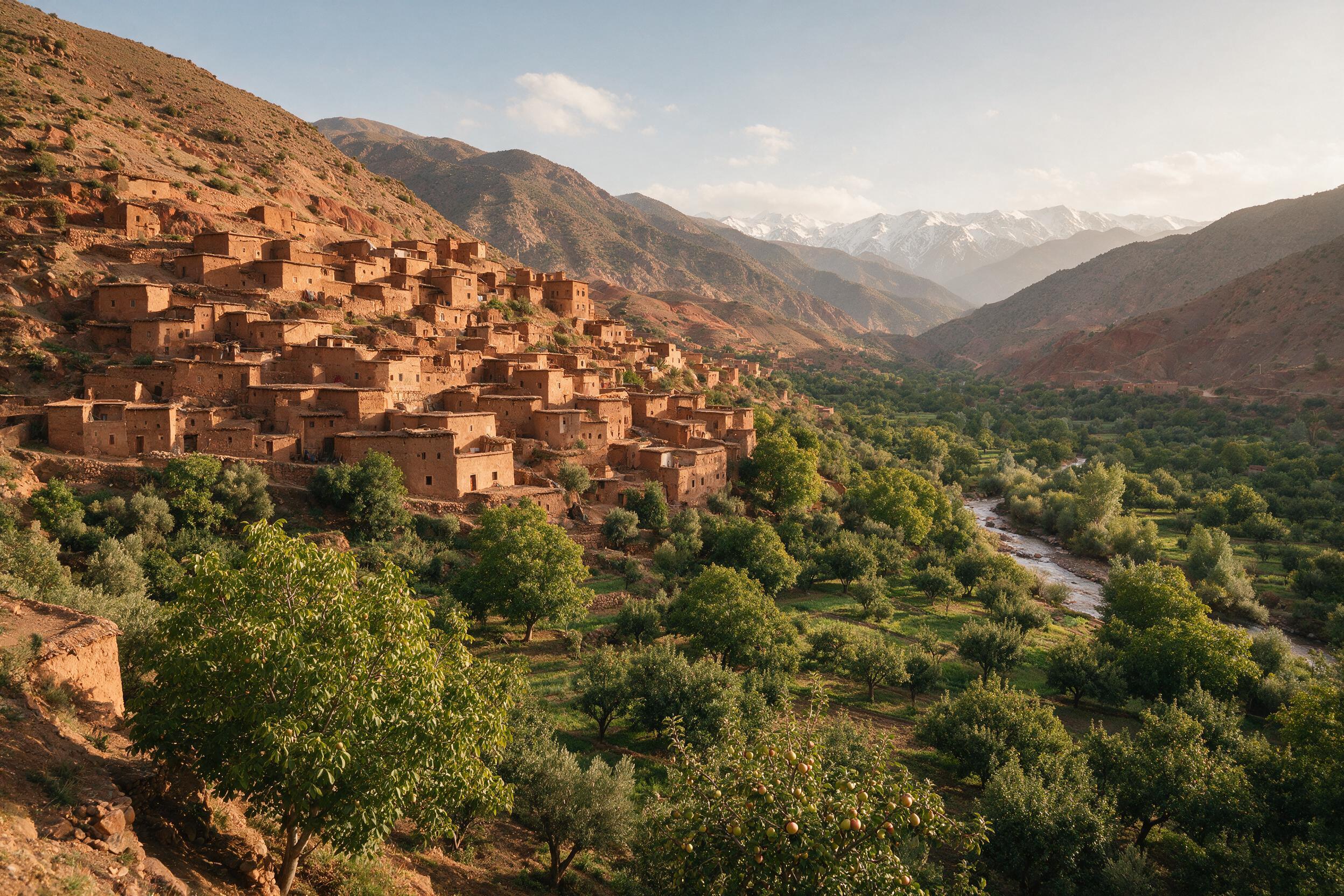
If you can spend a night rather than a day, a handful of small Berber-run guesthouses in the upper valley let you wake up to the mountains instead of just passing through them, and a short guided walk between villages the next morning — through terraced fields worked the same way for generations — says more about Amazigh (Berber) mountain life than any cooperative stop ever will.
Good for families: the valley floor walks are gentle, shaded, and short enough for kids, and the riverside lunch spots are relaxed rather than formal — nobody minds a restless eight-year-old here.
Mistake to avoid: if your driver suggests “just a quick stop” at an argan cooperative, know that it’s almost always a commission-based detour built into the day, not a random recommendation. It’s fine to go once out of curiosity, but don’t let it eat an hour of a half-day trip.
Fes Beyond the Chouara Tannery Crowd — Cross the River
The Chouara Tannery is the single most photographed thing in Fes, and for good reason — the stone vats of dye, worked by hand the way they have been for roughly a thousand years, are genuinely extraordinary. They’re also mobbed, and the leather shop terraces that offer you a free view down into the vats will hand you a sprig of mint to cut the smell and then apply real pressure to buy a jacket on your way out.
Cross the Oued Fes — the river that splits the old medina — into the Andalusian Quarter (Fes el-Andalous) and the crowd thins out fast. This side of the medina was settled by Muslim and Jewish refugees from Córdoba and Andalusia centuries ago, has its own Andalusian Mosque and its own smaller souks, and feels like a residential neighborhood rather than a tourist circuit — kids playing football against a wall, bakeries with a queue of locals rather than guides. It’s also home to the Sidi Moussa Tannery, a genuine working tannery that’s smaller and far less visited than Chouara, where you can watch the same dyeing process without the crowd or the sales pressure attached to the famous viewpoint terraces.
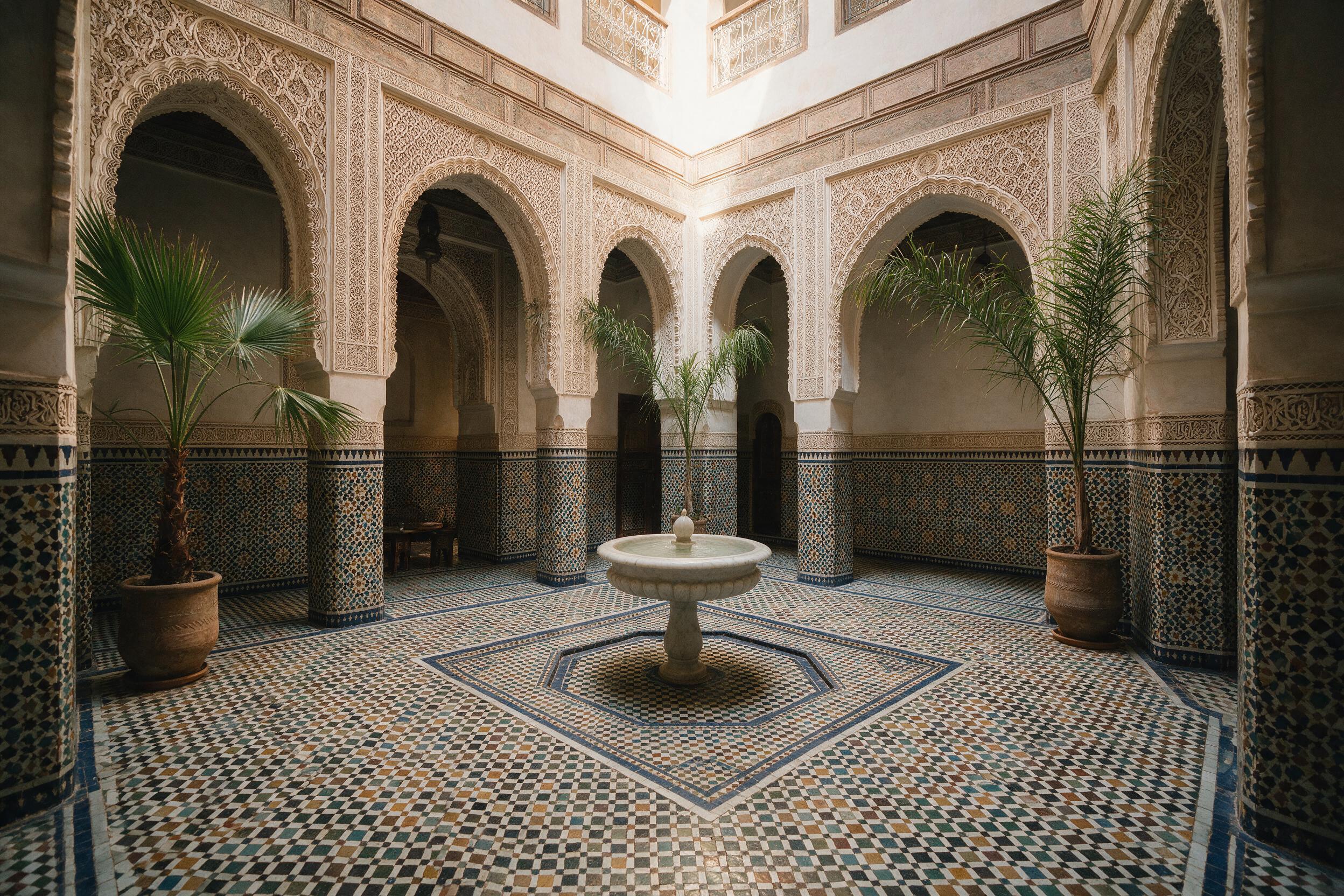
This is also where to base yourself. Riads in the Andalusian Quarter and around Batha, on the quieter southern edge of the old medina, cost roughly the same as the ones packed in tight near the main souk, but you’ll actually be able to sleep — no early-morning call to prayer competing with a nightclub, no scooters idling under your window. Batha itself is worth a slow morning: the Batha Museum sits inside a shaded garden of palms and fountains that functions as the closest thing Fes has to a park.
Food tip: skip the tourist-menu restaurants clustered near Bab Boujloud (the main medina gate) and look instead for a small neighborhood spot doing harira — the tomato-lentil soup Moroccans actually eat, not the diluted version served to groups. Ask your riad host for their actual lunch spot, not their tour-partner recommendation; the two are often different.
For luxury travelers: Fes has some of Morocco’s most serious high-end riads — multi-courtyard 19th-century merchant houses restored with proper budgets — and the Andalusian Quarter side gives you the same architecture with a fraction of the foot traffic outside your door.
Chefchaouen’s Quieter Blue — Above the Staircase Everyone Photographs
The blue staircase on Rue Kadi Alameh near Place Uta el-Hammam is Chefchaouen’s most famous frame, and by mid-morning it’s a queue of people waiting to take turns posing on the same three steps. It’s still worth seeing — just not for more than the ten minutes it takes to get your photo and move on.
The better version of Chefchaouen is uphill. The alleys above and around the town climb toward the ruins of the old Spanish Mosque, and unlike the staircase, the walk up genuinely thins the crowd out — by the time you’re past the first switchback, most of the day-trip groups have already turned back. Go at sunrise rather than the standard sunset slot everyone books: you get the same panoramic view over the blue medina roofs and the Rif Mountains behind, minus the fifty other people angling for the same shot. The light is also better for photography in the early morning — Chefchaouen’s blue reads truer in soft morning light than in the orange wash of sunset.
Closer to town, the Ras el Maa area — where a mountain stream runs down through a small waterfall right at the edge of the medina — is where locals actually do their washing and where a handful of unpretentious cafés serve mint tea to a mostly local crowd rather than a tour group. It’s a five-minute walk from the main square and most visitors walk straight past it toward the staircase without stopping.
For solo travelers: Chefchaouen is one of the most relaxed towns in Morocco to walk alone in, day or evening — the medina is small, well-lit, and the vibe is closer to a mountain town than a big city.
Rabat: the Capital City Morocco Doesn’t Bother Marketing
Rabat gets skipped by most first-time visitors entirely, which is strange, because it’s Morocco’s actual capital and arguably its calmest old town. There’s no hard sell here — no one grabbing your arm to look at a shop, because the local economy doesn’t run on tourism the way Marrakech’s does.
The Kasbah des Oudayas, a fortified 12th-century citadel at the mouth of the Bou Regreg River, is Rabat’s answer to a medina — whitewashed and blue-doored alleys, quieter and cleaner than anywhere comparable in Marrakech, opening onto a clifftop view over the Atlantic where the river meets the sea. Inside the kasbah, the Andalusian Garden is a shaded, formally laid-out green space that most Marrakech riads can’t match for scale, and the Café Maure just past it serves mint tea on a terrace looking straight out over the water — a genuinely peaceful way to spend an hour with a book.
A short taxi ride away, the Chellah necropolis — a walled Roman-then-Merinid ruin with storks nesting on the old minaret — gets a fraction of the visitors that Marrakech’s monuments do, despite being just as photogenic and considerably older in parts.
For couples: Rabat’s calm, uncrowded old town and its coastal cafés make for a much better final couple of days before flying home than trying to squeeze in one more chaotic city — it’s the decompression stop most itineraries skip.
Getting Between Them Without It Feeling Like a Slog
Morocco rewards a loop, not a single-city stay. A sensible route links Marrakech (arrival) → Essaouira (2-3 nights) → back through Marrakech and up into the Ourika Valley (1-2 nights) → Fes (2-3 nights, reached by a private transfer over the Middle Atlas or a short domestic flight) → Chefchaouen (2 nights) → Rabat (1-2 nights) → Casablanca for departure.
Between the imperial cities — Fes, Chefchaouen, Rabat, Casablanca — Morocco’s ONCF train network is comfortable, air-conditioned, and genuinely reliable, and it beats a shared grand taxi for comfort on longer legs. For Essaouira and the Ourika Valley, where trains don’t run, a private driver is worth the upgrade over a shared CTM bus or a self-drive — Moroccan mountain roads are well-paved but narrow, and having someone who knows the route means you actually get to look at the scenery instead of the road. This is exactly the kind of point-to-point routing a custom-built itinerary handles better than a fixed group tour, since it lets you set your own pace between towns instead of following someone else’s bus schedule.
The Practical Details
Visa for Indian Passport Holders
Indian citizens need a visa to enter Morocco — there’s no visa-on-arrival. Here’s the nuance most quick guides skip: Morocco’s e-visa (applied for at acces-maroc.ma) isn’t open to Indian nationality by default. According to Morocco’s Ministry of Foreign Affairs, the e-visa is available to Thai and Israeli nationals outright, and separately to anyone already holding a valid multiple-entry visa or residence permit from the US, UK, Canada, Schengen area, Japan, Australia, New Zealand, Ireland, Norway, or Switzerland. If you hold a valid Schengen, UK, or US visa, you likely qualify for the faster e-visa route. If you don’t, you’ll apply for the standard sticker visa through VFS Global or BLS International in India, which typically takes one to two weeks and asks for a return flight itinerary, confirmed accommodation, bank statements, and travel insurance. Apply four to six weeks before travel to give yourself a buffer — and verify current requirements directly at your nearest Moroccan consulate or in.diplomatie.ma before booking non-refundable flights, since visa policy for India has shifted more than once in recent years.
Getting There From India
There are no direct flights between India and Morocco as of 2026. The realistic routing is a one-stop connection via the Gulf — Emirates through Dubai, Qatar Airways through Doha, or Etihad through Abu Dhabi — or via Istanbul on Turkish Airlines, landing at Casablanca’s Mohammed V International Airport (CMN), with Marrakech Menara (RAK) as a secondary entry point. Total travel time typically runs 10-15 hours depending on layover, and fares from major Indian cities vary widely by season and airline — it’s worth pricing routes through a few Gulf carriers rather than assuming one is always cheaper.
Best Time to Visit
October through early November is the sweet spot: the punishing summer heat has broken, days are warm without being brutal, and the Atlas Mountains and coastal towns are genuinely pleasant to walk around in. September can still run hot and unpredictable inland. By late November, temperatures are dropping and rain becomes more likely, which actually makes it a good window for hiking and desert visits if you don’t mind packing layers — the Atlas Mountains get cold at night year-round, and Essaouira’s coastal wind means you’ll want a jacket even in October evenings.
Currency and Payments
The Moroccan Dirham (MAD) is a closed currency — you can’t buy it before you arrive or take much of it home, so exchange or withdraw once you land. Cards are widely accepted in riads, mid-range and upscale restaurants, and larger shops in cities, but medinas, small cafés, artisan workshops, and grand taxis still run on cash. Carry dirhams in small denominations for souk purchases and tips; ATMs are common in every town covered here, though rural stretches like the upper Ourika Valley have far fewer, so withdraw before you head into the mountains.
Safety
Morocco is broadly safe for tourists, including solo women, though the usual city-travel awareness applies — medina alleys can be disorienting after dark, and persistent unofficial “guides” in Marrakech and Fes are a nuisance more than a danger. A polite, firm “no thank you” and continuing to walk works better than engaging. The towns in this guide — Essaouira, Chefchaouen, Rabat — are all noticeably calmer and less hassle-prone than central Marrakech, which is part of their appeal.
Frequently Asked Questions
Do Indian passport holders need a visa for Morocco?
Yes. There’s no visa-on-arrival for Indian citizens. Most travelers apply for a standard sticker visa through VFS Global or BLS International in India; those already holding a valid US, UK, or Schengen visa may qualify for Morocco’s faster e-visa instead. Confirm current rules with the Moroccan consulate before finalizing travel dates.
How many days do you need for this kind of Morocco trip?
Ten to twelve days lets you cover Essaouira, the Ourika Valley, Fes, Chefchaouen, and Rabat without rushing any of them. If you only have a week, pick one southern pairing (Marrakech, Essaouira, Ourika Valley) or one northern pairing (Fes, Chefchaouen, Rabat) rather than trying to do both in seven days.
Is Essaouira worth it if I’ve already got Marrakech on my itinerary?
Yes — they’re different enough in feel (desert city versus Atlantic port) that doing both isn’t repetitive. Essaouira is also considerably calmer, which makes it a good decompression stop after Marrakech’s intensity.
What’s the best time of year to visit Morocco?
October to early November for the best balance of warm days, manageable heat, and lower rain risk. Late November into winter suits hiking and desert visits if you pack for cold nights.
Is Morocco safe for solo female travelers?
Generally yes, with normal city precautions. Chefchaouen, Essaouira, and Rabat are notably relaxed; Marrakech and Fes medinas need a bit more street awareness, mainly around persistent unofficial guides rather than any real safety risk.
Do I need cash or will cards work everywhere?
Cards work in riads, hotels, and upscale restaurants. Cash is still essential for medinas, small cafés, grand taxis, and artisan workshops — carry dirhams in smaller notes, and withdraw before heading into rural areas like the Ourika Valley.
Can I fly directly from India to Morocco?
No direct flights exist as of 2026. Expect a one-stop connection via a Gulf hub (Dubai, Doha, or Abu Dhabi) or through Istanbul, landing at Casablanca or Marrakech.
Should I book a group tour or arrange private transport between towns?
A private driver-guide is worth it for this kind of route — Essaouira, the Ourika Valley, and the mountain roads between Fes and Chefchaouen aren’t well served by fixed-schedule buses, and a private car lets you stop where you actually want to, rather than where a group itinerary decides.
Go Where the Souk Photo Doesn’t Show You
The version of Morocco in most people’s camera roll is real, but it’s also the smallest slice of what’s actually there. A working fishing port at midday, a mountain valley past where the tour buses turn around, a quarter of Fes where kids play football instead of guides pitching tours, a sunrise view over Chefchaouen with nobody else on the path, a capital city that doesn’t need to sell itself — that’s the Morocco worth building a trip around, and it takes exactly the kind of point-to-point planning that a fixed group tour isn’t built to offer.
If this is the version of Morocco you’d rather see, Get Tripped can put together a custom Morocco itinerary that strings these towns together properly — private transfers where they matter, riads picked for the neighborhood rather than just the address, and enough time built into Essaouira and the Ourika Valley that you’re not doing them as a rushed day trip. Get in touch and we’ll build the route around what you actually want to see, not what’s easiest to bus a group through.