
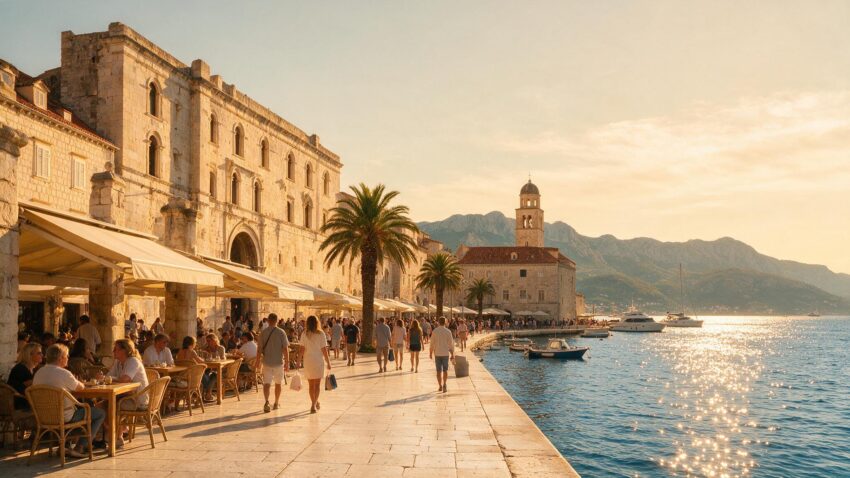
The fisherman outside Konoba Fetivi is untangling a net when we walk past at 8:40 in the morning, and he doesn’t look up, because tourists photographing him is just part of his Tuesday. Behind him, a wall of pale Roman limestone rises straight out of the harbor — not a museum reconstruction, an actual wall, two thousand years old, with laundry hanging from a window three floors up. Someone lives inside a Roman emperor’s retirement palace. That’s the first thing that gets you about Split: the ancient and the ordinary aren’t separated by a rope line. They’re the same building.
Most Croatia itineraries treat Split as a layover — the airport you land at before running for a Hvar ferry, or a half-day stopover between Dubrovnik and Zadar. That’s a mistake, and not a small one. Split deserves a full day on its own terms, slow enough to actually feel the place: the palace at the hour before the tour groups arrive, a market that still runs on what fishermen and farmers bring in that morning, a swim in water so clear it looks fake in photos, and a sunset from a hill the cruise-ship crowds mostly skip. This is that day, built the way we’d actually spend it if a client asked us to plan 24 hours in Split and get it right.
Why Split, and why one full day matters
Split is Croatia’s second-largest city and the gateway to the Dalmatian islands — Hvar, Brač, Vis — but it’s not just a ferry terminal with a nice backdrop. The old town is built literally inside and around Diocletian’s Palace, a retirement complex the Roman emperor Diocletian built for himself starting around 295 AD. When the Roman Empire fell apart and Salona (the nearby Roman provincial capital) was sacked in the 7th century, locals fleeing the destruction moved into the abandoned palace and never really left. Sixteen centuries later, people still live, run cafés, and sell vegetables inside those walls. UNESCO listed the whole complex as a World Heritage Site in 1979, and it’s one of the best-preserved Roman palaces anywhere in the world — not a ruin you view from behind glass, but a functioning neighborhood.
One day is enough to get a real feel for Split if you use it well. Two or three days lets you add an island day-trip. But even travelers heading straight on to Dubrovnik or the islands should carve out a full day here first — rushing it is the single most common regret we hear from clients who treated Split as a 3-hour stopover.
Morning: inside the palace before the crowds
Start early — by 8 AM the old town’s stone alleys are still cool and mostly empty, and the light coming through the narrow gaps between buildings has a soft, almost underwater quality that disappears by mid-morning. Enter through the Bronze Gate on the harbor side, which drops you straight into the palace’s substructures — vaulted basement halls that once stored wine, oil, and grain for the emperor’s household, and which spent centuries as a dumping ground before archaeologists cleared them out. (If Game of Thrones fans recognize the arches, this is where several Meereen scenes were filmed — a fun fact worth knowing before a guide inevitably brings it up anyway.)
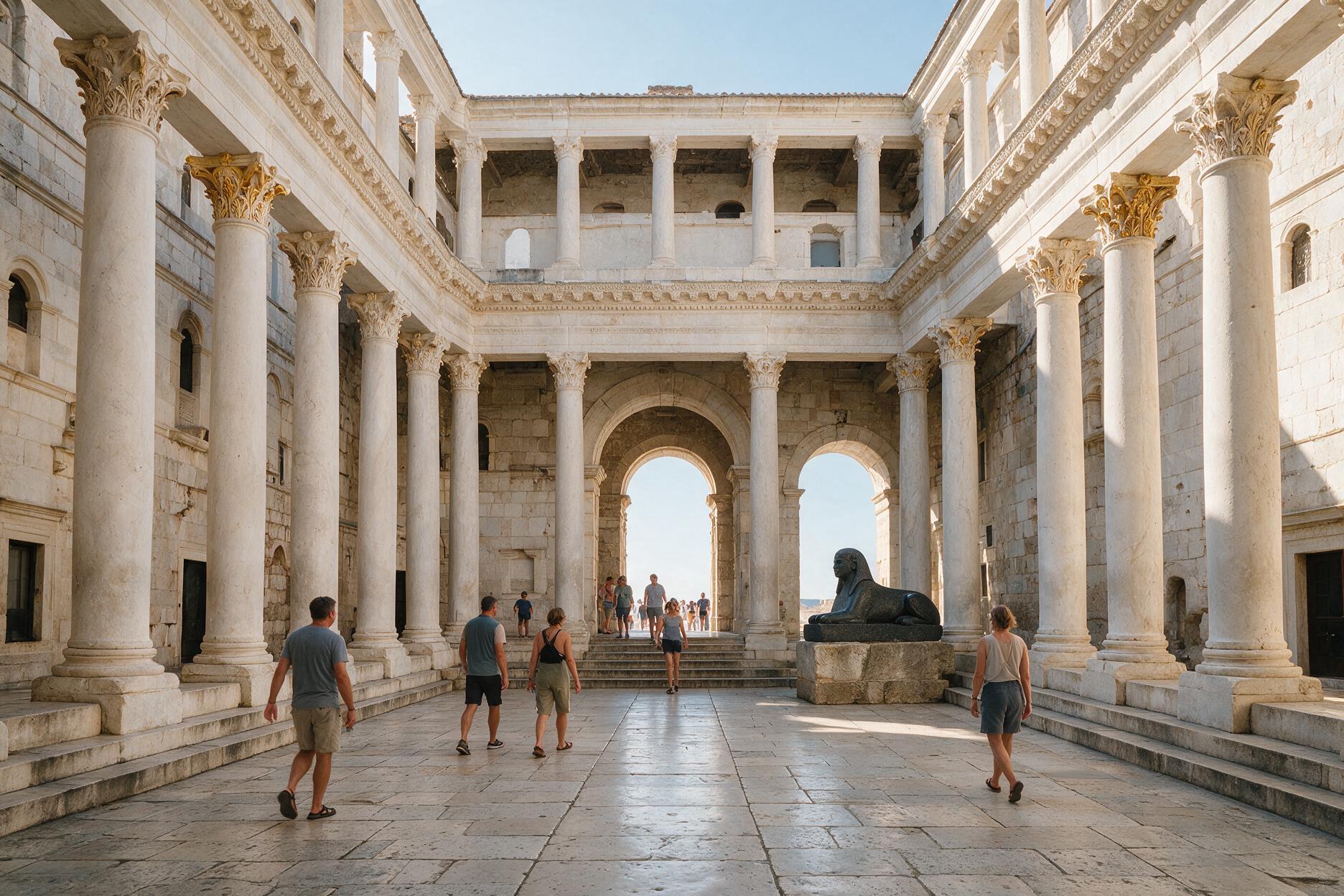
Climb up into the Peristyle, the palace’s central courtyard, where black granite sphinxes imported from Egypt by Diocletian himself still flank the columns — one of them nearly 3,500 years old, older than the palace by a couple of millennia. This is the heart of the old town, and by 10 AM it fills with tour groups and a costumed “Roman guard” posing for photos. Get here before 9 and you’ll have it close to yourself.
From the Peristyle, the Cathedral of St. Domnius sits in what was originally Diocletian’s own mausoleum — a strange irony, since Diocletian was one of history’s most notorious persecutors of early Christians, and his tomb became a cathedral. Climbing the narrow bell tower (buy tickets on-site or online in advance during peak summer months to skip a slow-moving line) gets you a rooftop view over the palace’s terracotta roofs that’s worth the tight, slightly claustrophobic stairwell.
Slip out of the packed main streets into the palace’s quieter side alleys — Split’s old town is smaller than it looks on a map, and half its charm is in the narrow passages tourists don’t bother with. Stop for coffee at one of the small local cafés tucked into these side streets rather than the ones directly on the Peristyle, where you’re paying a premium for the view. A flat white and a slice of something local runs a few euros less just one street over, and the coffee is usually better because it’s made for regulars, not for a photo backdrop.
Photography tip: the Peristyle photographs best in soft early light before 9 AM or in the blue hour just after sunset, when the floodlights come on but the sky still holds color. Midday sun flattens the limestone into a washed-out white that loses all the texture in the stone.
Midday: the Green Market and a proper Dalmatian lunch
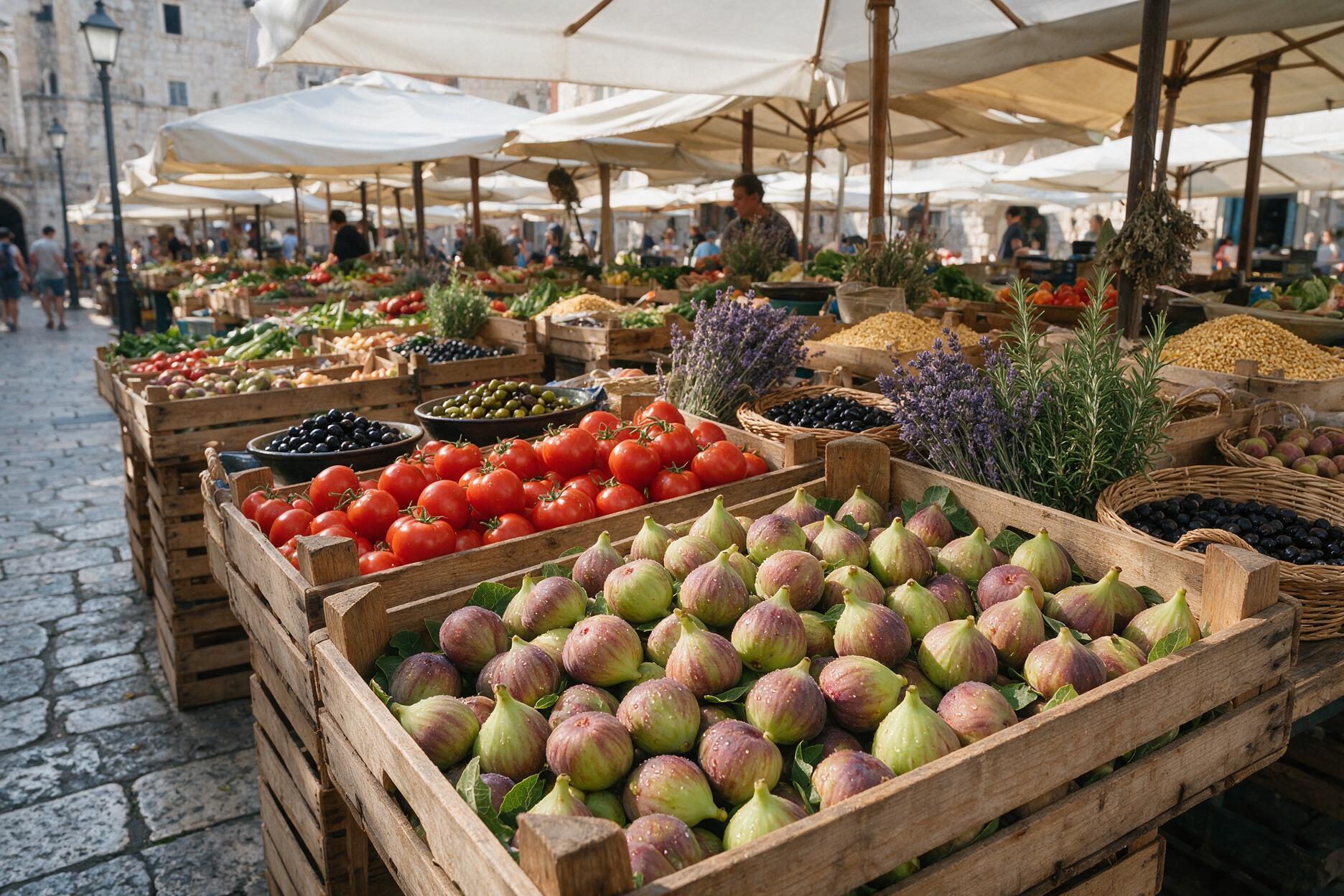
Walk out the palace’s Silver Gate on the eastern side and you land directly in Pazar, Split’s open-air Green Market, which has operated in roughly this spot for over a century. It’s not styled for tourists — it’s where Split actually buys its produce. Stalls pile up fresh figs, tomatoes still warm from the vine, bunches of lavender from the islands, home-pressed olive oil, and dried fruit and nuts sold by weight from women who’ve likely run the same stall for decades. Go before noon; by early afternoon the best produce is gone and stalls start packing up.
For lunch, skip the restaurants with laminated multi-language menus directly on the Riva — they’re priced for foot traffic, not flavor. Dalmatian cooking is built around what the sea and the karst hills actually produce: black risotto (crni rižot) stained with cuttlefish ink, grilled fresh fish sold by weight, peka-style lamb or octopus slow-roasted under a metal dome, and rustic seafood stews that taste like someone’s actual grandmother made them, because in a lot of Split’s family-run konobas, someone’s grandmother did. Konoba Fetivi, tucked near the Matejuška fishing harbor a short walk from the palace, is a good real-world anchor for this — a small, family-run tavern serving whatever came in that morning, with a seasonal menu that shifts by what’s fresh rather than what looks good in a photo. Villa Spiza, just inside the old town, is another solid, unpretentious option locals actually eat at, known for daily specials rather than a fixed menu. Either is a better use of a midday hour than anything with a tout standing outside handing out menus.
Mistake to avoid: don’t order the seafood at a place with a tout standing outside trying to pull you in — in Split, as in most heavily touristed Mediterranean old towns, the restaurants that need to hustle for customers usually aren’t the ones locals actually eat at. If a konoba is quietly full of Croatian conversation and half-empty of English, that’s usually the better sign.
Smart-spending tip: a full seafood lunch with wine at a proper konoba in Split runs noticeably less than the same meal would in Dubrovnik or Venice, without sacrificing quality — Split’s food scene is genuinely one of the better value propositions on the Adriatic for travelers who want the real thing rather than the cheapest thing.
Early afternoon: a swim at Kašjuni, or a slow climb up Marjan
After lunch, Split gives you two good options depending on the season and your energy. If it’s warm enough to swim — realistically May through early October — walk or take a short taxi ride around the Marjan peninsula to Kašjuni beach, a pebble cove with genuinely clear, pale-turquoise water and a beach bar for a cold drink afterward. It’s popular with locals rather than cruise-ship day-trippers, which is part of the appeal, though it does get busy on summer weekends — arrive by early afternoon on a weekday if you want space to spread out.
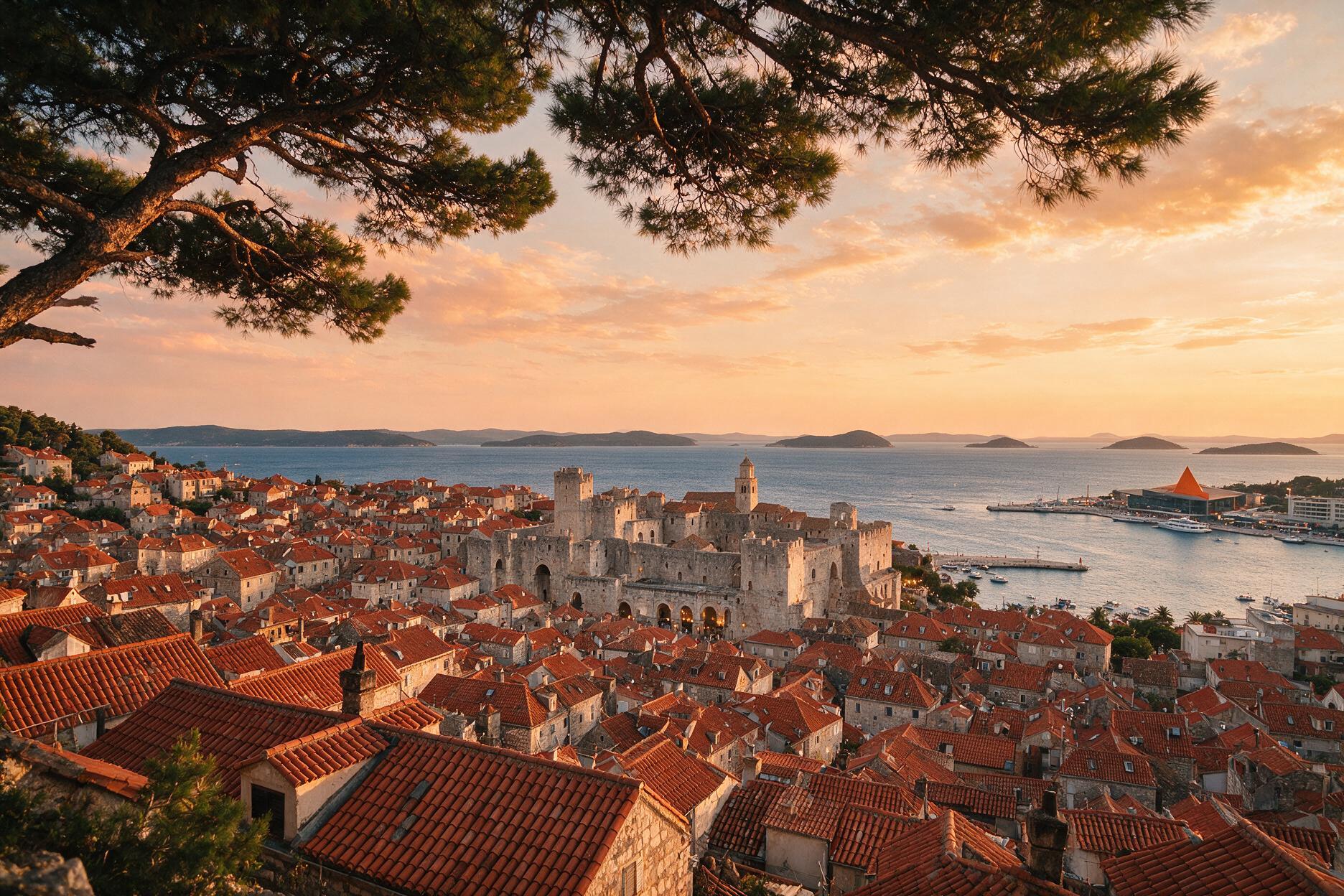
If swimming isn’t the plan, spend this window climbing into Marjan Hill itself — the pine-forested peninsula that locals treat the way New Yorkers treat Central Park. Paths wind up past small stone hermitage chapels, and the climb is shaded and genuinely pleasant even in warm weather, unlike most of the old town’s sun-baked stone streets. This is also where the “hidden gem” of the day lives: past the main Vidilica viewpoint (which does get a crowd), keep walking another 10–15 minutes toward the Telegrin peak area, where the path thins out and the view opens onto the full sweep of the harbor, the islands, and the old town rooftops with a fraction of the people.
For families: Kašjuni’s shallow shelf and beach-bar amenities make it a far easier afternoon than the rockier coves further along the peninsula. For couples: the quieter upper paths on Marjan, away from the main viewpoint, are a better bet for an actual conversation without a crowd.
Evening: the Riva at golden hour, dinner, and a proper sunset close
Come back down toward the water as the light starts to turn gold — this is when the Riva, Split’s palm-lined harborfront promenade, comes fully alive. Locals do their evening passeggiata here, kids chase pigeons around the fountain, and the cafés along the strip fill up with a mix of residents and travelers who’ve timed their day the same way you have. It’s touristy in the sense that everyone ends up here eventually, but it doesn’t feel manufactured — this is genuinely how Split spends its evenings.
For dinner, if you didn’t already hit Villa Spiza at lunch, it’s worth circling back for the evening seating, or trying DeListes, a small restaurant near the fish market that reworks half-forgotten Dalmatian recipes — think octopus stew with fava beans or Dalmatian-style lamb — with a slightly more composed, contemporary plating than a rustic konoba, without losing the region’s actual flavor. Pair whatever you order with a glass of Pošip or Plavac Mali, two Dalmatian whites and reds respectively that rarely make it onto wine lists outside Croatia and are worth trying here specifically because you can’t easily get them at home.
Close the day back up on Marjan Hill, at one of the western-facing viewpoints past Vidilica, timed for actual sunset rather than the half-hour before it. The Adriatic swallows the sun into the horizon somewhere past Čiovo and the islands beyond, the old town’s lights start coming on below, and — unlike the Riva at the same hour — you’ll likely have real space to just sit with it. It’s a genuinely underused close to the day; most itineraries send people to dinner and call it done, and miss the best fifteen minutes Split offers.
For luxury travelers: several boutique hotels tucked inside the palace walls themselves (rather than the larger properties along the waterfront) offer private terrace access with a similar view and zero walk required — worth the premium if an evening hike isn’t the priority.
For solo travelers: Marjan at sunset is one of the more comfortable solo moments in the whole day — populated enough to feel safe, quiet enough to actually enjoy alone, and an easy, well-lit walk back down into town afterward.
Getting to Split from India
There’s no direct flight from India to Split, so budget for one connection. The most common routings run via Istanbul (Turkish Airlines), Doha (Qatar Airways), or through a major European hub like Frankfurt, Munich, or Vienna, connecting onward to Split Airport (SPU). Total journey time typically runs 12–16 hours depending on layover length, and round-trip fares from major Indian cities generally fall in the mid-to-high range for a European trip — worth booking a few months out, since Split’s limited flight frequency means seats on the connecting leg fill up faster than the long-haul segment.
Transit tip: Split Airport sits about 20–25 minutes from the old town. A shared shuttle bus timed to flight arrivals is the easiest budget-conscious option, running roughly every 30–40 minutes; a private taxi or pre-booked transfer costs more but is worth it if you land late at night or are traveling with a group. If your trip includes island-hopping, note that ferries to Hvar and Brač leave from the harbor directly in front of the old town, making Split a genuinely convenient base rather than just a stopover.
Visa, currency, and practical planning for Indian travelers
Croatia joined the Schengen Area fully on 1 January 2023, which means Indian passport holders need a standard Schengen visa to visit — there’s no separate Croatian visa track anymore. Apply through VFS Global, budgeting the standard Schengen visa fee (roughly €90, plus VFS service charges) and, importantly, standard processing of 30–45 days from a complete application — don’t leave this until a month before departure. You’ll need travel insurance with a minimum of €30,000 coverage, proof of accommodation, and proof of sufficient funds. Croatia also uses the euro as its currency (it adopted the euro on 1 January 2023, having previously used the kuna), so no separate currency to plan around if you’re visiting other Schengen countries on the same trip.
Worth tracking as you plan a 2026 trip: the EU’s new Entry/Exit System (EES) and ETIAS travel authorization are being phased in for the Schengen area. EES is a digital border-registration system (biometric check-in at the border) that applies to all non-EU travelers regardless of visa status. ETIAS, once fully active, is a separate pre-travel authorization aimed at travelers who currently don’t need a visa at all — it does not replace the Schengen visa requirement for Indian passport holders, who still need to apply for a visa in advance as described above. Given how frequently EU entry-system timelines have shifted, confirm the current status directly with VFS Global or the Croatian embassy before you travel, since rules dated more than a few months old can already be out of date.
Mistake to avoid: applying for a Schengen visa less than 60 days before travel. Applications submitted too close to the departure date are frequently rejected outright regardless of how complete the paperwork is — build the visa timeline in before you lock flights.
Where to stay
Staying inside or immediately around the palace walls means everything in this itinerary is a 5–10 minute walk, and evenings feel like you actually live there rather than commute in. Mid-range boutique guesthouses tucked into old palace buildings offer genuine character without a five-star price tag; travelers wanting a full-service luxury stay will find several restored heritage properties along the Riva and just outside the old town walls with rooftop pools and Adriatic views. Avoid the anonymous business hotels further from the center unless you’re prioritizing price over atmosphere — in Split, location inside the old walls is most of the experience.
Frequently asked questions
Do Indian citizens need a visa for Split, Croatia?
Yes. Croatia is fully in the Schengen Area, so Indian passport holders need a standard Schengen visa, applied for through VFS Global, with standard processing taking 30–45 days.
What is the best time to visit Split?
Late May to early October covers swimmable weather, with September and early October standing out as the sweet spot — warm sea temperatures, thinner crowds than peak July–August, and daytime temperatures in the comfortable mid-20s Celsius rather than the summer high-30s.
How many days do you need in Split?
One full day, structured well, covers the old town, the market, a swim or hill walk, and a proper dinner. Two to three days lets you add a day trip to Hvar or Brač by ferry from the harbor.
What currency does Croatia use?
The euro. Croatia adopted the euro on 1 January 2023, replacing the Croatian kuna, so no separate currency exchange is needed if you’re also visiting other Eurozone countries.
Is Split or Dubrovnik better for a first trip?
They’re different experiences rather than a strict either/or. Split has a working, lived-in old town built inside an actual Roman palace and a more affordable, less staged food scene; Dubrovnik has a more dramatically preserved medieval old town but noticeably higher prices and heavier crowds, especially around cruise-ship arrival hours. Many of our clients do both, using Split as the calmer, cheaper anchor.
Can you drink tap water in Split?
Yes, tap water in Split is safe to drink and Croatia’s standards are consistent with the rest of the EU.
Is Split walkable, or do you need a car?
The old town and Marjan Hill are entirely walkable. A car isn’t necessary for a Split-focused day; it becomes more useful only if you’re planning day trips inland to places like the Krka waterfalls.
What should I not miss in Split besides the palace?
The Green Market (Pazar) just outside the palace’s Silver Gate and a proper sunset from Marjan Hill are the two most commonly skipped experiences that shouldn’t be — both are free, and both are where Split feels least like a stage set.
Planning your Dalmatian Coast trip
A day like this works as a standalone if Split is your only Croatian stop, but it’s also the natural anchor for a longer Dalmatian Coast itinerary — pairing Split with island time on Hvar or Brač, and continuing south toward Dubrovnik. If you’re mapping out a Croatia trip from India and want the visa timeline, flight routing, and day-by-day pacing handled properly rather than pieced together from a dozen open browser tabs, get in touch with Get Tripped Travels for a custom Dalmatian Coast itinerary built around exactly this kind of day.