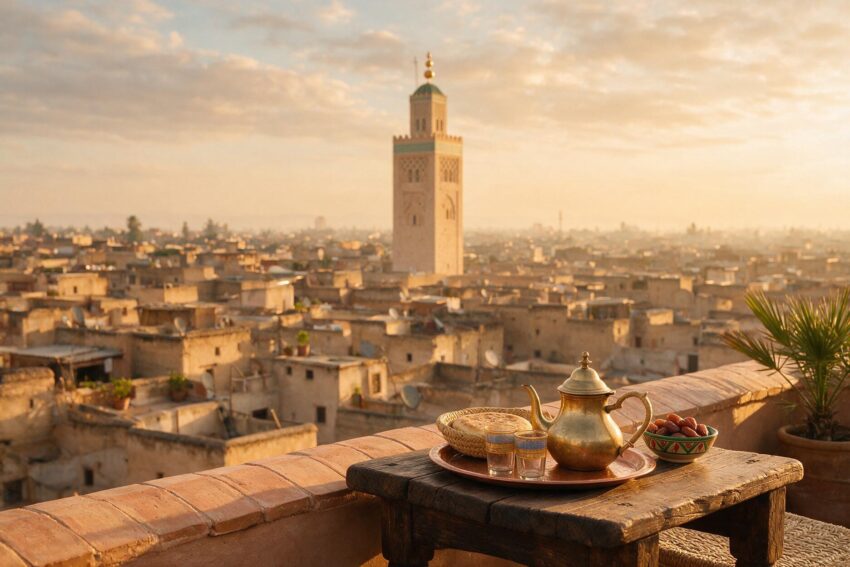
The call to prayer from the Koutoubia minaret reaches the rooftop before the sun does — five muezzins from five different mosques, none quite in time with each other. A rooster somewhere below the terrace wall answers back. Then the smell of charcoal starting up in a kitchen two roofs over drifts across the parapet, and it’s 6:40 a.m. in the Marrakech medina, and nothing about it looks like the postcard version of the city yet.
A single day and night built around eating your way through the medina is the best way to understand why people keep coming back to Marrakech even after the fake guides and snake-charmer hustle have worn thin. This Marrakech medina food trail follows one real day, dawn to well past midnight, through a rooftop breakfast, a spice souk, a hidden garden, a lunch that takes six hours to cook, a hammam, a sunset view, and Jemaa el-Fna at its most theatrical. Some of it is touristy. Some of it isn’t written up anywhere. Both are worth your time once you know which is which.
Table of Contents
- 6:30 AM: A Riad Rooftop Before the Medina Wakes Up
- 8:00 AM: Breakfast as the Medina Wakes Up
- 9:30 AM: Into the Souks — Spices, Dyers, and the First Real Bite
- Midday: A Hidden Courtyard Escape — Le Jardin Secret
- 1:00 PM: Lunch on the Food Trail — Tanjia and the Baker’s Oven
- 3:00 PM: The Hammam Pause
- 5:30 PM: Sunset from a Medina Rooftop
- 7:00 PM: Jemaa el-Fna After Dark — The Honest Version
- Planning Your Own Marrakech Medina Food Trail
- Frequently Asked Questions
6:30 AM: A Riad Rooftop Before the Medina Wakes Up
A riad isn’t a hotel with a nicer name — it’s a traditional courtyard house, walls blank to the street and everything turned inward toward a central patio, sometimes with a small plunge pool, always with a staircase up to a rooftop terrace. That inward-facing design is a few hundred years old and it still works: step off a narrow, half-awake alley into a riad’s door, and the noise of the medina drops away almost completely.
Most riads bring breakfast up to the rooftop rather than serving it in a dining room, so this first hour is usually just you, a pot of mint tea, and the skyline — satellite dishes, storks nesting on old walls, laundry lines, and the Koutoubia minaret above the rest of it. A mid-range riad runs roughly 600–1,200 MAD a night (about ₹6,200–₹12,300) with breakfast included. Push into the luxury tier — a private pool riad, a suite with a hammam attached, a property like La Mamounia on the edge of the medina — and nightly rates climb from around 1,500 MAD past 5,000 MAD (₹15,000 to well over ₹50,000) in peak weeks.
Transit tip: riad addresses are usually just a derb (alley) name and a door number, and GPS pins in the medina are unreliable at best. Almost every riad will arrange to meet you at a fixed, findable landmark — a square, a gate, a mosque — and walk you in from there, because no vehicle, taxi included, can get down most of these alleys. Agree on that meeting point before you land, not after.
8:00 AM: Breakfast as the Medina Wakes Up
Breakfast here is not croissants. It’s msemen — a square, layered flatbread folded and pan-fried until flaky outside and slightly chewy in the middle — alongside baghrir, a spongy semolina pancake locals call the “thousand-hole” bread for the bubbles that form as it cooks. Both get dipped in amlou, a thick spread of ground almonds, argan oil, and honey that tastes like nothing else you’ll have for breakfast this year. Fresh orange juice and mint tea, poured from a height so it aerates and cools slightly as it hits the glass, round it out.
By the time you’re on your second glass of tea, the medina below has properly woken up: metal shutters going up one by one, a handcart dragged over cobblestones, a shopkeeper hosing down the stone before the day’s foot traffic starts. This is the version of the medina almost nobody photographs, because by mid-morning it looks completely different.
9:30 AM: Into the Souks — Spices, Dyers, and the First Real Bite
Souk Semmarine is the medina’s main artery, and from it the smaller, more specific souks branch off — Souk Attarine for spices and perfume, stalls stacked with cones of ras el hanout, cumin, and saffron threads; and, a few turns further in, Souk Sebbaghine, the dyers’ souk, where hanks of wool hang dripping in magenta, indigo, and marigold yellow above the narrow passage. Late morning, before the wool has fully dried and while the light is still soft, is the best window to see it.
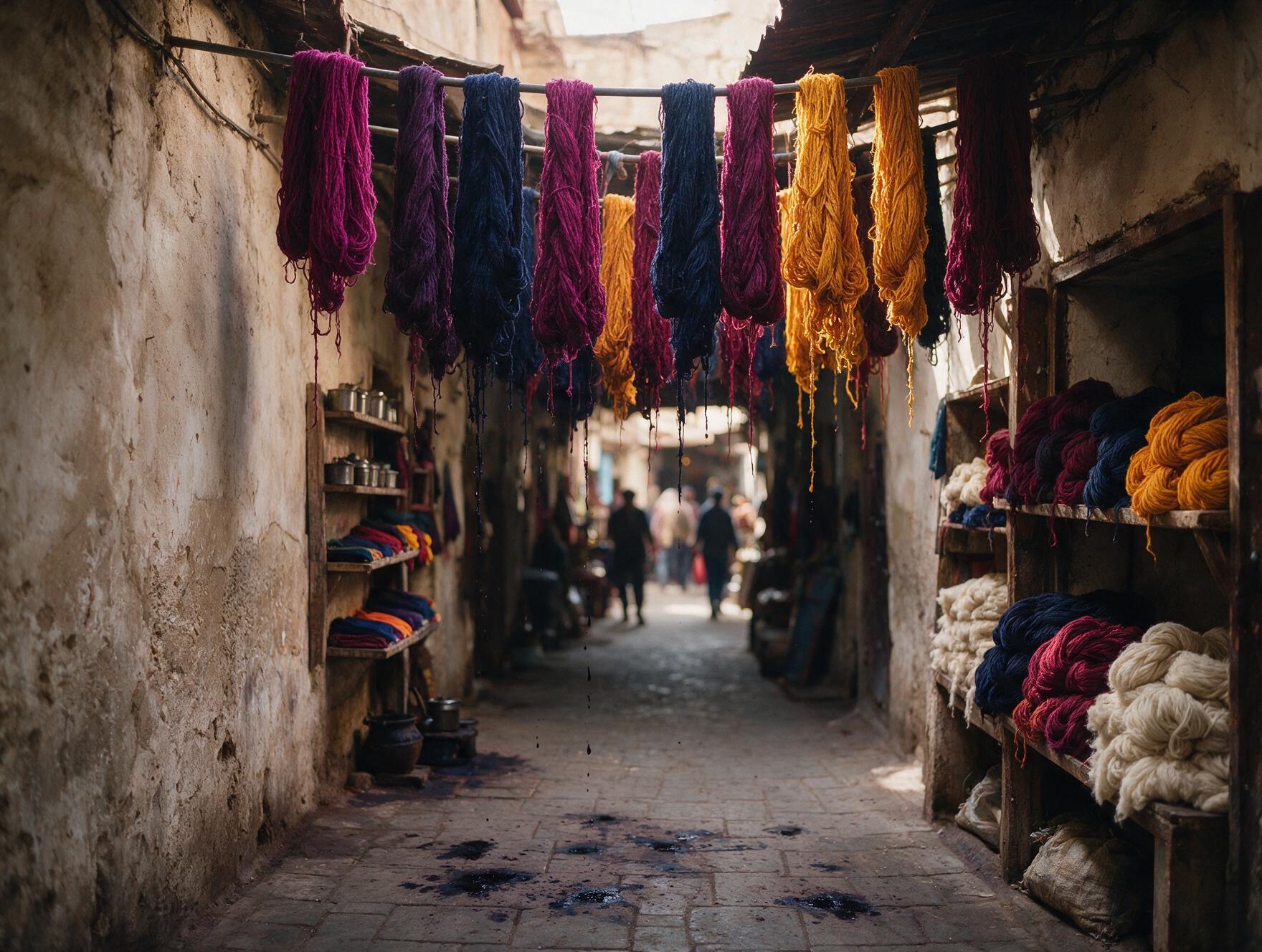
Photography tip: shoot the dyers’ souk between about 10 and 11 a.m. Later than that, the light turns harsh and overhead, flattening the colors that make the shot worth taking.
Somewhere around here is a good spot for the first real bite of the day: kefta bsmen, minced meat skewers grilled over charcoal and brushed with smen, a fermented, slightly funky clarified butter that gives the meat a distinct sourness under the char. A stall with a charcoal grill actually smoking, and a handful of local men eating standing up, is usually the tell worth following.
Mistake to avoid: someone steps in front of you, says the souk ahead is “closed for a festival” or “wrong way,” and offers to walk you to where you actually want to go. It’s a well-worn move that ends at a shop or a tannery “tour” and a request for a tip you didn’t agree to. A polite “la, shukran” (no, thank you) and continuing on your path is usually enough — genuine stallholders don’t chase.
Midday: A Hidden Courtyard Escape — Le Jardin Secret
Most first-time visitors know Jardin Majorelle, the blue-walled garden across town that draws bus tours and long queues. Fewer make it to Le Jardin Secret, a restored 19th-century riad garden inside the medina itself, split into an Islamic garden with a traditional four-quadrant water channel layout and an “exotic” garden of palms, cacti, and citrus. It reopened in 2016 after years of restoration, and even at midday it’s genuinely quiet — a real break from the souk noise rather than a photo-op with a queue.
Entry is 100 MAD (roughly ₹1,000), with a reduced rate for under-24s, and an extra 40 MAD to climb the tower for a view over the medina’s rooftops and, on a clear day, toward the Atlas Mountains. Hours shift slightly by month, generally 9:30 a.m. to somewhere between 6 and 7:30 p.m., so check the current schedule before you go.
1:00 PM: Lunch on the Food Trail — Tanjia and the Baker’s Oven
If one dish defines a Marrakech medina food trail, it’s tanjia marrakchia — not to be confused with tagine, the conical clay-pot dish most visitors already know. Tanjia is beef or lamb packed into a tall earthenware urn with preserved lemon, garlic, cumin, and a thread or two of saffron, sealed with paper and string, and left to cook for hours, not in a restaurant oven but buried in the hot embers of a neighborhood hammam furnace, the ferrane.
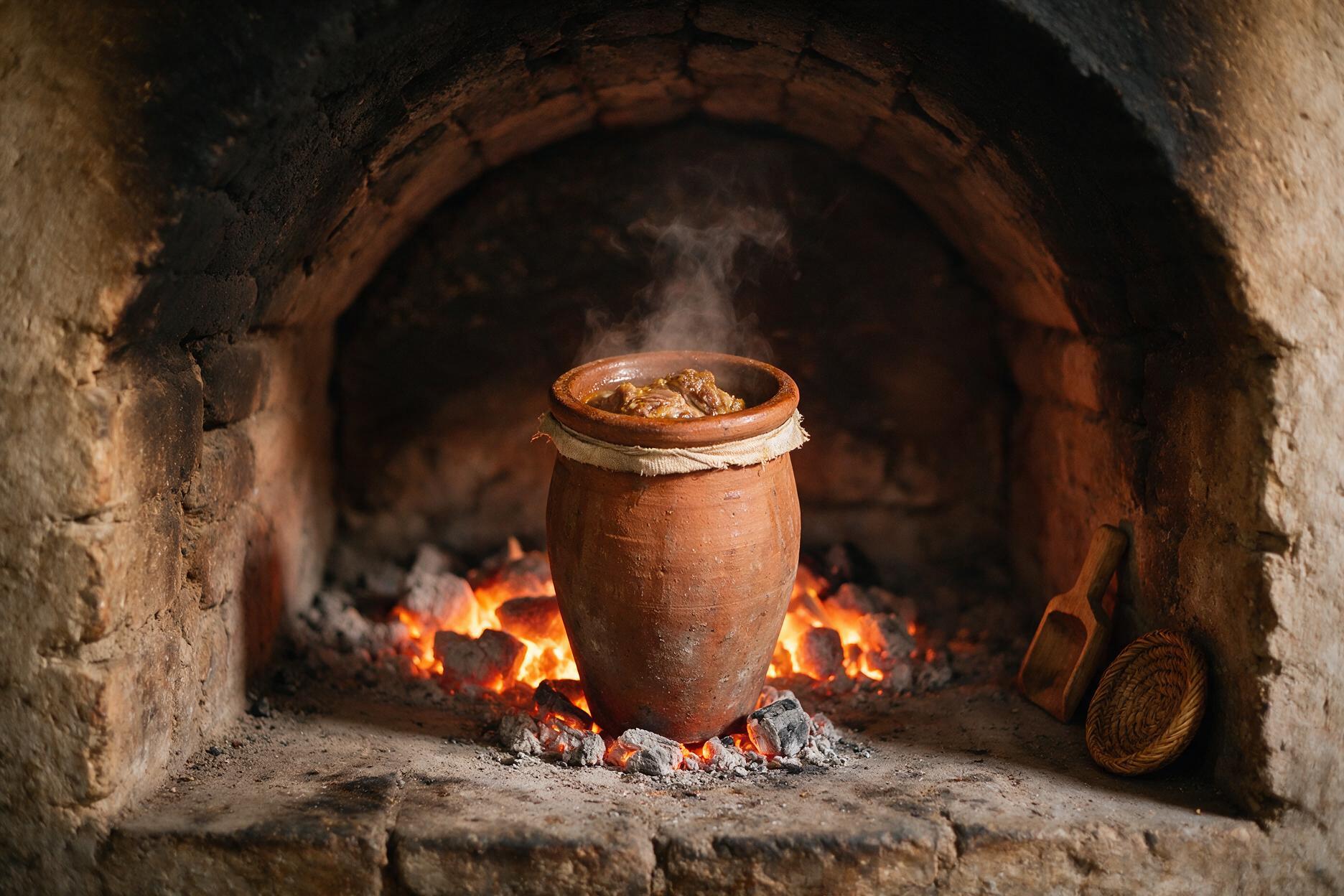
Fun fact: tanjia is traditionally known as a bachelor’s dish. Men without someone cooking for them at home would drop the sealed urn at the hammam furnace on their way to work and collect it, fall-apart tender, that evening — a slow-cooked meal that needed no attention in between. Some old-city neighborhoods near Bab Doukkala and the Mellah still use working ferrane ovens this way, and a handful of small, unglamorous restaurants near them serve tanjia closer to the original version than the tourist-menu one.
The same communal-oven logic applies to bread. Most medina homes and riads don’t have their own oven, so shaped dough gets carried to the neighborhood ferrane, marked in chalk so the baker knows whose loaf is whose, and baked in a wood-fired oven for a couple of dirhams.
Smart-spending tip: ask your riad a day ahead whether they’ll cook a home-style tanjia or tagine lunch for guests. Many will, for a fraction of what a sit-down restaurant charges, and it’s frequently better — closer to what a Marrakchi family actually eats on a weekend.
3:00 PM: The Hammam Pause
By mid-afternoon, the medina’s heat and noise catch up with most people, and a hammam is the local answer to that, not a spa import. There are three real tiers. A basic public neighborhood hammam costs around €4–8 (roughly ₹380–₹740) — communal, single-sex, no-frills, and about as authentic as it gets. A mid-range riad spa hammam, with black soap (savon beldi), a full-body kessa-mitt scrub, and a rhassoul clay mask, runs closer to €22–65 (₹2,000–₹6,000) and is usually private. At the top end, five-star hotel spas like La Mamounia charge €80–150 (₹7,400–₹13,900) for a more polished, if less intimate, version of the same ritual.
The scrub is the part nobody warns you about clearly enough: after black soap softens your skin in the steam room, the kessa mitt removes a genuinely visible amount of dead skin, rolling off in gray flecks — either satisfying or alarming depending on your tolerance for that sort of thing.
Honest caveat: public hammams are single-sex, communal, and can feel like a lot for a first-timer not used to bathing alongside strangers. There’s nothing wrong with skipping that version and booking a private riad hammam instead — it’s still a real hammam experience, just a gentler entry point.
For couples: most riad spas offer a side-by-side couple’s hammam room, which the public version doesn’t. If a shared experience matters more than the most “authentic” version, book that instead.
5:30 PM: Sunset from a Medina Rooftop
Café des Épices sits right on Rahba Lahdim, the spice square, and its rooftop — along with Nomad’s terrace just above it — is one of the better sunset spots in the medina because it isn’t hidden: you can watch the square’s spice and leather stalls pack up while the Koutoubia minaret catches the last orange light. It gets busy fast once the sun starts dropping, so arrive 30–45 minutes ahead for a rail-side table rather than one facing a wall.
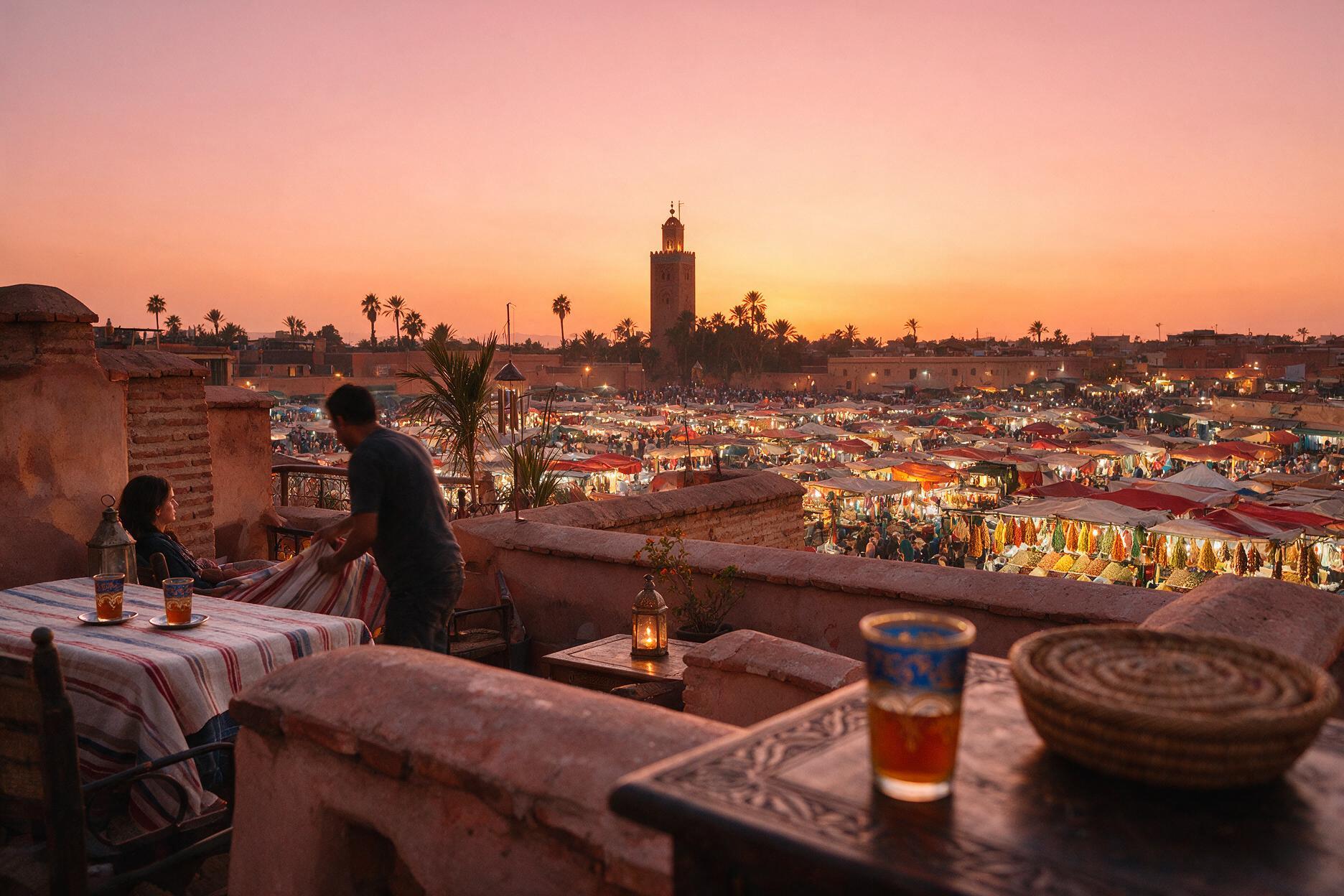
Photography tip: point the camera toward the Koutoubia as the evening call to prayer starts. The minaret silhouettes against a sky that goes from pink to a deep orange in about fifteen minutes, and that window is short — don’t spend it scrolling a menu.
7:00 PM: Jemaa el-Fna After Dark — The Honest Version
By early evening, Jemaa el-Fna transforms from an open square with a few juice carts into dozens of numbered food stalls, each specializing in one thing: a stall doing nothing but snails simmered in a spiced anise-and-cinnamon broth, another grilling merguez and kefta over open charcoal, another ladling harira — the tomato-and-lentil soup traditionally broken with dates and honey-soaked chebakia sesame cookies — and juice stalls stacked with pyramids of oranges, pomegranates, and avocados for blending.
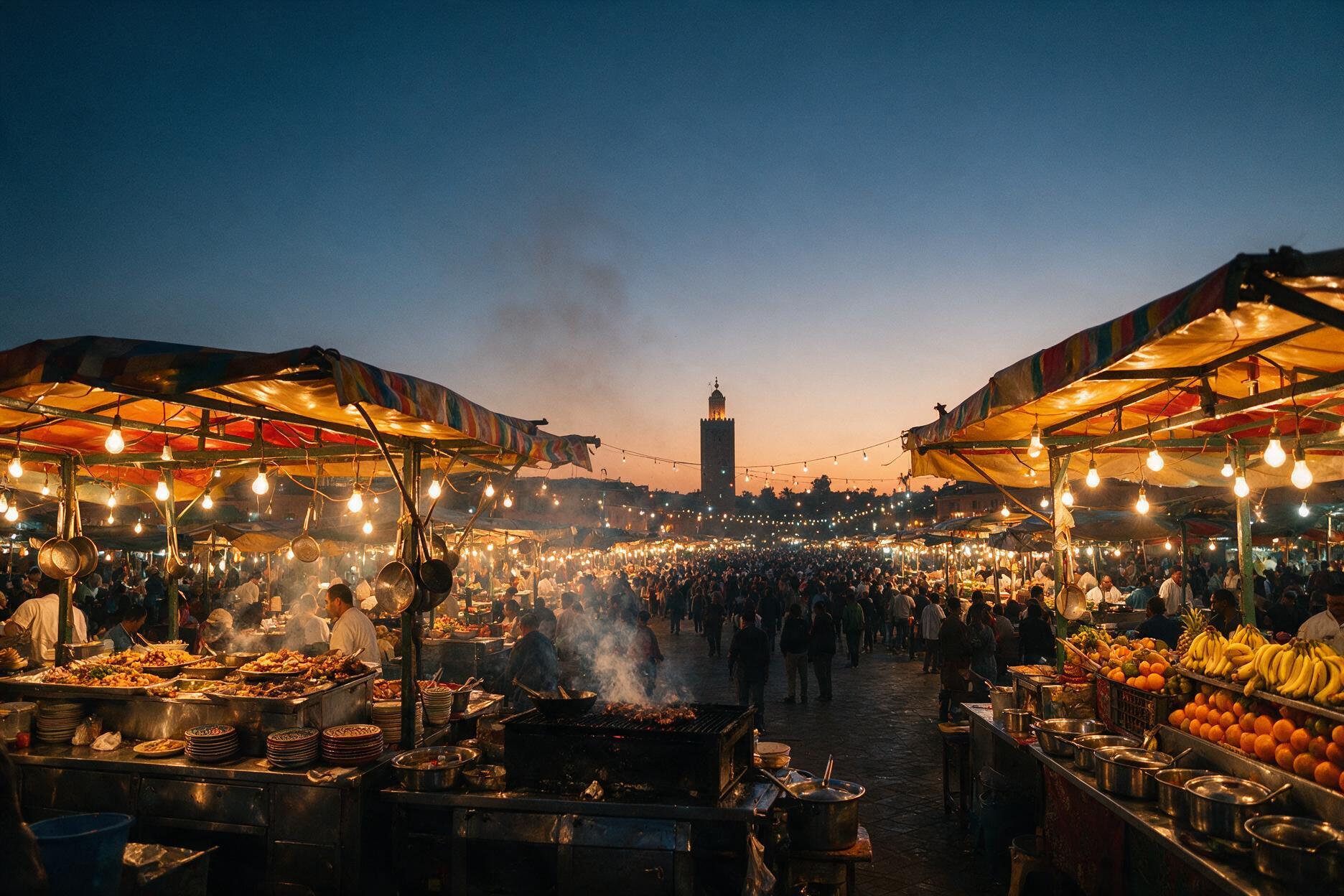
It’s also, without pretending otherwise, one of the most staged tourist experiences in Morocco. Henna artists will take your hand before quoting a price, then ask for far more once the design is half done. Snake charmers and monkey handlers will pose for a photo and then demand payment you never agreed to — and it’s worth knowing that using monkeys for tourist photos is widely criticized by animal welfare groups, so plenty of travelers choose not to engage with those acts at all, on principle rather than price.
Mistake to avoid: agree on a price out loud, before the henna needle touches your skin or the snake goes anywhere near your shoulders. “How much” asked after the fact is not a negotiation, it’s a bill.
None of that cancels out the food. The reliable rule in the square is to pick the stall with the most Moroccan families eating at it, not the one with the loudest tout waving a laminated menu in English. It’s touristy, it’s a production, and it’s still worth doing once — for the noise, the smoke, the storytellers gathering a crowd in Darija you won’t understand a word of, and the sense that this square has been doing exactly this, in some form, for centuries. UNESCO recognized it as a Masterpiece of the Oral and Intangible Heritage of Humanity, and standing in the middle of it at 9 p.m., that recognition makes more sense than it does on paper.
Planning Your Own Marrakech Medina Food Trail
Getting to Marrakech from India: Visa and Flights
Indian passport holders need a visa for Morocco — there is no visa-on-arrival and no visa-free entry, despite what some older blog posts still claim. The workable route is Morocco’s e-Visa, applied for online before you travel: a valid ordinary passport with at least six months’ validity, a passport-style photo, and proof of travel plans are the core requirements. Standard processing runs roughly 3–5 working days at a fee of about 770 MAD (approximately ₹7,900), with an express option in about a day for around 1,100 MAD (₹11,300). The e-Visa is single-entry, valid for up to 30 days per visit, and must be used within 180 days of issue. Apply well before you travel, not the week before.
There are no direct flights between India and Morocco, so every route from Delhi, Mumbai, or Bengaluru connects through a hub — commonly Dubai (Emirates plus Royal Air Maroc), Istanbul (Turkish Airlines), or Doha (Qatar Airways). Round-trip fares typically run ₹32,000–55,000 depending on route and season, with total travel time of roughly 12–16 hours including the layover. Some itineraries land at Casablanca and need a further domestic flight or a 2.5-hour train to Marrakech; others connect straight through to Marrakech’s own Menara Airport (RAK), about 6 km from the medina — worth booking over a Casablanca routing where the fare is similar.
Best Time for This Food Trail
Marrakech in peak summer is genuinely rough — daytime highs regularly clear 38–40°C in July and August, turning a rooftop breakfast into a race against the heat and an afternoon in the souks into something to survive rather than enjoy. September is the real turning point: average temperatures sit around 25°C, highs still touching 32°C but with far more bearable evenings, and minimal rainfall. October cools further, averaging around 22°C with highs near 28°C and slightly more rain (about 25mm). By November, days average closer to 17°C with highs around 23°C, and rain picks up to about 40mm — still very walkable, just pack a layer for the evenings.
Given the current season, late September through November is a genuinely good window for this itinerary — warm enough for rooftop evenings, cool enough that a day of walking the souks doesn’t wear you down by noon.
Where to Stay: Riads by Budget
Staying inside the medina walls, in a riad rather than a modern hotel in Gueliz (the newer part of the city), is what makes a day like this possible without a taxi between every stop. Mid-range riads with a rooftop and breakfast included run roughly 600–1,200 MAD a night (₹6,200–₹12,300). For a private pool, an attached hammam suite, or a landmark property like La Mamounia, budget from around 1,500 MAD up past 5,000 MAD a night (₹15,000–₹50,000+) in peak weeks. Either way, book a riad with a rooftop — it’s the one feature that turns a stay into an actual experience.
What a Day Like This Costs
Rough per-person figures, mid-range throughout: riad breakfast is usually included; a street-food lunch of tanjia and bread runs 40–80 MAD (₹410–₹820); a mid-range riad hammam with scrub and mask lands around €25–40 (₹2,300–₹3,700); a sunset rooftop drink or light meal is roughly 80–150 MAD (₹820–₹1,540); and an evening grazing through several Jemaa el-Fna stalls comes to around 100–200 MAD (₹1,030–₹2,060) if you stick to street stalls rather than the sit-down restaurants ringing the square. A guided food tour, if you’d rather have a local navigate stall selection and pricing for you, typically runs US$35–90 for two to four hours.
Money, SIM Cards, and Getting Around
Morocco runs on a split system: cards work at hotels, riads, larger restaurants, and supermarkets, but the souks, street-food stalls, and grand taxis are cash-only. The dirham is a closed currency — you can’t buy it before you arrive, so plan to withdraw or exchange after landing. ATMs are common, though many Moroccan banks add a local fee of roughly 20–40 MAD per withdrawal on top of whatever your own bank charges, so it’s more efficient to withdraw a larger amount less often. When an ATM offers to charge you in rupees or dollars instead of dirhams, decline it — that “convenience” conversion costs several percent more than letting your own bank handle it.
A local or eSIM data plan is worth setting up before you land, mainly for maps — GPS still helps even when street names inside the medina are inconsistent. Inside the medina, walking is almost always faster than a taxi, since most alleys are too narrow for cars anyway; petit taxis are metered for daytime rides, but confirm the meter is running (or agree a price upfront) for anything after dark.
For solo travelers: the medina’s alleys are genuinely disorienting even with a map, and a guided food tour for the souk portion of the day means less backtracking and less exposure to the “wrong way” hustle — not a sign you can’t handle it alone, just an efficient use of a short trip.
For families: the cobblestones and steps are hard on strollers, and Jemaa el-Fna after dark includes animal-handling acts some parents would rather kids not see up close — a late-afternoon visit, before the snake charmers and monkey handlers are in full swing, works better with younger children.
For luxury seekers: the same day with a private guide, a reserved rooftop table, a spa hammam at a property like La Mamounia, and a car meeting you at every medina gate is entirely available here — Marrakech supports both ends of the spectrum without much friction between them.
Frequently Asked Questions
How many days do you need in Marrakech?
Two to three full days is the sweet spot for the medina — enough for a day like the one above plus a slower second day. Experienced travelers on forums like Tripadvisor generally agree: one day isn’t enough to see past the surface, and four starts to feel long unless paired with a day trip to the Atlas Mountains or the Agafay desert.
Do Indian citizens need a visa for Morocco?
Yes. Indian passport holders need Morocco’s e-Visa before travel — there’s no visa-on-arrival or visa-free entry, regardless of what some older articles suggest. Apply online in advance; processing typically takes 3–5 working days.
Is Marrakech, and the medina specifically, safe to walk around at night?
The medina and Jemaa el-Fna are well-trafficked and generally safe by ordinary travel standards, since the square stays busy well past midnight. The real risks are practical rather than dangerous — overcharging, the “wrong way” hustle, and getting genuinely lost — not personal safety in the way that phrase usually implies.
Is Jemaa el-Fna worth it, or is it just a tourist trap?
Both, honestly. It’s staged in places — the henna pricing, the photo-then-demand-payment routine — and it’s also a genuine, centuries-old public square UNESCO recognized as intangible cultural heritage. Go once, agree on prices before anything touches your hand or your camera, and eat at the stall with the most local families in line.
Can you drink the tap water in Marrakech?
Most travel guidance recommends sticking to bottled or filtered water, including for brushing teeth, rather than drinking tap water directly — a standard precaution rather than a sign of a specific issue.
Do I need cash, or can I pay by card in the souks?
Cash. Riads, larger restaurants, and hotels take cards, but souk stalls, street food, and grand taxis are cash-only.
What should I wear in the medina, especially as a woman?
Marrakech is more relaxed about dress than some other parts of Morocco, but shoulders and knees covered is still the comfortable default, both for blending in and for entering any mosque courtyards that allow visitors. Lightweight, loose layers work better than anything fitted, for modesty and for the afternoon heat.
Is Marrakech a good fit for a honeymoon or a couples trip?
Yes — a private riad with a rooftop and plunge pool, a couple’s hammam session, and a reserved sunset table are all easy to arrange, and the mix of quiet courtyard stays and lively public spaces suits couples who want both.
A day like this one doesn’t cover all of Marrakech — it barely leaves the medina walls, and skips the Atlas Mountains, the desert, and half the palaces entirely. That’s the point of a food trail rather than a checklist: one thread pulled all the way through, from a rooftop at dawn to a crowded square well past midnight, with enough honest detours to actually feel like a day in the city rather than a tour of it.
If a Marrakech medina food trail like this sounds like the kind of trip you’d rather not plan stall-by-stall yourself, Get Tripped Travels can build it around you: a well-chosen riad, a private guide for the souks and food stops, and the visa and flight logistics handled before you land. Get in touch and let’s put together your Marrakech itinerary.