

The alarm goes off at 4:50 a.m. and Cape Town outside the window is just black — no orange city-glow, because a guesthouse in Tamboerskloof doesn’t really get any. Somewhere below, Lion’s Head is a darker shape against a dark sky. There’s a flask of instant coffee going cold on the nightstand, a headlamp that seemed excessive when you packed it and now feels like the smartest thing in your bag, and a decision that has to be made in the next ten minutes: are you actually doing this, or are you going back to sleep and catching the cable car up Table Mountain at a civilised hour like a normal person.
You’re doing this. Cape Town rewards people who get up early, and by 6 a.m. the whole city is lit gold from a viewpoint most visitors never bother to climb. This is what one full day here can look like built around a real sequence of hours instead of a checklist — a sunrise summit, a slow neighbourhood breakfast, a harbour that still runs on fishing, and a sunset you’ll pick from two very different options. Here’s how the day unfolds, plus what an Indian traveller needs to plan it — visa, flights, money, safety, all of it.
Table of Contents
- 5:10 a.m. — The Climb Up Lion’s Head
- Coming Down Hungry: Coffee and Koesisters in Bo-Kaap
- A Slower Walk Through the Bo-Kaap
- South of the City: The Drive to Kalk Bay
- An Afternoon in Kalk Bay — Harbour, Tidal Pool, Antiques
- Sunset: Signal Hill or Camps Bay
- Where This Day Fits Into a Real Cape Town Trip
- FAQs: Cape Town for Indian Travellers
- Last Thought
5:10 a.m. — The Climb Up Lion’s Head
The Lion’s Head trailhead on Signal Hill Road is already a small crowd of headlamps when you get there — mostly locals out for their regular morning fix. The first stretch is a wide gravel path switching back through fynbos scrub, easy enough that you start wondering if the warnings were overblown. They weren’t. About two-thirds up, the path splits: one route goes over exposed rock with chains and metal ladders bolted into the sandstone, the other loops around on a longer, gentler contour path. Take the ladders if you’re reasonably fit and don’t mind exposure — it’s hands-and-feet scrambling with solid metal to hold, not technical climbing. Take the bypass with a bad knee or if you just don’t want adrenaline before coffee. Both meet again near the top.
The return trip is a little over five kilometres and takes most people ninety minutes to two and a half hours, depending on photo stops — and by the last twenty minutes the sky behind Table Mountain has gone from charcoal to bruised purple to the specific orange that only shows up in a handful of cities. The summit is a scramble over rock rather than a platform, and it gets crowded, thirty or forty people some mornings, everyone quietly negotiating for the same three metres of view. Nobody’s rude about it. Everyone’s there for the same reason.
What you get for the climb: the city bowl laid out below, Table Mountain’s flat top catching the first light before anything else does, Robben Island a grey smudge in the bay, Camps Bay’s white apartment blocks just starting to catch colour on the Atlantic side. It’s a 360-degree view that Table Mountain itself, oddly, doesn’t give you as cleanly, since you’re standing on top of it rather than looking at it.
Mistake to avoid: starting without a headlamp because “there’ll be enough people around to see by.” There won’t be, not on the lower section, and a phone torch in one hand is risky on loose rock. Buy a cheap headlamp before you leave India.
If you’d rather not climb before sunrise: Signal Hill, the next ridge over, gives a similar panoramic view with a car park near the top — no scrambling required. Better with young kids or older parents. Save Lion’s Head for a group that wants the climb.
Coming Down Hungry: Coffee and Koesisters in Bo-Kaap
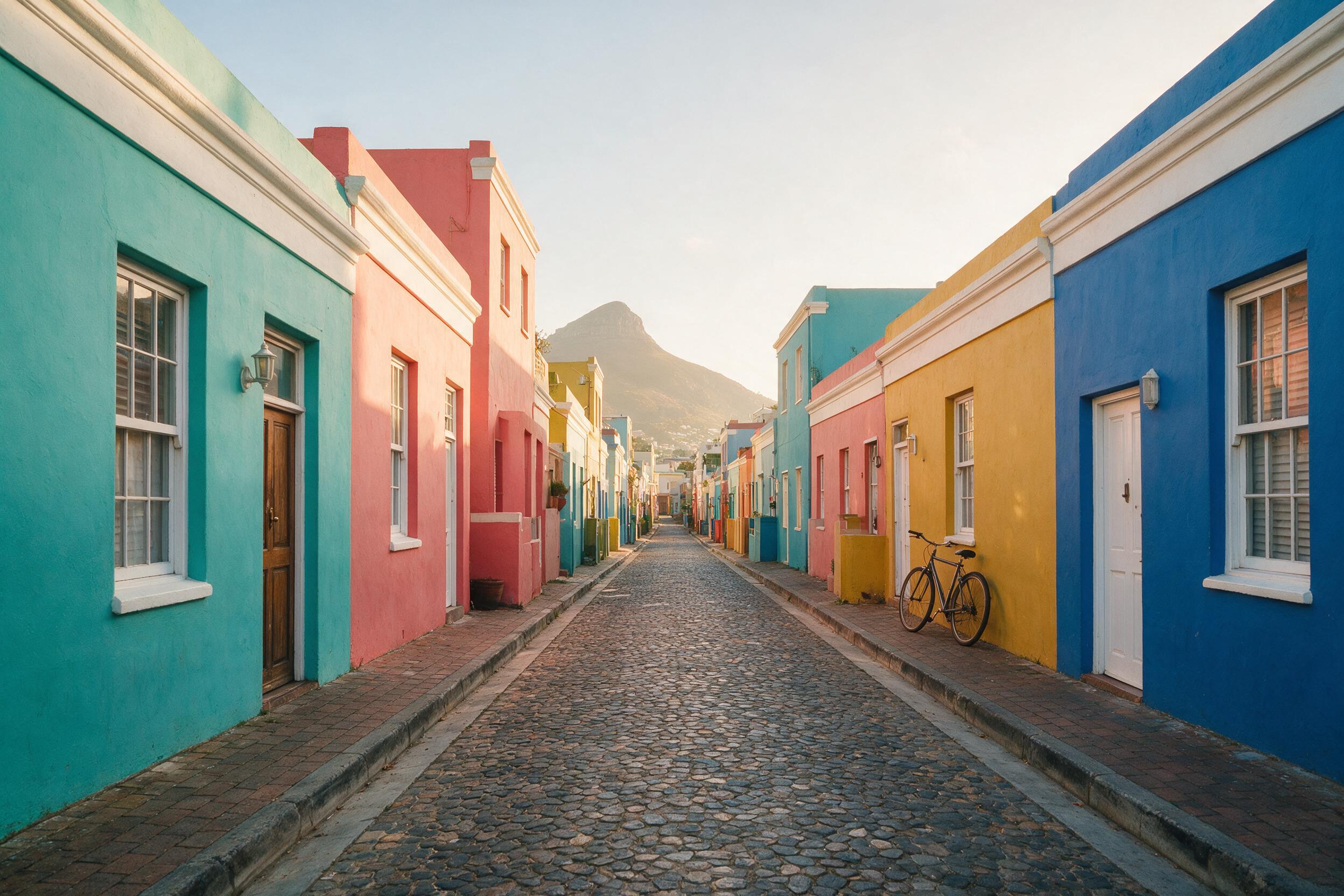
By 7:45 a.m. you’re back at the car park, thighs aware of every step, and the fifteen-minute walk down into the Bo-Kaap feels like the obvious next move — you’re already close, and “exhausted from a hike” always wants carbs immediately.
Bo-Kaap is Cape Town’s oldest residential neighbourhood, built on the slope of Signal Hill, and its houses are the ones you’ve seen in every Cape Town photo without knowing the name — turquoise next to fuchsia next to mustard yellow, cobbled lanes, minarets between the rooftops. The colour isn’t tourist styling. The community here descends largely from people brought to the Cape as enslaved labour from what’s now Malaysia, Indonesia and parts of Africa in the 1600s and 1700s, and the neighbourhood is still predominantly Muslim, still genuinely residential — people live behind those bright doors and send their kids to school down these same lanes. Walk it like a guest, not a film set: keep to the street, ask before photographing anyone on their doorstep, and don’t assume an open door is an invitation.
Breakfast is at Rose Corner Café, a small, unfussy spot doing koesisters — a spiced, syrup-glazed plaited pastry, the Cape Malay version, not to be confused with the Afrikaner koeksister, a different shape and texture despite the nearly identical name — alongside “warm worsies” (grilled sausage rolls) and strong, sweet coffee. It’s not built for photographs. It’s built for people who’ve just walked fifteen minutes downhill and need sugar and caffeine before anything else happens.
A Slower Walk Through the Bo-Kaap
With breakfast in you, give the Bo-Kaap another unhurried hour. Atlas Trading Company, a family-run spice shop on Wale Street since 1946, is worth ten minutes just for the smell — sacks and jars of cardamom, cumin, dried chillies, and the Cape Malay spice blends that show up in almost everything you’ll eat here, sold by weight, not in tourist-tin packaging. If you cook at home, this beats most of what you’ll find at the V&A Waterfront.
If it’s closer to lunchtime by the time you’re through, two names come up again and again for Cape Malay food done properly: Bo-Kaap Kombuis, up on Rose Street with a terrace view over the city and a masala steak sandwich that’s become something of a legend, and Biesmiellah, the neighbourhood’s oldest and most-loved restaurant, doing butter chicken, bobotie and braai platters that land somewhere between South African and South Asian — oddly, comfortingly familiar if you grew up on Indian home cooking, clearly from the same historical trade routes and spice cabinets.
Honest caveat: by mid-morning on a weekend, the main photogenic stretch of Wale Street can have more visitors with cameras than residents outside. Go on a weekday if you can, and go early — the light’s better before 9 a.m. anyway.
South of the City: The Drive to Kalk Bay
Kalk Bay sits about 45 minutes south of the city centre on the False Bay side of the peninsula, and the drive there is part of the experience, not just transit. Take the M4 out through Muizenberg — worth a five-minute stop for the row of brightly painted Victorian bathing boxes on the beach — then pick up Boyes Drive, a slow, high coastal road running along the mountainside above the railway and the sea, with pull-offs where everyone stops for photos of the bay curving toward Cape Point. It adds maybe ten minutes over the direct route and is worth every one.
A private transfer booked through your travel operator is the easiest way to do this leg. Self-driving is doable — South Africans drive on the left, same as India — but on a day that started at 5 a.m., handing the wheel to someone else isn’t a bad idea.
An Afternoon in Kalk Bay — Harbour, Tidal Pool, Antiques
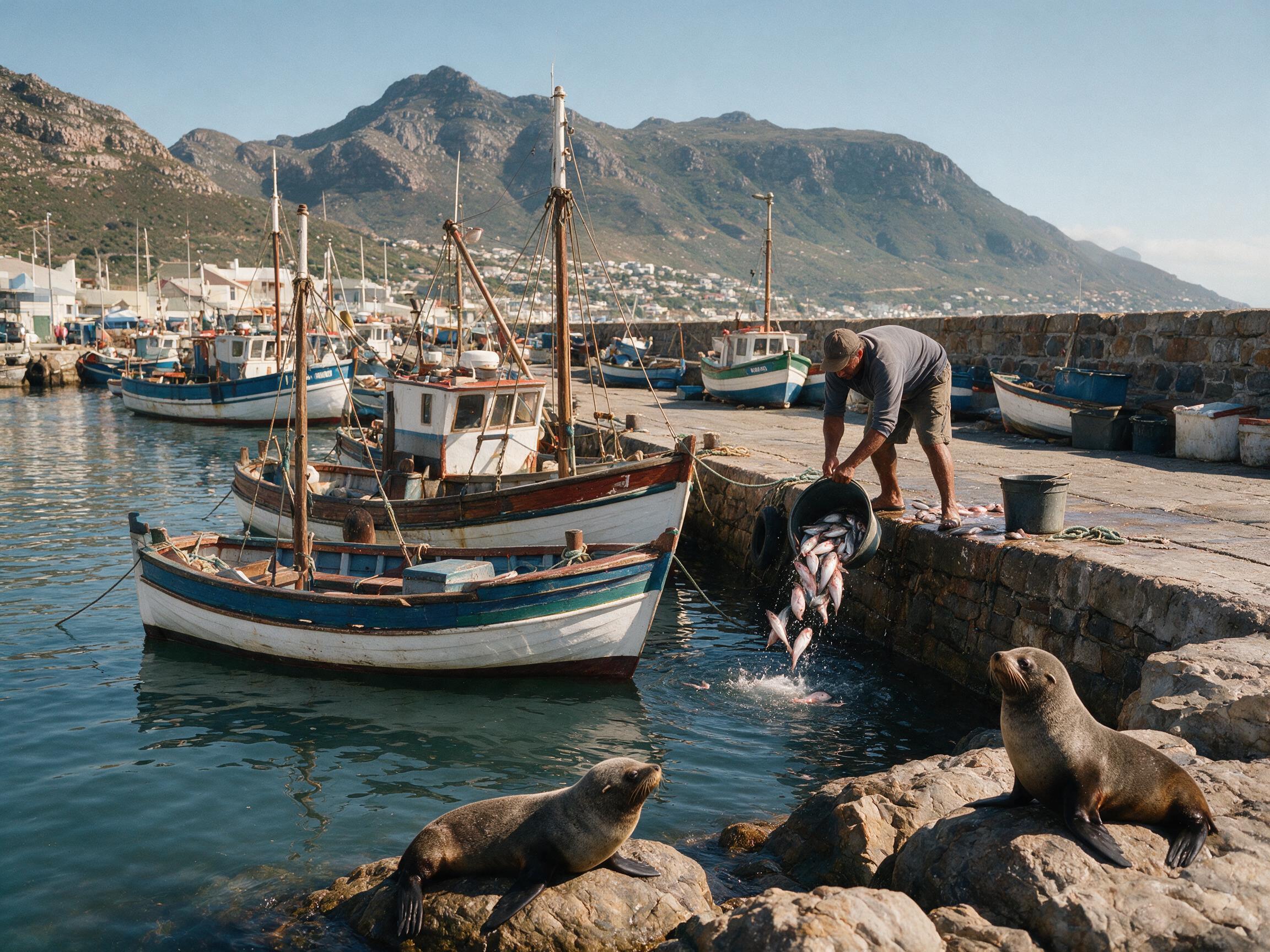
Kalk Bay is still a working fishing harbour — one of the last on this stretch of coast not converted into a yacht marina. Get there around midday and you’ll catch the boats coming in, buckets of fresh snoek and yellowtail hauled off the deck, Cape fur seals loitering nearby hoping for scraps, and fishmongers selling the catch right there on the quay. It’s noisy, a bit fishy, and one of the few stops on this itinerary that isn’t performing for tourists — it would look the same if you weren’t there.
Main Road, parallel to the harbour, is a strip of antique shops, vintage clothing stores and secondhand bookshops that rewards actual browsing. Kalk Bay Trading Post, inside the old post office building, is stacked with mid-century furniture and odd collectibles. Quagga Rare Books & Art and Kalk Bay Books are worth twenty minutes if you read. The Kalk Bay Co-op groups local designers and craftspeople under one roof if you want something made in South Africa rather than shipped in.
For a swim, Dalebrook Tidal Pool is the popular choice — a rock-walled pool refreshed by the tide, calmer than the open Atlantic. Woolley’s Pool, a short walk further, is usually quieter. This is the milder, False Bay side of the peninsula, but “warmer” here is relative — it’s still a bracing swim by Indian standards, closer to a cold plunge than a Goa beach. Go in anyway.
For lunch, Kalky’s — a no-frills counter on the harbour — does fish and chips wrapped in paper, eaten standing up with the boats behind you. Harbour House has the better sit-down view, right over the water with the day’s catch on the menu, and Live Bait next door leans into sushi and seafood pasta. Brass Bell, a little further along, has tables close enough to the rocks that waves occasionally spray the window — book ahead for one if the surf’s up.
Fun fact: Kalk Bay takes its name from the Dutch/Afrikaans word for lime — early settlers burned shells piled up on this shoreline to make lime mortar, a less romantic origin story than most people assume for a place this pretty.
Sunset: Signal Hill or Camps Bay
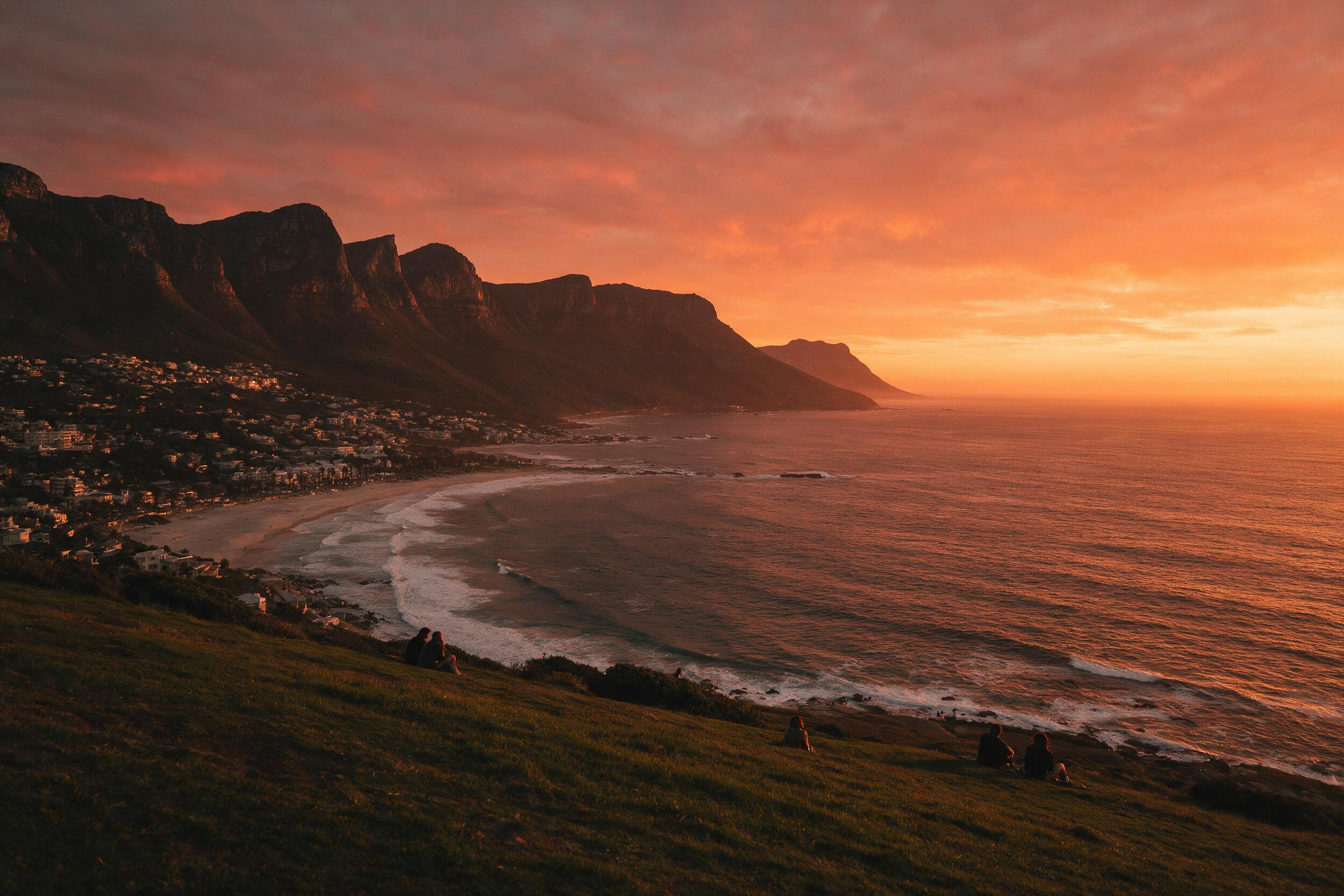
Back in the city by late afternoon, the last decision is where to watch it end, and it depends on the evening you want. Signal Hill gives you height and a wide, uncluttered 360-degree view — Table Mountain on one side, the Atlantic on the other, the city bowl turning gold and then pink below you. It’s a short drive up, parking fills fast in the final half hour, and there’s no food or drink beyond what you bring yourself — good for a quiet close, maybe a bottle of Cape wine smuggled up in a bag.
Camps Bay is the opposite mood — a beach promenade lined with restaurants and bars, the jagged Twelve Apostles range as a backdrop, palm trees making a South Atlantic beach look faintly tropical. It’s louder, dressier, better if you want the day to end in a proper sit-down dinner. Book a sea-facing terrace table and you get the same sunset with better service.
One thing that can wreck either plan: the “Cape Doctor,” the strong southeasterly wind that picks up especially in January and February, can turn a calm afternoon into a sand-in-your-eyes evening with almost no warning. Check the wind forecast that morning, not just the temperature — a warm day with 40 km/h gusts is a worse sunset than an overcast, still one.
Where This Day Fits Into a Real Cape Town Trip
One day like this works best inside a longer trip — five to seven days lets you add the Cape Winelands, a full Cape Point and penguin-colony day at Boulders Beach, and a proper Table Mountain cable car visit for the days your legs don’t want another hike. Here’s what to actually plan around.
Best Time to Visit Cape Town
Cape Town runs on a Mediterranean climate, which means the seasons are flipped from what “summer” and “winter” mean in India — December to February is the Cape Town summer, hot and dry with long daylight hours, and it’s also peak season, so flights and hotels cost more and popular spots get crowded. January especially draws big crowds and is prime Cape Doctor wind season. The shoulder months — March to April and September to October — are the sweet spot for a trip like this one: mild temperatures, thinner crowds, and September to October adds spring wildflowers and the start of whale-watching season along the coast near Hermanus. June to August is Cape Town’s rainy winter, cooler and wetter but also the best window for whale sightings and noticeably cheaper flights and stays, if grey skies don’t bother you.
Getting There: Flights from India
There’s no direct flight from any Indian city to Cape Town yet. South African Airways has announced plans to return to the Indian market through 2026, but its stated priority is the Mumbai–Johannesburg route, with Cape Town and Durban connections framed as a longer-term ambition — worth rechecking closer to your travel dates. For now, the realistic options from Mumbai or Delhi are one-stop routings: via Johannesburg, or via a Gulf hub — Dubai on Emirates, Doha on Qatar Airways, Abu Dhabi on Etihad — or via Addis Ababa on Ethiopian Airlines. Total journey time typically runs 13 to 17 hours including the layover. One-way economy fares have been showing up in the ₹30,000–45,000 range in fare searches, with round trips more typically ₹65,000–95,000 in economy during shoulder season; business class runs considerably higher and is worth it on a sector this long. Fares move constantly, so treat these as a planning range, not a quote.
Visa Requirements for Indian Passport Holders
This is the one section to double-check yourself before booking, since it changed recently and is still rolling out in phases. Indian passport holders cannot get a visa on arrival in South Africa — a common misconception that will get you turned back at check-in. Since October 2025, South Africa has rolled out a new Electronic Travel Authorisation (ETA) system, and Indian nationals were among the first four nationalities included, alongside China, Indonesia and Mexico, applying online through Cape Town International, OR Tambo (Johannesburg) and Lanseria airports. The ETA is applied for entirely online before departure — no embassy visit — allows multiple entries, and permits stays of up to 90 days with one further 90-day extension available. As of August 2026, the ETA fee is 500 South African Rand, roughly ₹2,900. A separate, older eVisa system exists too, but it’s had documented reliability issues, so the ETA is the recommended route. Apply well ahead of travel, and check the official Department of Home Affairs ETA portal directly before booking, since details have kept updating through 2026.
Where to Stay
For a day built around this itinerary, City Bowl or Tamboerskloof puts you closest to the Lion’s Head trailhead and the Bo-Kaap, with comfortable mid-range boutique guesthouses around ₹8,000–15,000 a night. The Atlantic Seaboard — Sea Point, Fresnaye, Camps Bay — trades a slightly longer drive for sea views, with properties from solid four-star up to genuine five-star addresses overlooking the water. Couples and honeymooners tend to prefer a Camps Bay or Clifton base for exactly that reason.
Costs, Safety and Money
South Africa runs on the Rand (ZAR), currently around ₹5.9–6 to the Rand. Cards and tap-to-pay are standard across restaurants, hotels and shops in tourist areas — but keep a few hundred Rand on you for harbour fish sellers, small Bo-Kaap vendors, and tips, which aren’t compulsory but are genuinely part of the culture: 10–15% at restaurants, R20–50 a day for housekeeping, R10–20 per bag for porters. There’s no UPI equivalent here.
On safety: Cape Town’s tourist corridor — City Bowl, V&A Waterfront, the Atlantic Seaboard from Sea Point to Camps Bay, and Constantia — is comfortable to walk with the same urban awareness you’d use in any big city. The common risk is opportunistic petty theft, not violent crime aimed at tourists — keep your phone pocketed rather than in hand, don’t leave anything visible in a parked car, and use Uber or Bolt rather than an unmarked taxi. Bo-Kaap is fine in daylight as a respectful visitor, not somewhere to wander alone late at night. Don’t visit the townships independently — that’s worth doing with a reputable guided operator.
FAQs: Cape Town for Indian Travellers
Do Indians need a visa for South Africa in 2026?
Yes — there is no visa on arrival for Indian passport holders. Since October 2025, most Indian travellers apply through South Africa’s new online Electronic Travel Authorisation (ETA) system before departure, which currently costs 500 Rand (about ₹2,900) and allows stays of up to 90 days with one possible extension. Apply well in advance and verify the current process on the official Department of Home Affairs portal, since the system is still being rolled out.
Are there direct flights from India to Cape Town?
Not currently. Travellers from Mumbai or Delhi connect through Johannesburg, or via Gulf hubs like Dubai, Doha and Abu Dhabi, or via Addis Ababa on Ethiopian Airlines. Total journey time usually runs 13–17 hours including the layover. South African Airways has talked about expanding India connectivity through 2026, so this is worth rechecking closer to your travel dates.
What is the best time of year to visit Cape Town?
March–April and September–October are the sweet spot — mild weather, thinner crowds, and (in spring) wildflowers and early whale-watching season. December–February is peak summer, hot and busy with higher prices; June–August is cooler and wetter but cheapest, and the best window for whale sightings.
Is the Lion’s Head hike difficult for a first-time visitor?
It’s rated moderate to difficult mainly because of a steep, technical final stretch with chains and metal ladders — but there’s a longer, gentler bypass route around that section for anyone who’d rather skip the scrambling. Reasonably fit adults manage the round trip in 1.5–2.5 hours. If you’re travelling with young kids or older parents, Signal Hill next door gives a similar view with a drive-up car park and no climbing at all.
Is Cape Town safe for Indian tourists?
Broadly, yes, within the tourist corridor — City Bowl, V&A Waterfront, Atlantic Seaboard, Constantia — with the same street-smart habits you’d use anywhere: don’t flash your phone, use Uber or Bolt instead of unmarked taxis, and don’t wander into unfamiliar neighbourhoods alone after dark. Petty theft, not violent crime, is the realistic risk for tourists sticking to normal visitor areas.
Can I swim at Kalk Bay, and is the water warm?
Yes — Dalebrook and Woolley’s tidal pools are protected, calm swimming spots refreshed by the tide. The water on this False Bay side is milder than Cape Town’s Atlantic beaches like Camps Bay, but it’s still noticeably cold by Indian beach standards — think brisk plunge, not a warm sea.
Do I need cash, or is card accepted everywhere in Cape Town?
Card and tap-to-pay cover almost everything in restaurants, hotels and shops in the main tourist areas. Carry some Rand cash for harbour fish stalls, small Bo-Kaap vendors, and tips, since not every informal seller has a card machine. There’s no UPI equivalent in South Africa.
How many days should I plan for Cape Town?
Five to seven days lets you do a day like this one, plus a full Cape Point and Boulders Beach penguin day, a Winelands day around Stellenbosch or Franschhoek, a proper Table Mountain cable car visit, and at least one unplanned day, which Cape Town tends to reward.
Last Thought
What makes this day work isn’t any single stop — Cape Town has a dozen viewpoints as good as Lion’s Head and a dozen neighbourhoods as photogenic as the Bo-Kaap. It’s the order. Climbing before the city wakes up, eating where the food actually comes from, getting briefly cold in a tidal pool, then closing the day out somewhere that’s earned the view. Do it in the wrong order — cable car up midday, generic mall lunch, a rushed sunset stop between two other bookings — and you’ll still have seen Cape Town’s greatest hits. You just won’t remember the texture of any single hour, and that texture is the whole point of going somewhere instead of just visiting it.
Plan This Day With Get Tripped
We build South Africa itineraries around exactly this kind of day — the sunrise hikes and harbour lunches that don’t show up on a generic ten-city tour, paired with the flight routing, visa paperwork and vetted stays that make the practical side effortless. If Cape Town’s been sitting on your list, get in touch with our travel designers and we’ll put together a South Africa trip built around real days like this one, not a checklist.