
The queue outside Sagrada Família at 8:45 AM is already forty people deep, but it’s moving, and by the time the doors open at 9 the light hasn’t hit the stained glass yet — that comes later, closer to noon, when the west windows turn the whole nave gold and blue at once and a dozen people stop mid-sentence without meaning to. That’s the trick to doing Gaudí’s Barcelona properly: it’s not really about ticking off five buildings, it’s about being in the right one at the right hour. Pair that with a slow tapas crawl through El Born once the museums close, and you’ve got a single day that explains more about this city than a week of hopping between the beach and Las Ramblas ever would.
Table of Contents
- Morning: Sagrada Família Before the Coaches Arrive
- Midday: Casa Batlló and Casa Milà on Passeig de Gràcia
- Late Afternoon: Park Güell, Timed Right
- Evening: A Tapas Crawl Through El Born
- If You Have a Second Day: Casa Vicens
- Where to Base Yourself
- A Photography Note
- Booking, Tickets, and What This Day Actually Costs
- Getting to Barcelona from India
- A Few Things Worth Knowing First
- FAQs
Morning: Sagrada Família Before the Coaches Arrive
Book the earliest entry slot you can get — most days that’s 9 AM — and skip the audioguide rental line by pre-loading it on your phone the night before. Gaudí worked on this basilica for 43 years and never saw it finished; it’s still not finished now, and that unfinished quality is part of what makes it strange rather than just impressive. The interior is the reason to come early: those tree-like columns branch upward into a canopy that genuinely looks organic rather than engineered, and the stained glass does something no photograph quite captures — cool blues and greens on the Nativity side in the morning, warm reds and golds on the Passion side as the sun swings around later. Standard entry runs €26–€40 depending on whether you add tower access; the towers are worth it if you don’t mind a narrow spiral staircase down, but skip them if you’re short on time, since the nave itself is the main event. Budget 90 minutes minimum, longer if you’re someone who reads every plaque.
Midday: Casa Batlló and Casa Milà on Passeig de Gràcia
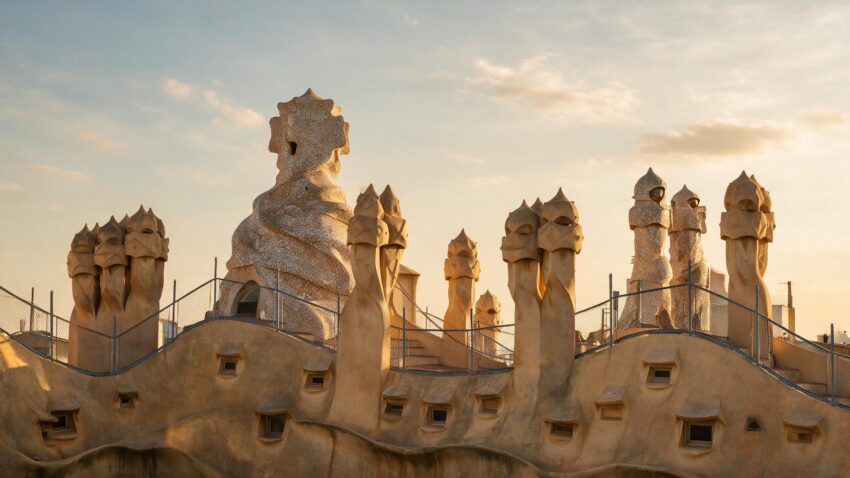
Walk or take the metro to Passeig de Gràcia, where Casa Batlló and Casa Milà (also called La Pedrera) sit a five-minute walk apart on the same street — an odd, wonderful coincidence of two Gaudí houses commissioned by two different families who apparently didn’t love each other’s taste. Casa Batlló’s facade, all bone-like balconies and a scaled roofline meant to evoke Saint George’s dragon, photographs better from across the street than up close, so cross over before you go in. Casa Milà’s rooftop is the real draw — the chimneys look like armored soldiers, or a Star Wars fan convention, depending on who you ask, and it’s one of the few Gaudí rooftops you can actually walk right up to. Entry to each runs from around €25. If you only have time for one, make it Casa Milà; the rooftop earns its reputation, and the crowds are marginally more manageable than Batlló’s. Grab lunch here rather than near Sagrada Família — the tourist-menu prices near the basilica are a giveaway that you’re paying for proximity, not quality.
Late Afternoon: Park Güell, Timed Right
Book a Park Güell slot for 4 to 5 PM, not midday. This is a genuine insider move, not a cliché tip — the park sits on a hill on the north edge of the city, and the light in late afternoon turns the mosaic terrace (the one everyone’s seen in photos, with the wavy bench and the tiled lizard fountain at the entrance) into something closer to what Gaudí actually intended: warm, uneven, alive. At midday it’s flat and overexposed, and you’ll be sharing the bench with fifty other people trying to get the same shot. Entry to the monumental zone is around €18 and needs to be booked online in advance — walk-ups are routinely turned away in peak season. Give yourself an hour, and if your legs are willing, walk back down through Gràcia rather than taking the metro straight back; it’s one of Barcelona’s most lived-in neighborhoods and a good decompression after three straight Gaudí sites.
Evening: A Tapas Crawl Through El Born
El Born is where this day earns its “experience” label instead of just being a checklist with better production values. Start at El Xampanyet, one of the oldest and most unapologetically local tapas bars in the city — standing room at a marble counter, cava served in small glasses, anchovies that taste nothing like the tinned version you’re used to. From there, walk to Cal Pep, where there’s no menu and no reservations at the counter; you sit, the staff decides what you’re eating based on what’s good that day, and you argue with nobody about it. If you want something quieter, Can Cisa, tucked into a side street, does a tomato salad that’s talked about more than a tomato salad has any right to be, and it’s a good spot for a slower final course if the rest of the crawl has been fast and loud. For a nightcap, PetNat’s natural wine list is worth the detour if you’re someone who cares about what’s in the glass, not just what’s on the plate. None of this requires a booking except Cal Pep on weekends, and even then, arriving right at opening solves it.
A caveat, because not everything about El Born is a secret anymore: some of these spots, especially El Xampanyet, get a tourist crowd by 8 PM. Go at 6:30 or 7 if you want the counter to yourself for a few minutes before it fills in.
If You Have a Second Day: Casa Vicens
Most people doing “the Gaudí day” never make it to Casa Vicens, and that’s exactly why it’s worth flagging. It was Gaudí’s first major commission, finished in 1885, tiled in green and white ceramic with a Moorish influence you don’t see in his later, more famous work — and because it only reopened to the public in 2017, it hasn’t built up the queue culture the other four sites have. It sits in Gràcia, a fifteen-minute walk from Park Güell, which makes it an easy add if you’re doing this as a two-day trip rather than cramming everything into one. Tickets need booking online, but same-week availability is far more realistic than it is for Sagrada Família.
Where to Base Yourself
Eixample, the grid neighborhood surrounding Passeig de Gràcia, is the obvious choice for this itinerary — it puts you within walking distance of Casa Batlló and Casa Milà and a short metro ride from both Sagrada Família and El Born. Mid-range boutique hotels here run €150–€220 a night; if you want to push into genuine luxury, a handful of properties along Passeig de Gràcia itself put you close enough to walk to two of the four sites before breakfast. Avoid basing yourself right next to Sagrada Família purely for convenience — the immediate area is touristy in the way that inflates restaurant prices without improving the food, and you lose the atmosphere El Born and Gràcia actually offer in the evening.
A Photography Note
Casa Milà’s rooftop is the one shot everyone comes for, and it’s genuinely worth the effort — but the better, less-photographed angle is from the street below, looking up at the undulating stone facade in the last hour of daylight, when the building’s wave-like curves catch shadow instead of flat midday sun. For Park Güell, skip the crowded main terrace shot and walk the upper paths instead, where the covered walkways with their slanted stone columns photograph just as well with a fraction of the people in frame.
Booking, Tickets, and What This Day Actually Costs
Combined entry to Sagrada Família, Casa Milà, and Park Güell runs roughly €70–€85 per person if booked directly rather than through a bundled tour, and booking each 2–3 weeks ahead is the difference between getting your preferred time slots and settling for whatever’s left. Add another €50–€70 per person for a proper tapas crawl dinner with wine across three or four stops — more if you’re doing full plates rather than sharing small ones, which is really how tapas is meant to be eaten anyway. All told, budget €150–€200 per person for the day excluding hotel and transport, which is reasonable for what amounts to five hours of world-class architecture and a genuinely good dinner.
Getting to Barcelona from India
There’s no direct flight from India to Barcelona yet, so you’re looking at one stop — commonly via Istanbul, Doha, Dubai, or a major European hub — with total journey time typically running 12 to 16 hours depending on the connection. Indian passport holders need a Schengen visa to enter Spain; we’ve covered the current fees and process in detail in our Schengen visa guide, which is worth reading before you book anything, since processing can take a few weeks in peak season. Once you’re in the city, Barcelona’s metro is efficient and the T-Casual ticket (10 rides, shareable) is the easiest way to move between Sagrada Família, Passeig de Gràcia, and Park Güell without overpaying for taxis.
A Few Things Worth Knowing First
Wear shoes you don’t mind standing in for hours — this day involves more standing (in queues, at tapas counters) than walking, which surprises people who expect the opposite. Pickpocketing around Sagrada Família and on the metro is real and well-documented, not a scare story; keep bags zipped and in front of you, especially in the ticket queue. And if you’re traveling with kids, know that Park Güell’s uneven cobbled paths and the standing-room tapas format make this itinerary better suited to couples or small groups without strollers — a family version of this day would swap the tapas crawl for a sit-down dinner and add a break at the beach after Park Güell.
FAQs
How many days do you really need for Gaudí’s main sites?
You can do the four covered here — Sagrada Família, Casa Batlló, Casa Milà, Park Güell — in one full day if you book time slots in advance. Add Casa Vicens and a slower pace and it becomes a comfortable two days.
Do I need to book Sagrada Família tickets in advance?
Yes, always. Walk-up tickets are unreliable even in shoulder season, and peak-season same-day slots regularly sell out by mid-morning.
Is El Born safe to walk around at night?
Yes, it’s a well-trafficked, well-lit neighborhood popular with both locals and visitors in the evening — the usual city-center pickpocket caution applies, but it’s not an area with any particular safety concern after dark.
What’s the best month to do this Barcelona day?
April–June or September–October — warm enough to enjoy Park Güell’s outdoor terraces without the July–August heat and cruise-ship crowds that hit the city hardest.
Can I do this itinerary without pre-booking anything?
Not really, not in peak season. Park Güell and Sagrada Família both use timed entry systems that sell out days or weeks ahead, and Cal Pep on weekends fills up fast without a reservation.
Is this a good itinerary for a honeymoon?
Very much so — the pacing (architecture by day, a slow tapas crawl by night) suits couples well, and El Born’s narrow lanes and wine bars make for one of the more romantic evenings you’ll have in the city.
The Takeaway
Most first-time Barcelona visitors try to see everything and end up rushing all of it. This day works because it doesn’t — four buildings, one neighborhood, timed right, with nothing crammed in just to say you did it. It’s a better introduction to the city than a longer, busier itinerary would give you.
Get Tripped can build this into a longer Barcelona and Spain itinerary, with skip-the-line tickets booked ahead and a reserved table where reservations actually matter. Get in touch and we’ll put the full trip together.