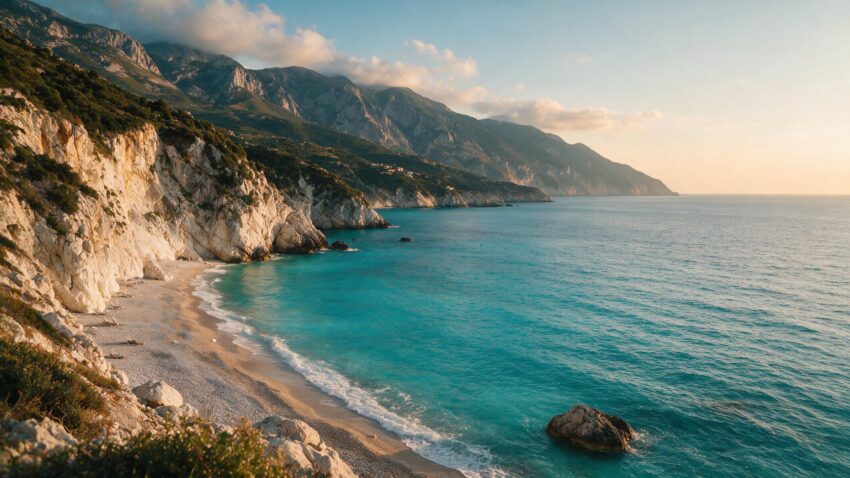
Every third traveler who’s done Croatia in the last five years will tell you the same thing: Dubrovnik’s old town is beautiful and also completely unbearable by 11 AM, wall-to-wall with cruise-ship day-trippers moving in one direction like a slow tide. Ninety minutes south by road, across a border most Indian travelers have never thought to cross, Albania’s Ionian coast has the same turquoise water, the same limestone cliffs, and roughly none of that crowd — not because it’s less beautiful, but because almost nobody’s told you it’s there yet.
Table of Contents
- Why Albania, Why Now
- Himarë and Dhërmi: The Riviera Without the Crowds
- Berat: The City of a Thousand Windows
- Gjirokastër: Stone Streets, Almost No Tourists
- What to Skip (and What Actually Isn’t a Cliché Here)
- A Fun Fact That Explains a Lot of the Landscape
- Visa, Flights, and Getting Around
- Best Time to Go
- What It Costs
- A Few Things Worth Knowing
- FAQs
Why Albania, Why Now
Albania spent most of the last century sealed off under one of Europe’s most isolated communist regimes, which is a strange thing to credit for good tourism, but it’s part of the reason so much of the coastline and the hill towns never got developed the way Croatia’s or Greece’s did. What’s left is genuinely undercrowded — not “undercrowded” in the marketing-copy sense, but actually quiet, with village restaurants that still run on a handwritten menu and beach towns where the loudest thing at sunset is a card game at the next table over. September, when the sea’s still warm and the July crowd has gone home, is when this becomes obvious in a way that’s hard to overstate if you haven’t experienced Mediterranean Europe both packed and empty.
Himarë and Dhërmi: The Riviera Without the Crowds
Skip Sarandë and Ksamil if you can — they’re lovely, but they’re also the two towns that have started showing up in every “hidden gem” article about Albania over the last two years, which means they’re not really hidden anymore. Himarë, a little further up the coast, keeps a quieter seafront promenade and a genuinely laid-back pace; the pebble beaches nearby are the kind you reach on foot from a family-run taverna rather than through a resort lobby, and the seafood is caught by people you can actually watch untangle the nets that morning. Dhërmi, just north, is where a handful of stylish boutique beach bars have started appearing without yet tipping the town into overdevelopment — book a sunset table on the terrace above the water and you’ll understand why people who’ve found this stretch of coast tend not to shout about it. Both towns sit in the mountains-meet-sea part of the Albanian Riviera, which means a short hike inland gets you views over the coastline that no beach chair can match.
Berat: The City of a Thousand Windows
Berat is a UNESCO World Heritage town built up a hillside in tiers, its white Ottoman houses stacked so densely and so uniformly that the nickname — the City of a Thousand Windows — undersells it slightly. Walk up through the old quarter in the late afternoon and the castle at the top, still partially inhabited within its walls, gives you a view down over the river and the terracotta rooftops that’s one of the best free vantage points in the Balkans. It’s roughly 3–4 hours by car from the Riviera coast, which makes it a natural stop on the way back toward Tirana rather than a separate trip. Go for the golden hour, not midday — the white facades reflect brutal glare at noon and turn genuinely warm-toned an hour before sunset.
Gjirokastër: Stone Streets, Almost No Tourists
If Berat is Albania’s best-known hidden gem, Gjirokastër is the one even seasoned Balkan travelers sometimes miss. Another UNESCO town, built almost entirely from silver-grey stone — roofs included — with a hilltop fortress that dominates the skyline and houses a small but genuinely interesting museum inside. What sets it apart from Berat isn’t the architecture so much as the near-total absence of the tour-group circuit; you can walk the old bazaar quarter and hear more Albanian than English, which after a few days on the more social-media-friendly Riviera towns feels like a reset. It’s a worthwhile stop if you’re doing a loop that includes Berat and the Riviera rather than a standalone destination — treat it as the “wonderfully authentic and far less commercial” counterpoint to Berat’s slightly more polished tourist infrastructure.
What to Skip (and What Actually Isn’t a Cliché Here)
Skip the day-trip formula of “see Tirana, see Sarandë, go home” — Tirana is a fine capital with decent nightlife, but it’s not why you’re coming to Albania, and giving it more than a night steals time from the coast and the hill towns that are the actual draw. Skip Ksamil’s most photographed beach coves in August; they’re now genuinely crowded, which defeats the point of coming here instead of Croatia. What isn’t a cliché, even though it sounds like one: Albania’s mountain interior, particularly the Llogara Pass road between Vlorë and the Riviera coast, is one of the more dramatic drives in Europe, switchbacking through pine forest before dropping you suddenly at sea level with the Ionian spread out below. Most first-time visitors treat it as a transit route. It deserves a stop at the top.
A Fun Fact That Explains a Lot of the Landscape
Albania’s communist-era leader built an estimated 173,000 concrete bunkers across the country between the 1960s and 1980s — roughly one for every 15 or so citizens at the time — anticipating an invasion that never came. Most are still there, scattered across hillsides, beaches, and farmland, some now repainted by locals into flower planters or impromptu cafés. You’ll spot them constantly on the coast road between Himarë and Dhërmi, and once someone points the first one out, you can’t stop noticing them for the rest of the trip.
Visa, Flights, and Getting Around
Indian passport holders need a visa for Albania, but it’s one of the more painless ones in Europe: the standard short-stay e-visa costs around €15 (roughly ₹1,350), applied for entirely online at Albania’s official e-visa portal, with standard processing taking up to 15 working days (complex applications up to 30, so don’t leave this to the last minute). You’ll need a passport valid at least three months beyond your trip, travel insurance covering at least €30,000, proof of accommodation, and a return flight booking. If you already hold a valid, previously-used Schengen, US, or UK visa, you can skip the e-visa entirely and enter visa-free for up to 90 days in a 180-day period — worth checking before you pay for a visa you don’t need.
There’s no direct flight from India to Tirana, so expect one stop — commonly via Istanbul on Turkish Airlines, or via Abu Dhabi or Doha on Etihad or Qatar Airways. Fares vary widely depending on how far ahead you book and which connection you take; budget carriers like Wizz Air and Ryanair also serve Tirana from various European hubs if you’re building a longer multi-country trip. Once you’re on the ground, renting a car is genuinely the best way to see the Riviera and the hill towns — public transport exists but runs on a loose, locally-understood schedule that doesn’t reward a tight itinerary. Roads through the mountains are well-maintained but narrow and switchback-heavy, so this is not the drive to hand to someone who’s nervous on unfamiliar roads.
Best Time to Go
September is close to the sweet spot: the sea stays warm at 21–24°C well into the month, the crowds that fill Ksamil and Sarandë in July and August have thinned out, and daytime temperatures settle into the high teens to high twenties rather than the 35°C-plus swelter of peak summer. Late spring — May into early June — is the other good window, with air temperatures in the comfortable high teens to high twenties and a similar lack of crowds, though sea temperatures haven’t fully warmed yet if swimming is the priority. Avoid July and August unless you specifically want the Riviera’s liveliest, busiest version of itself — that’s when Ksamil and Sarandë get the crowds this trip is designed to avoid.
What It Costs
This is one of Albania’s genuine advantages over its more famous Adriatic neighbors: a comfortable, well-appointed trip here costs meaningfully less than the equivalent in Croatia or Greece, without any real drop in quality. A well-chosen boutique hotel or a private villa with a sea view on the Riviera runs €80–€150 a night in the shoulder season; a proper seafood dinner for two with wine typically comes to €40–€60. For a 7-day trip covering the coast and the two hill towns, with a rental car, mid-range to upscale accommodation, and no corner-cutting on meals, plan on roughly €1,300–€1,900 per person excluding international flights. Card acceptance is improving but still patchy outside Tirana and the main Riviera towns, so carry euros — Albania uses the lek domestically, but euros are widely accepted in tourist areas, particularly along the coast.
A Few Things Worth Knowing
A genuinely common Albanian gesture trips up almost every first-time visitor: a head nod that looks like “yes” to most of the world often means “no” here, and vice versa — when in doubt, listen to the actual word rather than trusting the head movement. Fuel stations thin out fast once you’re off the coastal road and into the mountains, so top up before a Llogara Pass or Gjirokastër drive rather than assuming you’ll find a station along the way. And while the Riviera’s restaurant scene has genuinely leveled up in the last few years, don’t expect the polish of a five-star resort kitchen everywhere — the best meals here tend to come from small, family-run places with a short menu and no English translation, not the venues that look most Instagram-ready from the road.
FAQs
Is Albania safe for Indian travelers?
Yes — Albania is a generally safe, welcoming destination for foreign visitors, including solo and family travelers. Standard city-travel precautions apply, but there’s no particular safety concern specific to the Riviera or the hill towns covered here.
Do I need a visa to visit Albania from India?
Yes, unless you already hold a valid, used Schengen, US, or UK visa, in which case you can enter visa-free for up to 90 days. Otherwise, the e-visa costs around €15 and is applied for entirely online.
How is Albania different from Croatia if the coastline looks similar?
The geography and water color are genuinely comparable, but Albania’s tourism infrastructure is far less developed, which means lower prices, fewer crowds, and a coastline that still feels lived-in rather than built specifically for visitors — at the cost of slightly less polish in some hotels and restaurants.
What’s the best base for exploring the Albanian Riviera?
Himarë or Dhërmi both work well as a quieter base than Sarandë, with easy access to the coast road and day trips to Ksamil, Vlorë, and the Llogara Pass.
Can I visit Berat and Gjirokastër on a coastal trip, or do they need a separate itinerary?
Both work well folded into a Riviera-based trip — Berat is roughly 3–4 hours from the coast, and both towns can be combined into a loop back toward Tirana at the end of your trip rather than treated as separate destinations.
Is renting a car necessary in Albania?
Strongly recommended if you want to cover the Riviera and the hill towns in one trip. Public transport exists but doesn’t run on a schedule that suits a tight itinerary, and a car gives you the flexibility to stop at viewpoints like the Llogara Pass.
The Takeaway
Albania isn’t hidden because it’s hard to get to or hard to enjoy — it’s hidden because most Indian travelers simply haven’t been told it’s an option yet, while everyone else books the same Croatia and Greece itineraries their friends already did. That’s exactly the window worth traveling into before it closes.
Get Tripped can build a private Albania itinerary — Riviera, Berat, and Gjirokastër included, with a driver if you’d rather not handle the mountain roads yourself. Reach out and we’ll put together a route around your dates.