
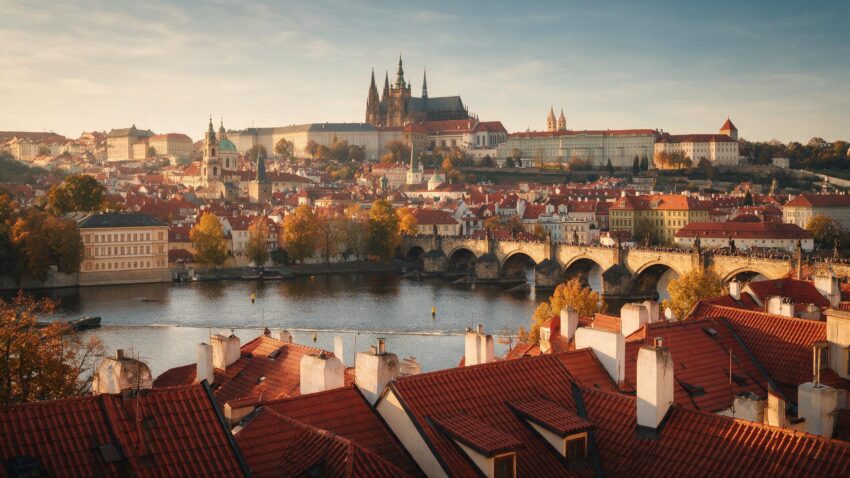
Somewhere around 8am on Náplavka, the Vltava River embankment south of the Dancing House, a woman was setting out wheels of goat cheese on a folding table while a man three stalls down ground coffee beans that smelled like they’d win an argument with any café back home. Nobody around me was holding a selfie stick. Nobody was queuing for anything. This was the Saturday farmers’ market Prague residents actually shop at, and it’s a fifteen-minute walk from Old Town Square — a square that, by 10am the same morning, would be shoulder-to-shoulder with tour groups following raised umbrellas.
That contrast is basically the whole argument for spending a day in Prague the way this post lays out: start where the locals start, let the famous stuff happen in the middle of the day when you’re passing through anyway, and end somewhere with beer, trees, and no tour bus parking.
Table of Contents
- Getting to Prague from India
- Visa and When to Go
- Morning: Náplavka Market and Vinohrady
- Midday: Old Town, Done Right
- Afternoon: The Castle Side, Without the Crowds
- Evening: A Žižkov Beer Garden
- Money and Getting Around
- Internet, SIM, and Smart Spending
- Two Mistakes to Avoid
- Who This Day Suits
- FAQs
Getting to Prague from India
There’s no non-stop flight from India to Prague yet, so budget for one connection. The fastest routing currently runs through Baku on Azerbaijan Airlines at around 10 hours 20 minutes total, with Lufthansa via Munich, SWISS via Zurich, and Turkish Airlines via Istanbul all close behind at 10.5-11.5 hours. Emirates via Dubai and Air India via Vienna are slower but often price competitively if your dates are flexible. Prague pairs naturally with a Vienna or Munich add-on if you’re already routing through one of those hubs — worth asking about when you book, since a two-night stopover barely adds to the fare on some itineraries.
Visa and When to Go
Czechia is a Schengen country, so the visa rules mirror what we’ve covered for the rest of the zone: Indian passport holders need a Schengen visa before travel, currently €90 for adults (about ₹8,300) plus a mandatory VFS Global service charge, with standard processing around 15 calendar days — though it stretches to 30 in peak May-August travel season, so don’t leave this to the last month. One Schengen visa covers a Prague-Vienna-Budapest loop if that’s the trip you’re building.
Early autumn is the window we’d point you toward — September and October give you crisp air, the beer gardens still fully open, and none of the January sleet that makes Old Town Square genuinely miserable to stand in. Spring (April-May) works too, with cherry blossoms in Petřín park adding a specific reason to time it that way.
Morning: Náplavka Market and Vinohrady
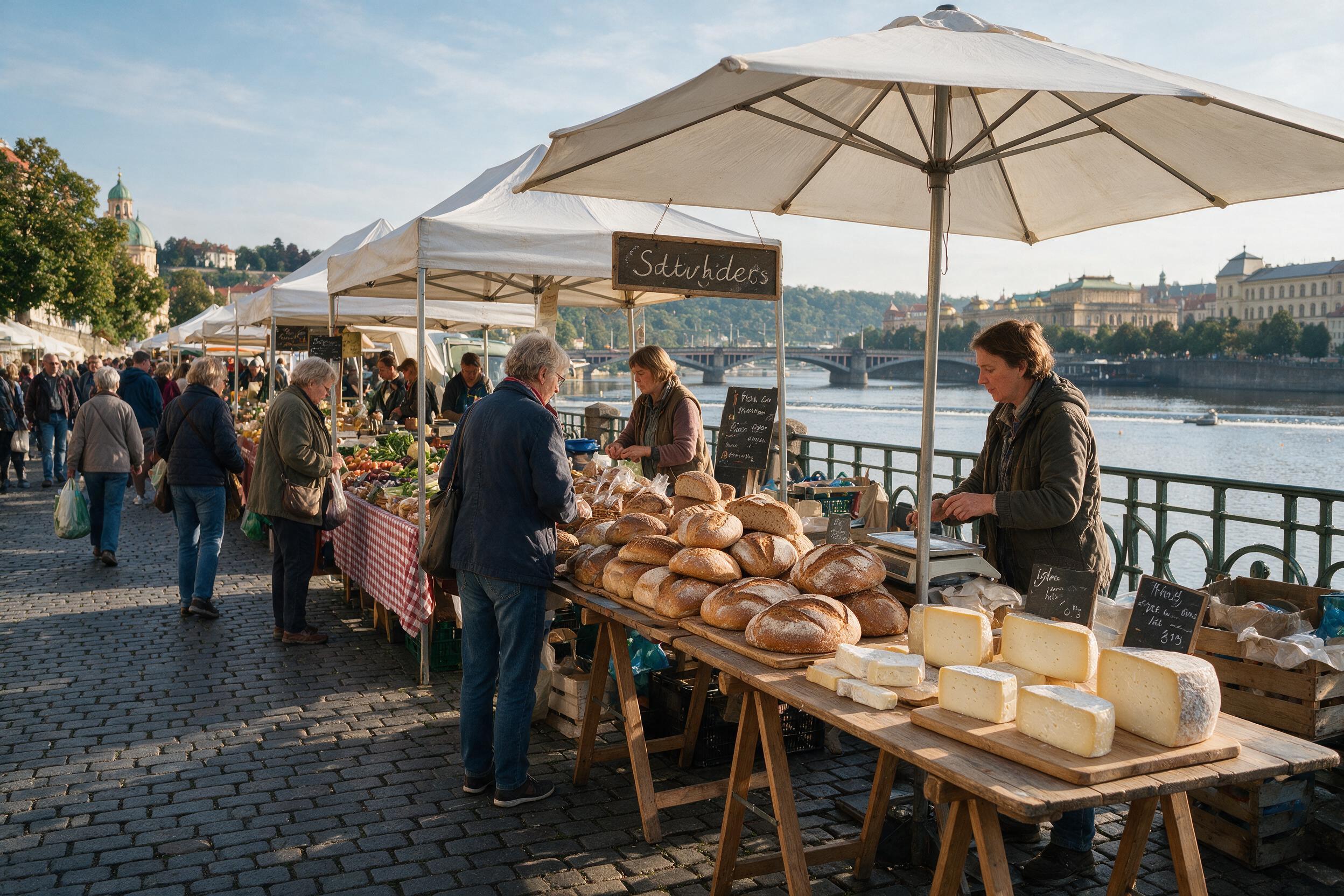
Start at Náplavka on a Saturday if your dates allow it — the farmers’ market runs weekly along the riverbank and it’s the single best place in the city to eat breakfast the way Prague actually eats breakfast: fresh bread, real cheese, coffee that hasn’t been sitting in an urn since 7am. From there, walk or take a short tram ride up into Vinohrady, the residential district east of the New Town that most three-day Prague itineraries skip entirely because it doesn’t have a single “sight” on it.
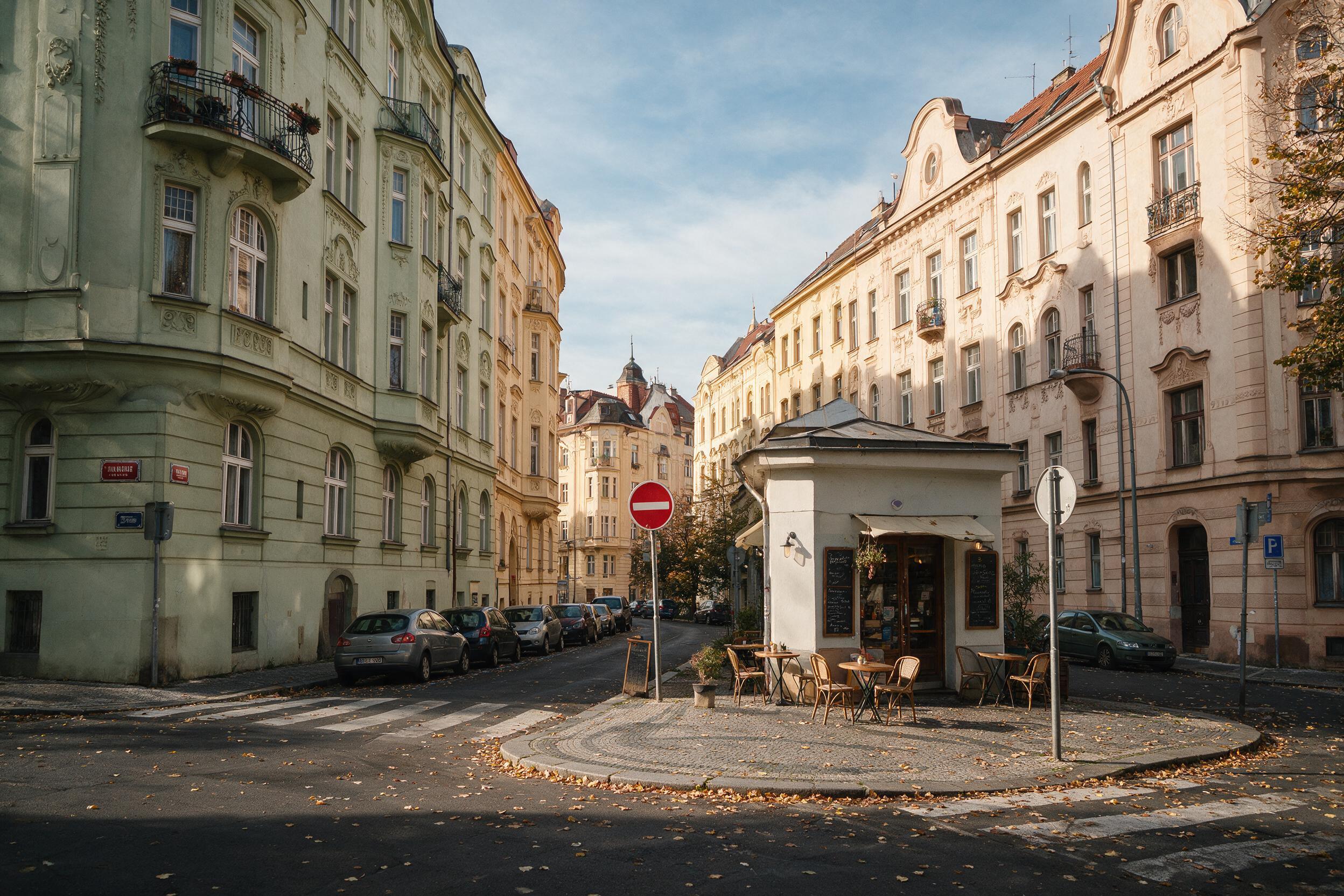
Vinohrady: no fixed sights, which is exactly why it’s worth the detour.
That’s the point. Vinohrady is where a lot of Prague’s better independent coffee roasters and small bakeries actually operate, spread around a grid of Art Nouveau apartment buildings with almost no tourist foot traffic. It’s not a hidden-gem cliché to say this neighborhood feels like the city’s actual daily life rather than its stage set — it just happens to also be true here. Give it 60-90 minutes with no fixed agenda.
Midday: Old Town, Done Right
You should see Old Town Square — the astronomical clock, the Týn Church spires, the whole postcard — and midday, when you’re moving through rather than settling in for a meal, is the right time for it. Where the day goes wrong for a lot of visitors is sitting down to eat there. Restaurants directly on the square run close to double what the same dish costs two streets over: a large beer for €7-9 on the square versus €2-3 a five-minute walk away, goulash at €18-24 versus €7-10. Walk toward Karlova or Dlouhá street instead and the quality, if anything, improves along with the price.
Beyond the pasta-and-pastry basics, this is also the neighborhood to try svíčková — slow-braised beef in a cream-and-root-vegetable sauce, served with bread dumplings, which is closer to Czech comfort food’s actual center of gravity than anything you’ll find marketed as a “traditional lunch” near the tourist sights. A handful of the small pubs off Dlouhá street do a version worth building a meal around. Skip the trdelník stands, honestly — it’s the one thing on this list we’d actively steer you away from. The sweet rolled pastry sold everywhere near Old Town Square as “traditional Czech” actually originated in Transylvania, gets marked up to €6-8 as a tourist souvenir, and isn’t even something locals eat. If you want the real Czech pastry equivalent, look for koláče — small filled buns, usually poppyseed or plum, sold at neighborhood bakeries for closer to €1.50.
Afternoon: The Castle Side, Without the Crowds
Cross the Charles Bridge — yes, it’s crowded, there’s no version of this day that avoids that particular fact, but going mid-afternoon rather than sunset thins it out somewhat — into Malá Strana, the Lesser Town below Prague Castle. The castle complex itself is worth the visit, but the better hour there is actually late afternoon, after most guided tour groups have moved on to their dinner reservations. Walk up through the quieter Petřín park side rather than the main tourist route from the bridge, and you’ll get most of the same views with a fraction of the foot traffic.
If you have twenty minutes to spare on the way down, the Lennon Wall near the French Embassy is worth a quick detour — a graffiti wall that’s been continuously repainted with protest art and messages since the 1980s, still active today, and genuinely different every time you visit rather than the static Instagram backdrop it sometimes gets treated as.
Evening: A Žižkov Beer Garden
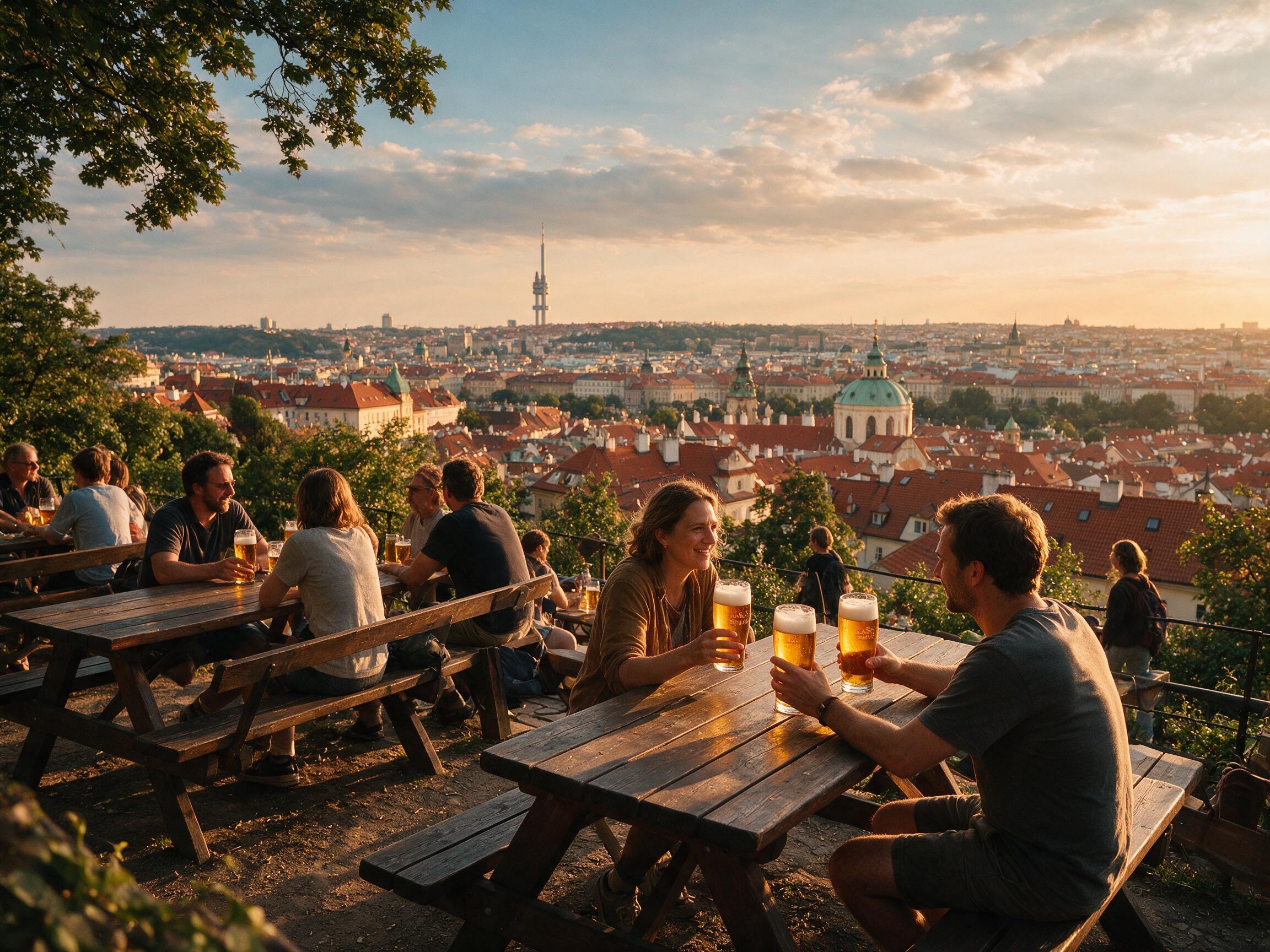
End the day in Žižkov, the working-class district that locals half-joke has more pubs per capita than any neighborhood in Europe. Riegrovy Sady, a hillside park with a beer garden that opens as soon as the weather cooperates, gives you a sunset view over the city’s red rooftops and the TV Tower (the strange black spire with giant crawling baby sculptures climbing it — you’ll know it when you see it) without a single tour group in sight. A half-liter of Czech pilsner here runs a fraction of what the same beer costs on Old Town Square, and the crowd is almost entirely local.
This is also, for what it’s worth, the best photography window of the day — the low evening light over the rooftops from Riegrovy Sady’s hillside beats anything you’ll get from the more famous viewpoints at Prague Castle, mostly because you’ll actually have room to set up a shot.
Money and Getting Around
Czechia uses the koruna (CZK), not the euro, despite being in the EU — a detail that trips up a fair number of first-time visitors who assume otherwise. Cards are widely accepted in cafés and restaurants, but carry some cash for market stalls and smaller pubs. One genuine trap: avoid the bright yellow-and-orange Euronet ATMs clustered near tourist sites — their combination of transaction fees and poor exchange rates can cost you €15-30 on a single withdrawal. Use a Czech bank’s ATM (Česká spořitelna, ČSOB, Komerční banka) instead, or bring a card like Revolut that doesn’t mark up the exchange rate. The city’s trams and metro are cheap, frequent, and genuinely the fastest way between these neighborhoods — a 24-hour transit pass costs a few hundred koruna and pays for itself after three rides.
Internet, SIM, and Smart Spending
An eSIM (Airalo, Holafly, and a few Czech-specific providers all cover Prague well) is the easiest option — you can activate it before you land and skip hunting for a SIM counter at Václav Havel Airport after a long connecting flight. Free WiFi is genuinely reliable in most cafés and all hotels, so a local SIM is more about convenience than necessity.
On smart spending: the biggest single lever isn’t which restaurant you pick, it’s which street it’s on, as the Old Town Square pricing gap above shows. The same logic applies to guided tours — a private two-hour walking guide through Vinohrady or Žižkov, booked through a local operator rather than a big-name platform, often costs less than a “skip the line” group tour of the castle and gives you a far more specific, personal version of the city. If you’re going to spend on one splurge in Prague, make it a river-view dinner in Malá Strana rather than another souvenir stop near the astronomical clock.
Two Mistakes to Avoid
First: don’t exchange money at the currency booths scattered through Old Town advertising “0% commission” — the rate itself is often 15-20% worse than the market rate, which is a worse deal than a bank charging a small visible fee. Check the actual EUR/CZK or INR/CZK rate on your phone before handing over cash. Second: don’t book a hotel directly on or overlooking Old Town Square expecting a quiet night — the square doesn’t fully settle down until well past midnight in peak season, and rooms one or two streets back cost less and sleep considerably better.
Who This Day Suits
For couples, the Riegrovy Sady sunset into a Žižkov dinner is about as good a low-key romantic evening as this city offers, and it costs a fraction of a set-menu restaurant near the castle. For solo travelers, Vinohrady’s café culture is easy and unintimidating to explore alone — nobody looks twice at a single person reading with a coffee for two hours here. For families, the castle complex and the astronomical clock’s hourly show both hold kids’ attention, though we’d suggest doing the market and Vinohrady walk earlier in the trip when energy levels are higher, saving the more passive castle-and-viewpoint afternoon for when everyone’s ready to slow down.
A Fun Fact
Prague Castle is listed by Guinness World Records as the largest ancient castle complex in the world, at roughly 70,000 square meters — closer in scale to a walled town than a single building, which is part of why “seeing the castle” can eat an entire afternoon without you noticing.
FAQs
Is there a direct flight from India to Prague?
No, not currently. The fastest connecting options run around 10-11.5 hours total via Baku, Munich, Zurich, or Istanbul, with one stop.
Do Indian citizens need a visa for the Czech Republic?
Yes. Czechia is part of the Schengen Area, so Indian passport holders need a Schengen visa before travel, currently €90 for adults with roughly 15 calendar days of standard processing (up to 30 in peak season).
What currency does Prague use?
The Czech koruna (CZK), not the euro — a common point of confusion since Czechia is an EU member. Cards are widely accepted, but keep some cash for markets and smaller pubs.
How many days do you need in Prague?
Two to three full days covers the city well. This itinerary is built as one day, meant to be dropped into a longer Central Europe trip alongside Vienna, Budapest, or a broader Czech countryside extension.
Is trdelník actually a Czech food?
Not originally — it comes from Transylvania and became a Prague tourist staple over the last decade or so, sold at a significant markup near major sights. Koláče, small filled pastries, are the more authentic local equivalent.
What’s the best neighborhood to stay in for a first Prague visit?
Malá Strana or Vinohrady both work well — close enough to walk into Old Town, but quiet enough to actually sleep, unlike hotels directly on or near Old Town Square.
Build This Into a Longer Trip
This one day works as a standalone taste of Prague, but it’s an even better fit as one stop on a longer Central Europe loop — Prague into Vienna by train in about four hours, or Prague paired with a countryside extension into Český Krumlov’s medieval old town. Get Tripped can build either version around your dates and the Schengen visa timeline, so the planning headache stays ours and the good parts — beer gardens included — stay yours.