
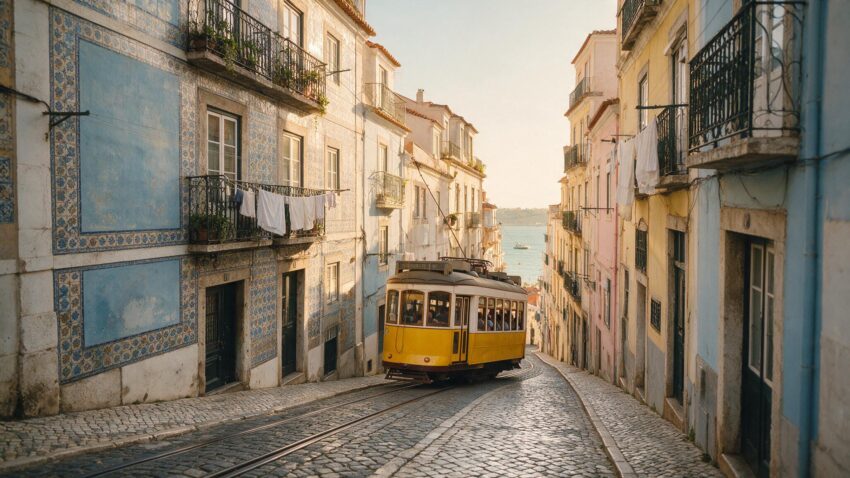
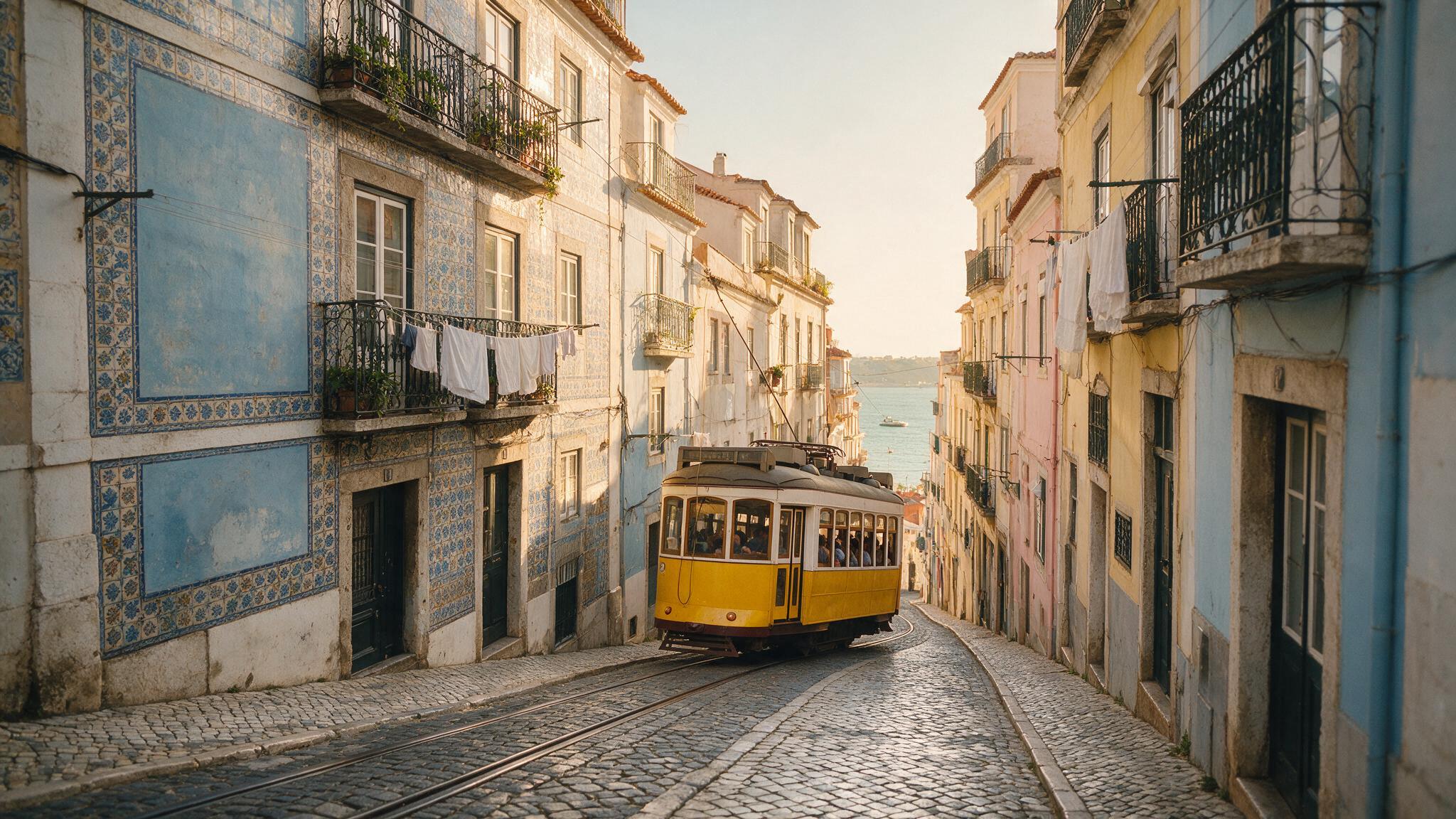
The first sound is a church bell — the Sé Cathedral, ringing seven times, thin and a little cracked, the way old bells sound. Then a shutter creaks open two floors up, a woman shakes out a rug over the railing, and a cat that has clearly claimed the warm stone step in front of a shuttered grocery doesn’t so much as open an eye. Somewhere below, a coffee machine hisses. This is Alfama at 7 a.m., before the tour groups, before the tuk-tuks, before the tram bells start clanging up the hill — and it’s the best possible way to start a day in Lisbon.
Lisbon rewards a slow morning and punishes a rushed one. It’s a city of hills, tiles, and light that turns everything gold twice a day, and one 24-hour stretch — done right — can genuinely capture its character, even if it leaves you wanting a full week next time. This is that day: Alfama at sunrise, the (in)famous Tram 28, a pastel de nata that’s worth the queue, the monastery and tower at Belém, lunch at a food hall that changed how the world thinks about food halls, a golden-hour view over terracotta rooftops, and dinner where the music does the talking.
Table of Contents
- Before You Go: Visa, Flights, and When to Land in Lisbon
- Sunrise in Alfama: Getting Pleasantly Lost
- The Tram 28: Beautiful, Brutal, Worth It
- Belém by the River: Monastery, Tower, and a Pastry Worth Queuing For
- Lunch at Time Out Market
- Golden Hour at a Miradouro
- Fado After Dark
- Getting Around, Paying for Things, and One Mistake to Avoid
- FAQs: A Day in Lisbon
Before You Go: Visa, Flights, and When to Land in Lisbon
Portugal is part of the Schengen area, so Indian passport holders need a Schengen visa before they fly — there’s no visa-on-arrival shortcut here. The standard adult fee is €90 (roughly ₹8,200 at current rates), paid at the time of your VFS Global appointment, and official processing is quoted at around 15 calendar days — though in practice Indian applications often take 15 to 30 working days, longer in peak season. Book your VFS appointment 4 to 6 weeks before you plan to travel, not the week before. Delhi and Mumbai centres get booked out fastest.
There’s no direct flight from India to Lisbon yet, so budget one layover — Dubai, Doha, Abu Dhabi and Istanbul are the busiest connection points — for a total journey of roughly 14 to 20 hours depending on the routing. Return economy fares swing quite a bit with season and how far out you book: expect somewhere between ₹65,000 and ₹1,20,000, with the lower end showing up on Gulf-carrier routings booked three to four months ahead, and the upper end on peak-summer or last-minute fares. Flying midweek tends to shave a little off the price too.
As for when to go: October is genuinely one of the best windows. Daytime temperatures hover around a comfortable 22-23°C, the punishing summer crowds have thinned out, and — this is the detail that convinced us — the queue outside Pastéis de Belém noticeably shortens. April to June is the other sweet spot, with jacaranda trees in bloom and long, mild evenings. July and August are hot, packed, and the Tram 28 queue can eat an hour of your day; go then only if you have no other choice.
Sunrise in Alfama: Getting Pleasantly Lost
Alfama is Lisbon’s oldest neighbourhood, the one part of the city that survived the catastrophic 1755 earthquake largely intact, which is why its streets still follow a logic older than street grids — a tangle of Moorish-era lanes that climb, dip, and dead-end without warning. This is deliberate: don’t try to navigate Alfama with a map open. Put the phone away for forty minutes and just climb.
You’ll pass laundry strung between windows, azulejo tiles in patterns that don’t repeat for blocks, tiny mercearias (grocers) stacking crates before opening, and — if you’re up early enough — almost no other tourists. Stop for a bica (Lisbon’s version of an espresso, strong and small) at whichever hole-in-the-wall counter smells right. Don’t overthink it.
One quiet find worth building into this walk, and one that doesn’t show up on the usual top-ten lists: Livraria do Simão, tucked into the Escadinhas de São Cristóvão near the edge of Alfama. It’s arguably the smallest bookshop in Portugal — about four square metres, so small that the owner and a customer genuinely cannot stand inside at the same time. It holds roughly 4,000 secondhand books, some quite rare, spilling out through an archway off Rua da Madalena. You won’t buy anything you can read, most likely, but it’s a two-minute detour that no group tour will take you on.
The Tram 28: Beautiful, Brutal, Worth It
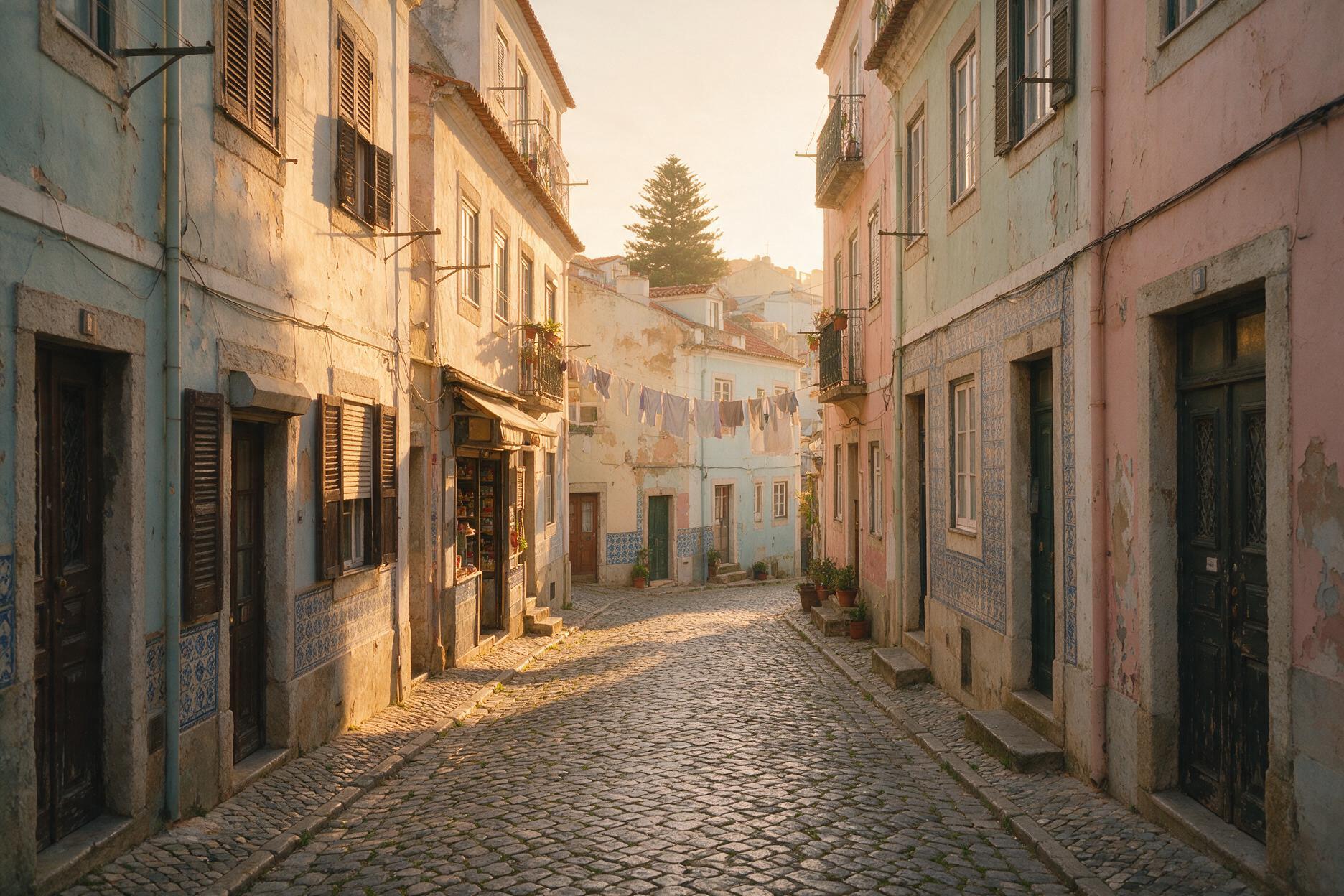
Here’s the honest version, because most articles oversell this one. Tram 28 is a genuinely charming 1930s-era yellow tram that rattles from Martim Moniz through Graça, Alfama, Baixa, Chiado and Estrela to Campo Ourique — 34 stops of steep hills and tight corners the tram was never really designed for, past São Jorge Castle, the Sé Cathedral, and Miradouro da Graça. It is also, by mid-morning, absurdly crowded. The tram seats about 20 people with room for maybe 30 more standing, and the queue at the Martim Moniz starting point can run past an hour in cruise-ship season.
The workaround locals actually use: board early — before 9 a.m. — or late, after about 9:30 p.m. If you can’t manage either, walk to a stop in the middle of the route rather than joining the queue at the terminus, or start from the Campo Ourique end where the tram is usually near-empty and you’ll get a seat for the ride back down through the old town. Tram 12E covers some of the same ground with a fraction of the crowd, if 28 is simply too much on the day.
A single ticket bought on board costs €3; tap a reloadable Viva Viagem card instead and it drops to €1.50. And one honest caveat that’s worth repeating loudly: this route is a known pickpocket zone precisely because everyone is packed in shoulder to shoulder, distracted by the view. Wear your bag across your body, in front of you, zipped. It sounds obvious until you’re the one person on the tram who didn’t bother.
Belém by the River: Monastery, Tower, and a Pastry Worth Queuing For
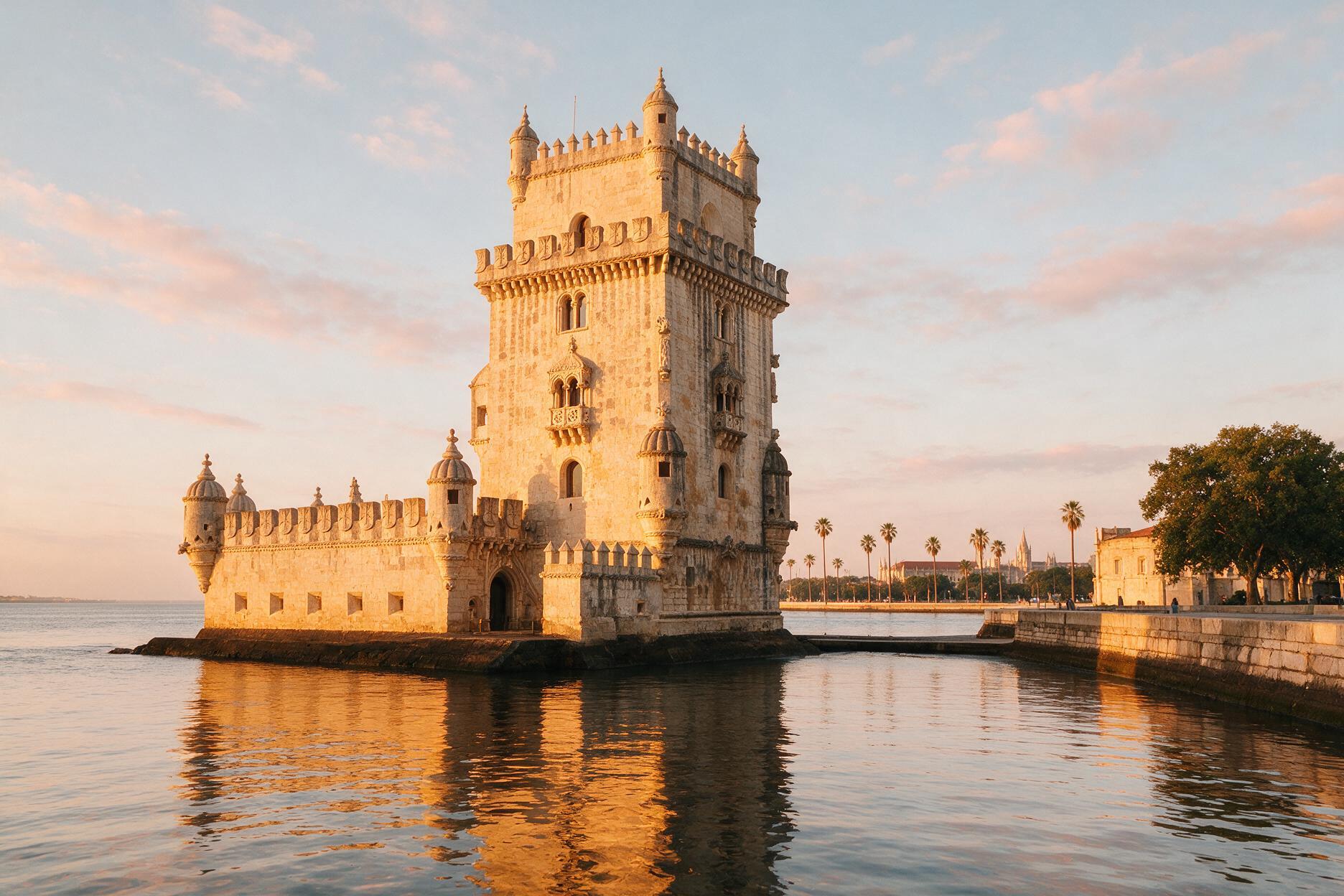
Take the tram or a taxi out to Belém, on the river’s edge west of the centre, where Portugal’s Age of Discovery ships once set sail. Two UNESCO World Heritage buildings sit within a ten-minute walk of each other here — the Monastery of the Hieronymites and Tower of Belém were jointly inscribed in 1983, and both are worth the trip even if you only have time for one.
Jerónimos Monastery is the one to prioritise if you must choose. Its limestone cloisters are carved with such intricate Manueline detail — ropes, coral, armillary spheres — that you can see why it took nearly a century to complete. It’s open Tuesday to Sunday, roughly 10 a.m. to 5:30 or 6:30 p.m. depending on season, closed Mondays, and adult entry runs close to €20 (prices have crept up in recent years, so check the official ticket page before you go). Pre-booking online saves a real queue in high season — walk-up lines here can stretch alarmingly on a sunny Saturday.
Belém Tower, a short walk along the riverfront, is smaller and, honestly, more photogenic from the outside than the inside. The interior climb is a single narrow spiral staircase with 93 steps, which means the wait to go up can be long and the payoff modest if you’re pressed for time. Our honest take: worth walking up to and around for the view of the Tagus, but skip the climb if you’re tight on the clock — spend that half hour at the monastery instead. A combined “Belém Bundle” ticket covers both sites plus an audio guide for around €21, which is the better-value option if you’re doing both.
Then, the pastry. Pastéis de Belém has been baking custard tarts from the same recipe since 1837, allegedly passed down from monks at the very monastery you just walked through, after Portugal’s religious orders were dissolved in 1834 and someone needed to make a living. The recipe is kept in a locked back room known only to a handful of master confectioners — genuinely, to this day. Skip the line at the counter and grab a table instead; table service moves faster than you’d expect, and a pastel de nata here, dusted with cinnamon and powdered sugar, still warm, is a different food from the pre-packaged version you’ll find at every café in Lisbon. It’s touristy, yes. It’s also the real thing, and there’s a reason the queue exists.
Lunch at Time Out Market
Head back toward the centre for lunch at Time Out Market Lisboa, inside the restored 19th-century Mercado da Ribeira near Cais do Sodré. Opened in 2014, this was the original Time Out Market — the format the brand later exported to cities like New York, Miami and Dubai started right here, with stalls curated from some of Lisbon’s most respected chefs and restaurants rather than generic food-court fare.
There are 26 kitchens, 8 bars and a handful of specialty shops under one soaring iron-and-glass roof, so the actual challenge is deciding, not finding something good. Go for a plate of grilled bacalhau (salt cod), a bifana (pork sandwich, deceptively simple, always excellent), or ginjinha — Portugal’s sour-cherry liqueur, sold by the shot glass, sometimes in an edible chocolate cup. It’s loud, communal seating, and genuinely a good barometer of Lisbon’s food scene in one building. The honest caveat: it’s popular enough that lunch tables can be hard to find between 1 and 2 p.m. — arrive slightly earlier or slightly later and you’ll dodge the worst of it.
Golden Hour at a Miradouro
Lisbon’s seven hills mean the city is stitched together with miradouros — public viewpoints — and picking one for sunset is less about which is “best” and more about which fits your day. Three worth knowing by name:
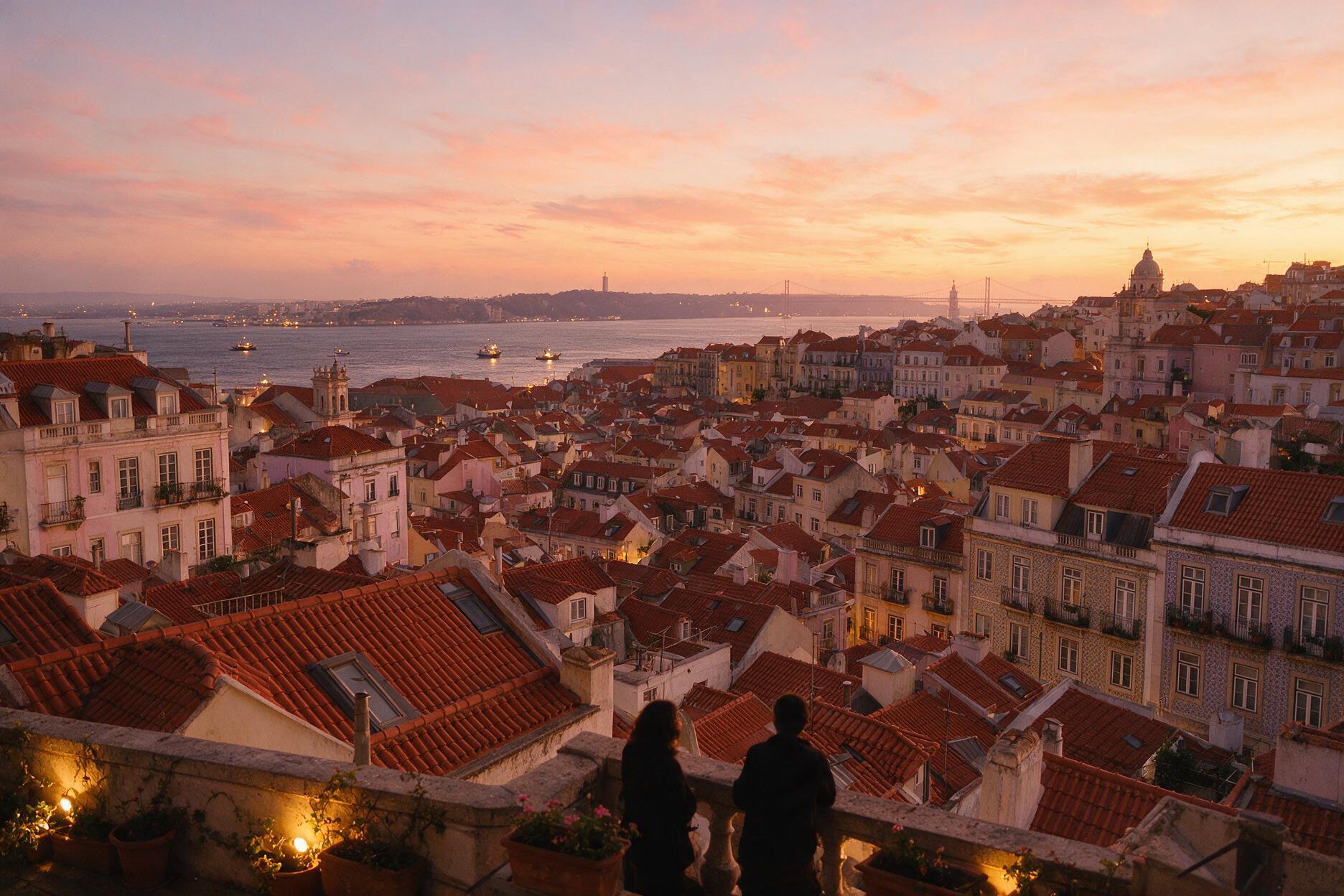
Miradouro das Portas do Sol, on the edge of Alfama, is probably the most photographed — a wide terrace looking out over a jumble of terracotta rooftops down to the river, with the tram tracks visible curling below. It’s easy to reach and gets busy, but it earns the crowd.
Miradouro da Senhora do Monte, a bit higher up and a genuine climb, is the quieter, more romantic option — a pine-shaded hilltop with an 18th-century chapel, and arguably the widest panorama in the city. Fewer selfie sticks, more locals with a bottle of wine.
Miradouro de Santa Catarina, over toward Bairro Alto, faces the 25 de Abril Bridge and has a stepped, amphitheatre feel that fills up with a younger, mixed local-and-visitor crowd around sunset, often with a portable speaker and a drinks cart nearby. Less “view,” more “scene” — pick this one if you want company with your sunset rather than silence.
If you have an extra hour earlier in the afternoon rather than folding it into golden hour, LX Factory — a mid-19th-century textile factory turned creative complex in Alcântara — is worth the detour. The standout inside is Livraria Ler Devagar, a cavernous former printworks that still has its original printing press suspended from the ceiling, with a jazz record shop tucked on the top floor. It’s touristy in the way LX Factory generally is now, but it’s still one of the more atmospheric bookshops you’ll walk into anywhere. Sundays add a market from about 10 a.m. to 6 p.m. if your one day happens to land on a Sunday.
Fado After Dark
End the day the way Lisbon has ended its days for two centuries: with fado. This isn’t background music — it’s a genre built entirely around saudade, a specific, hard-to-translate Portuguese ache of longing, sung by a single voice over Portuguese and classical guitar, in rooms usually too small and too dim for anything to distract you from it.
Alfama and Bairro Alto are the two traditional homes of fado, and both have genuine houses rather than tourist-trap versions. Clube de Fado, tucked into a three-hundred-year-old building in the shadow of the Sé Cathedral in Alfama, was founded in 1995 by guitarist Mário Pacheco, who once accompanied the legendary Amália Rodrigues — which tells you the pedigree here isn’t for show. Dinner starts around 7:30 p.m., the music around 8:30, and the two run together through the night rather than as separate “show” and “dinner” segments — no ticket, no stage announcement, fado sung right beside the tables between courses. A fixed dinner menu runs around €78 per person. Reserve ahead; this isn’t a walk-in kind of night.
The honest caveat here: fado is an acquired mood, not a spectacle. If you’re expecting something upbeat or performative, it will feel slow. Go in expecting to sit still, eat slowly, and actually listen — that’s the whole point, and it’s also why it works so well as the last thing you do before the day ends.
Getting Around, Paying for Things, and One Mistake to Avoid
Lisbon’s metro is clean, fast, and covers the airport and main tourist zones well, but Alfama’s steepest lanes are metro-free by nature — you’re walking or you’re on the tram. A Viva Viagem card (€0.50 to buy, then loaded with credit or day passes) covers metro, bus, tram and the funiculars, and is worth getting on day one rather than paying cash fares each time. Uber and Bolt both operate widely and are reasonably priced for hopping between neighbourhoods when your feet give out — which, on a hill city, they will.
Cards are accepted almost everywhere in central Lisbon now, including small cafés, but it’s still smart to carry some cash (euros) for tiny family-run tascas, the odd market stall, and public toilets, which sometimes only take coins. eSIMs are the easiest option for connectivity — Portuguese providers like Vodafone and MEO sell tourist SIMs too, but an eSIM set up before you land saves a stop at the airport kiosk.
The one mistake to actually avoid: wrong shoes. Lisbon’s pavements are calçada portuguesa — small, hand-laid limestone and basalt cobbles, often polished smooth by decades of foot traffic, and genuinely slippery when wet or worn. Combine that with the hills and this is not a sandals-and-flip-flops city, however warm the weather looks. Bring shoes with real grip. It’s a small thing that changes an entire day.
FAQs: A Day in Lisbon
Do Indians need a visa for Portugal?
Yes. Portugal is part of the Schengen zone, so Indian passport holders need a Schengen visa before travel. The standard fee is around €90, and you’ll apply through VFS Global — book your appointment 4 to 6 weeks ahead of travel dates.
Is one day enough in Lisbon?
One day gives you a real, well-rounded taste of the city — Alfama, Belém, a market lunch, a sunset view and fado — but Lisbon rewards more time. If you can stretch it to 3-4 days, you’ll have room for a Sintra day trip, the Alfama fado more slowly, and the coastal towns of Cascais or Setúbal.
What is the best time to visit Lisbon from India?
October is a strong pick — mild weather, thinner crowds, shorter queues at spots like Pastéis de Belém. April to June is the other good window, with pleasant temperatures and long evenings. July-August is hottest and most crowded.
How crowded does Tram 28 actually get?
Very, especially late morning through afternoon in high season, when the queue at the Martim Moniz terminus can run past an hour. Ride before 9 a.m. or after 9:30 p.m., or board from a middle stop or the Campo Ourique end, to avoid the worst of it.
Do I need to pre-book tickets for Jerónimos Monastery and Belém Tower?
Pre-booking isn’t mandatory but is strongly recommended in peak season — walk-up queues can eat a significant chunk of your day. A combined ticket covering both sites plus an audio guide is the better-value option if you plan to see both.
Is Lisbon walkable, and what shoes should I wear?
Very walkable in spirit, less so underfoot — the city’s traditional cobbled pavements get slippery and the hills are real. Skip sandals; bring closed, grippy shoes.
What currency does Portugal use, and should I carry cash?
The euro. Cards are widely accepted, but carry some cash for small tascas, market stalls and coin-operated toilets.
Where should I stay in Lisbon for a longer trip?
Alfama and Chiado both put you within walking distance of most of this itinerary, with Chiado slightly more polished and Alfama more atmospheric (and steeper). Príncipe Real is a quieter, leafier alternative if you’d rather retreat from the crowds each evening.
One Day, and a Reason to Come Back
A single day in Lisbon isn’t really about ticking off a list — it’s about noticing how the light changes the same tiled wall three times before dinner, how a nine-minute tram ride can feel like a small adventure, how a two-century-old song can quiet an entire room without anyone asking it to. Twenty-four hours is enough to fall for this city. It is never quite enough to leave satisfied.
That’s usually where the real trip starts — Sintra’s palaces a short ride away, the surfing beaches of the Algarve, a detour into Porto’s port wine cellars, or simply four more unhurried days in Lisbon itself, sleeping in, eating slowly, and letting Alfama’s lanes lead you somewhere you didn’t plan.
If this one day has you thinking about the rest of the week, that’s exactly the conversation we like having at Get Tripped. We build full Portugal and Iberian Peninsula itineraries around exactly this kind of pace — real neighbourhoods, real food, real breathing room between the landmarks — matched to mid-range and boutique stays we’ve actually vetted, not just listed. Get in touch with our travel designers and let’s turn this one perfect day into your next real trip.