
Six Thirty in the Morning, Café Sperl Isn’t Even Open Yet
Vienna doesn’t rush, and the city makes you learn that lesson within your first hour. I once tried to squeeze a “greatest hits” day into this city on four hours of sleep, sprinting between the Hofburg and the State Opera with a paper map, and came away remembering almost none of it. The second time, I gave the day exactly one rule: nothing before 9 AM, and no more than three stops that actually matter. That’s the day worth telling you about — a single loop through Vienna’s imperial core, its market, and its coffeehouses, paced the way a Viennese Saturday actually moves.
In This Guide
- Getting to Vienna from India
- Visa requirements for Indian passport holders
- Morning: the Hofburg, without the tour groups
- Midday: the Naschmarkt, Vienna’s oldest market
- Afternoon: Graben, Kohlmarkt, and Stephansdom
- Evening: a proper Viennese coffeehouse
- Which neighbourhood to actually stay in
- Best time to visit
- What the day (and the trip) costs
- A mistake worth avoiding
- FAQs
Getting to Vienna from India
There’s no non-stop flight between India and Vienna right now, which surprises people given how well-connected the rest of Western Europe is from Delhi and Mumbai. Instead, you’re looking at a one-stop routing — Etihad via Abu Dhabi is the most consistently convenient, with Lufthansa via Frankfurt or Munich, and Turkish Airlines via Istanbul as solid alternatives, especially if you want a longer layover to explore a second city on the way. Flight time works out to roughly 9-11 hours total including the connection, and fares from Delhi or Mumbai typically start around ₹40,000-55,000 return in economy during shoulder season, climbing meaningfully around Christmas markets season and summer.
If Vienna is one stop on a longer Central Europe trip — pairing it with Budapest, Prague, or Bratislava, all a short train ride away — flying into Vienna and out of a different city (or vice versa) is worth pricing out; it often works out cheaper than a same-city round trip once you’re already planning to move around the region.
Visa Requirements for Indian Passport Holders
Austria is a Schengen country, so the process is the standard one: apply through VFS Global, currently running about €90 (roughly ₹8,200) in visa fees plus the VFS service charge. Processing typically takes two to three weeks, longer in peak summer months, so apply at least a month out and have your flight bookings, hotel confirmations, and financials (bank statements, ITRs, employment letter) in order before your appointment. If Austria is one leg of a multi-country Schengen trip, apply through the consulate of whichever country you’re spending the most nights in, or your first port of entry if the nights are split evenly.
Morning: The Hofburg, Without the Tour Groups
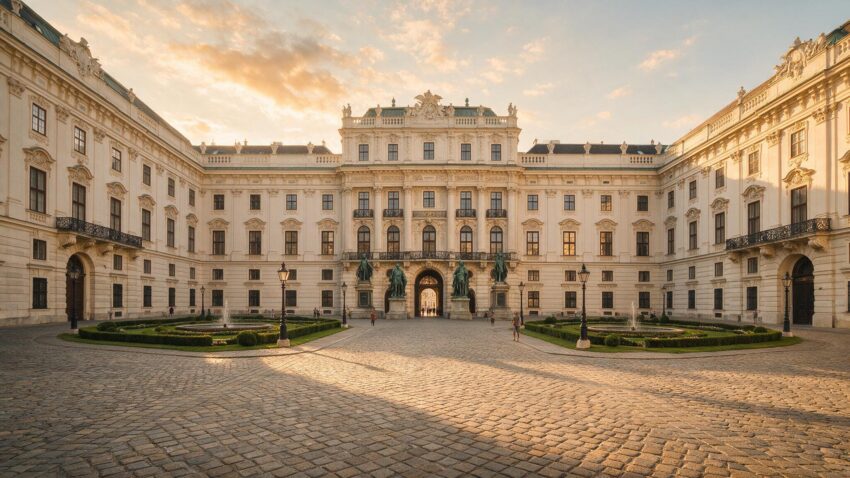
Start at the Hofburg by 9 AM, which sounds like an oddly specific instruction until you’ve seen what the courtyard looks like by 11, when the tour buses have caught up with you. The former Habsburg imperial palace is enormous — you could spend a full day in the Sisi Museum and Imperial Apartments alone — but for a single day, give it ninety minutes, walk the state apartments, and let yourself skip anything that isn’t holding your attention. The Habsburgs collected a lot of rooms; not every one earns equal time.
From the Hofburg, walk rather than tram it toward the Naschmarkt — it’s about twenty minutes through the Ringstrasse’s grand, slightly over-scaled architecture, past the Vienna State Opera, which is worth a glance from outside even if you’re not catching a performance. Vienna’s trams are genuinely excellent if your feet give out (a single ticket covers about an hour of travel across the network, or get a 24/48/72-hour pass if you’re stacking multiple days), but the walk itself is part of what makes Vienna’s core feel walkable in a way few European capitals still are.
Midday: The Naschmarkt, Vienna’s Oldest Market
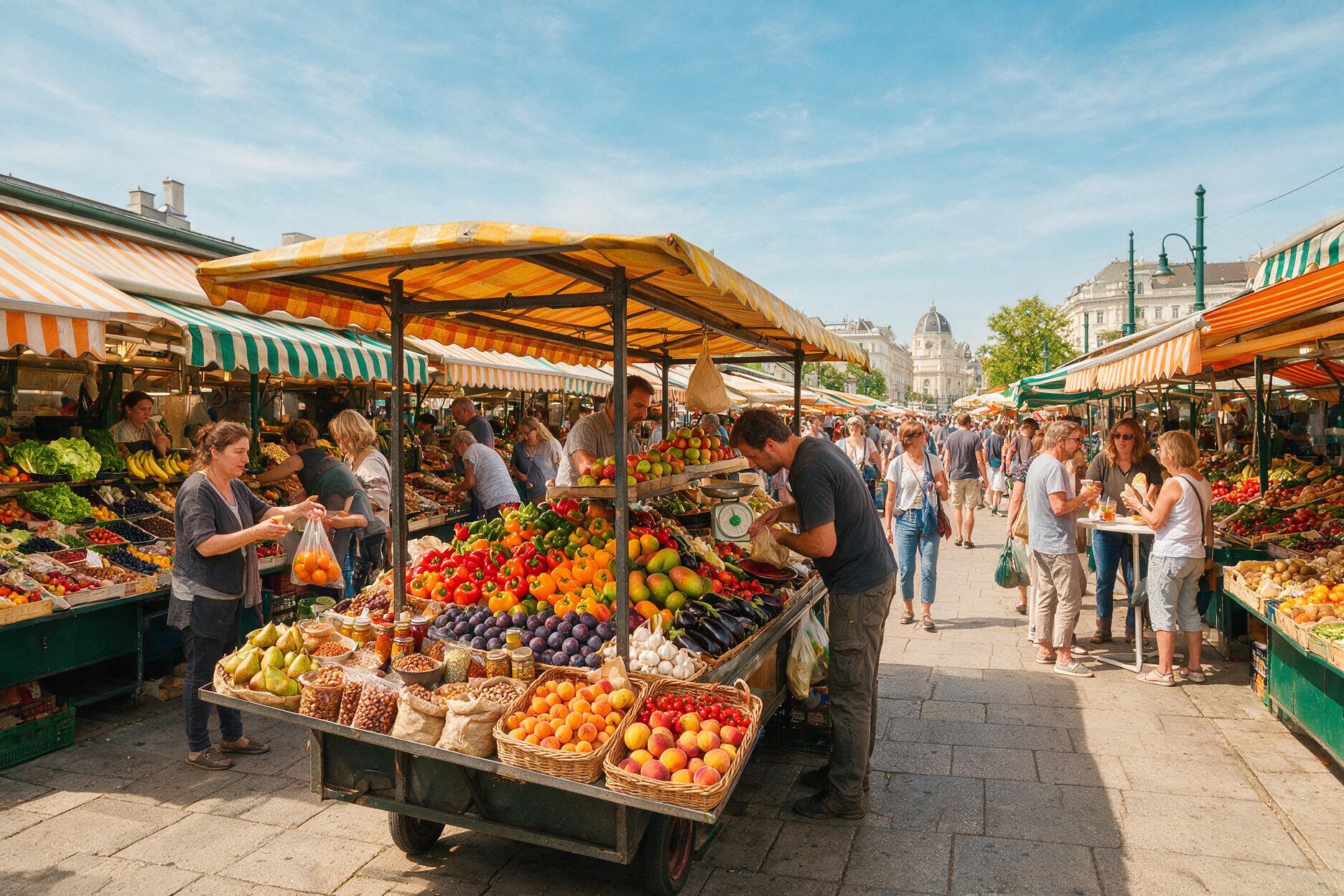
This is the stop I’d protect if the rest of the day fell apart. The Naschmarkt runs along the Wienzeile with around 130 stalls plus an indoor market hall, and it’s less a tourist attraction dressed up as a market and more an actual market that happens to be excellent to wander. Go for the produce stalls stacked with things you don’t usually see side by side — Turkish, Balkan, and Middle Eastern grocers next to old-school Viennese butchers and cheese counters — and stay for lunch at one of the sit-down spots woven through the stalls: Neni does excellent Israeli-Levantine plates, Tewa and Umar are solid for something quicker, and Zur Eisernen Zeit is a good, unfussy pick if you want something closer to Austrian comfort food.
If your day happens to fall on a Saturday, the flea market at the western end of the Naschmarkt is worth the extra hour — hundreds of vendors selling everything from genuine antiques to complete junk, in the specific ratio that makes flea markets fun. It wraps up by 2 PM sharp, so don’t leave it for late afternoon assuming you’ll catch the tail end.
A small, honest caveat: the Naschmarkt gets genuinely crowded by early afternoon, especially on weekends, and the stalls closest to the U-Bahn entrance mark their prices up accordingly. Walk two-thirds of the way down before you start buying anything, and you’ll do noticeably better.
Afternoon: Graben, Kohlmarkt, and Stephansdom
From the Naschmarkt, it’s a short tram or a twenty-five minute walk back into the 1st District, where Vienna’s pedestrian spine runs from the Graben through Kohlmarkt to Stephansplatz. This stretch is unapologetically upscale — old jewellers, Demel’s imperial-era pastry counter, the kind of shopfronts that have looked essentially the same for a century — and it ends at Stephansdom, Vienna’s Gothic cathedral, whose tiled roof pattern is worth the neck strain to actually look up at properly rather than just photograph from street level.
If you have the legs for one more climb, the south tower (nicknamed “Steffl”) gets you a proper view over Vienna’s rooftops, though it’s a narrow spiral staircase with no lift — skip it if that’s not your thing, the cathedral interior alone justifies the stop.
Evening: A Proper Viennese Coffeehouse
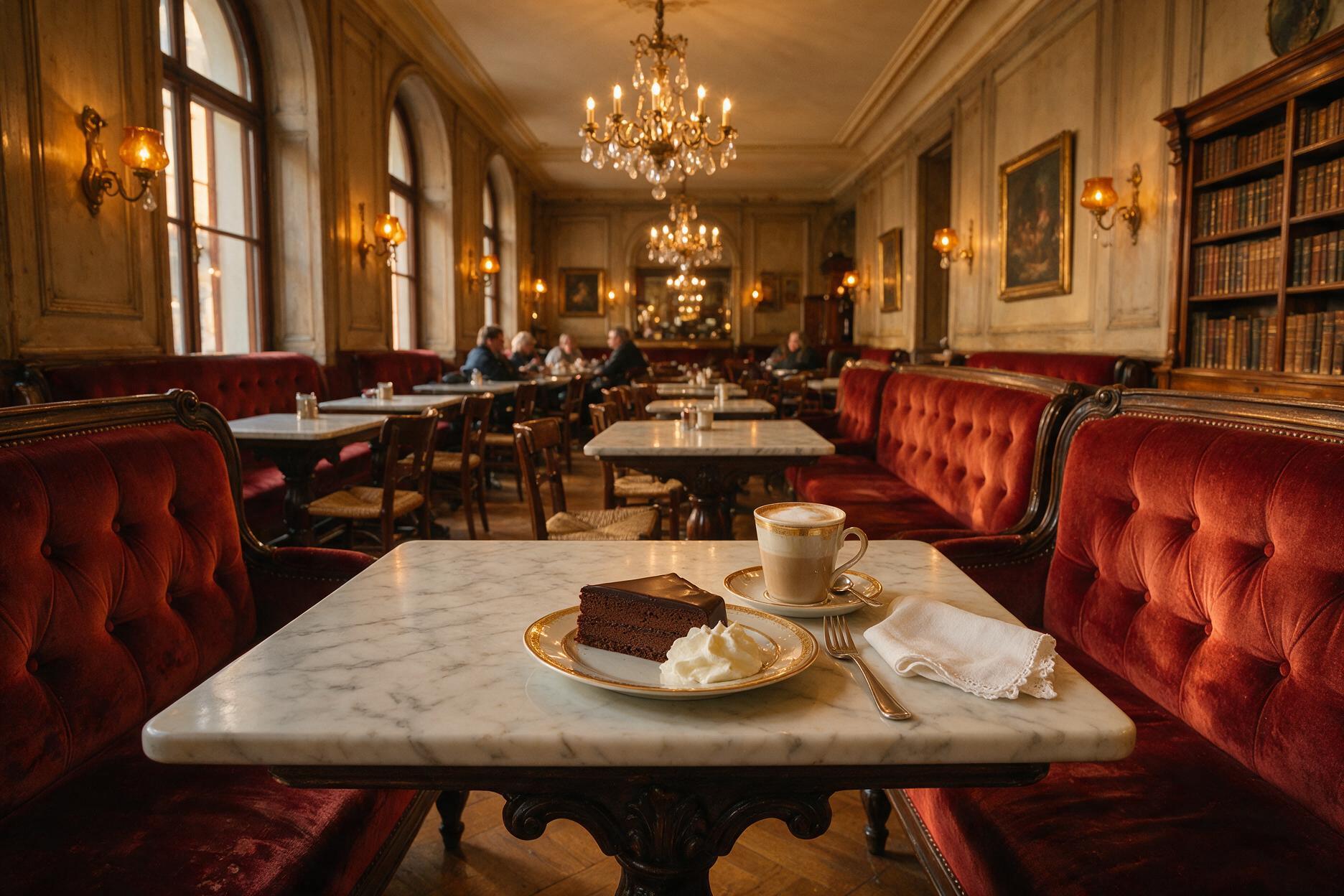
Save your last stop for a coffeehouse, not because it’s a cliché (it is, a little) but because Vienna’s coffeehouse culture earned its 2011 UNESCO intangible cultural heritage listing honestly — this isn’t a quick-espresso-and-go culture, it’s a sit-for-two-hours-with-a-newspaper-and-nobody-will-rush-you culture, and experiencing that pace once is worth more than another attraction ticked off. Café Central is the famous one, ornate and historically loaded (Trotsky reportedly played chess here), and worth seeing once despite the tourist traffic it now pulls. Café Sperl, running continuously since 1880, is the quieter, more local alternative — genuinely worn velvet booths, a billiard table nobody photographs but plenty of regulars still use, and a Wiener Melange that isn’t performing for anyone. One thing to flag: Sperl closes on Sundays through July and August, so if you’re visiting in high summer, check ahead rather than showing up to a shut door.
Order a Melange (Vienna’s take on a cappuccino) or an Einspänner (espresso with whipped cream, served in a glass) and a slice of Sachertorte if you haven’t already had one elsewhere, and just sit. That’s genuinely the whole instruction.
Which Neighbourhood to Actually Stay In
The 1st District puts you inside the imperial core, walkable to almost everything above, but it’s also the most expensive and, by evening, the most tourist-dense. The 6th District (Mariahilf), home to the Naschmarkt itself and Mariahilfer Straße’s wider mix of dining, is a good middle ground — still highly walkable, noticeably better value, with a more local, lived-in feel by night. The 4th District (Wieden), just south of the Ring, is quieter and more residential, good if you want an unhurried café-and-courtyard version of Vienna rather than a sightseeing-adjacent hotel.
Best Time to Visit
Late April through June and September through October are Vienna’s sweet spots — mild weather, gardens in bloom or turning, and noticeably thinner crowds than peak summer. December has its own strong case if Christmas markets are the draw (the ones at Rathausplatz and Schönbrunn are genuinely well done, not just mulled wine and marked-up crafts), but expect cold weather and higher hotel rates. July and August are warm, occasionally properly hot, and busiest — fine if those are your only available dates, but book coffeehouse-adjacent activities with the crowd caveats above in mind.
What the Day, and the Trip, Actually Costs
A day like this one runs comfortably on a mid-range budget: figure €15-25 for Hofburg entry (Imperial Apartments plus Sisi Museum combined ticket), €20-30 for a proper Naschmarkt lunch with a drink, €2.60 for a single tram/U-Bahn ticket or around €8 for a 24-hour pass, and €8-12 for coffee and cake at a classic coffeehouse — call it roughly €55-75 (₹5,000-6,900) per person for the full day excluding accommodation. Vienna hotels run the gamut from comfortable four-star properties around the Ring for roughly €150-220 a night to genuinely grand options like the Hotel Sacher or Park Hyatt Vienna for travellers who want the full imperial-city experience.
A Few Things Worth Knowing Before You Go
A fun fact that actually earns the name: the Sachertorte you’ll be offered at half the cafés in Vienna has been the subject of a genuine, decades-long legal dispute between Hotel Sacher and Demel over who gets to call theirs “the original” — order both over two different afternoons and form your own opinion, it’s a more interesting rivalry than it has any right to be.
For photography, skip the obvious Hofburg courtyard shot and instead head to the Naschmarkt in the last hour before closing, when the light comes in low and gold along the stalls and half the vendors are packing up produce crates — it’s a far more honest picture of the city than another Schönbrunn facade shot. If you want one classic frame, the view from Stephansdom’s south tower over the tiled roof pattern is worth the climb.
A genuinely local spot most guidebooks skip: Phil, a combined bookshop-café just off Mariahilfer Straße in the 6th District, all mismatched furniture and secondhand books, is a good antidote if the Ring’s grandeur starts to feel like a stage set. It’s the kind of place a Viennese friend would send you rather than a tour operator.
On value: Vienna’s museums cluster their free or reduced-price evenings on specific weekdays (the Albertina and several others offer discounted late openings), so if you’re flexible on which afternoon you do indoor sightseeing, checking the current schedule before you land can meaningfully cut costs without cutting anything from the itinerary.
For couples, the coffeehouse evening above is honestly the best value romantic hour in the city — better than a pre-booked “romantic dinner” that costs three times as much for the same city views. Families will find the Naschmarkt easier going earlier in the day, before the crowds and the flea-market crush; and if you’re travelling solo, Vienna is one of the more comfortable European capitals to eat alone in — coffeehouse culture is built entirely around solitary lingering, so nobody will treat a table for one as unusual.
A Mistake Worth Avoiding
Don’t try to combine the Hofburg, Schönbrunn Palace, and the Naschmarkt into one day — it’s a common instinct when you’ve only got 48 or 72 hours in the city, and it turns Vienna into a checklist sprint instead of the slow, deliberate city it actually is. Schönbrunn alone, with its gardens and the Gloriette viewpoint, deserves its own half-day rather than a rushed hour squeezed between two other stops. If you’ve only got one full day, this itinerary (Hofburg, Naschmarkt, the Graben to Stephansdom, and a coffeehouse) is the better use of it; save Schönbrunn for a second day or a return trip.
Frequently Asked Questions
Is there a direct flight from India to Vienna?
Not currently. The most convenient one-stop options are Etihad via Abu Dhabi, Lufthansa via Frankfurt or Munich, or Turkish Airlines via Istanbul, with total journey times of roughly 9-11 hours.
How many days do you actually need in Vienna?
Two to three full days covers the core sights, including Schönbrunn as a separate half-day, without feeling rushed. One day works if you’ve already seen Vienna before and want a slower, more targeted return visit like the one above.
Is the Naschmarkt open every day?
The market stalls run Monday to Saturday; it’s closed on Sundays. The flea market at the western end only runs on Saturdays and wraps up by 2 PM.
Do I need to book Hofburg or Stephansdom tickets in advance?
Advance booking isn’t essential outside peak summer weekends and December, but it does let you skip the ticket-counter queue, which is worth the few minutes it takes to book online the night before.
What’s the best area to stay in Vienna for a first visit?
The 6th District (Mariahilf) is the best balance of walkability, value, and local feel for a first-timer; the 1st District is worth it if you want to be inside the imperial core and don’t mind paying more for it.
Is Vienna expensive compared to the rest of Western Europe?
It’s comparable to Germany and noticeably cheaper than Switzerland or the Nordics for equivalent quality — a genuinely good coffeehouse experience or Naschmarkt lunch costs meaningfully less here than the equivalent in Zurich or Paris.
Before You Go
Vienna rewards a slower day more than almost any European capital I’d put on a first-timer’s list — it’s a city built around sitting still on purpose, which is a strange thing to have to be told but genuinely changes how the day feels once you stop fighting it. If you want this built into a longer Central Europe itinerary — Vienna paired with Budapest, Prague, or a Danube river cruise — Get Tripped’s Europe planning team can put the whole route together around your dates.