
Santorini’s caldera view from Oia is worth the hype exactly once, and worth fighting three hundred people with selfie sticks for exactly never again. I said this to a Greek ferry captain over coffee in Piraeus and he laughed and said, “So go to Milos instead. Nobody fights you for anything there.” He wasn’t selling me a tour package. He was just right.
Santorini and Mykonos get all the search volume and most of the Instagram grids, and neither is a bad island — but they’re also the two most crowded, most expensive, and least distinctly Greek of anything in the Cyclades. Once you’ve done the caldera photo, the actual texture of these islands — white villages that aren’t performing for tourists, beaches that don’t need a reservation, tavernas where the fish came off a boat that morning — lives one or two ferry rides further out. This is the case for going there instead, or at least going there too.
Table of Contents
- Getting to Greece from India: The New Direct Route
- Visa Requirements
- Best Time to Go
- Getting Between the Islands
- Milos: The Moonscape Beaches
- Folegandros: The Clifftop Chora Nobody Rushes To
- Naxos: The Island With Actual Mountains
- Where to Stay
- Food and Money
- Internet, Packing, and a Photography Tip
- Safety and Practical Notes
- A Mistake to Avoid
- Who This Trip Suits
- FAQs
Getting to Greece from India: The New Direct Route
Until this January, getting to Greece from India meant a connection through Istanbul, Doha, or a European hub, adding hours and a layover to what should be a straightforward trip. That changed on January 23-24, 2026, when IndiGo launched India’s first direct connectivity to Greece — non-stop flights from both Mumbai and Delhi to Athens, three times weekly on each route, flown on the Airbus A321XLR (India’s first use of that aircraft type), with a 12-seat business-style IndiGoStretch cabin up front. It’s currently the only direct India-Greece connection any airline offers, and it turns a trip that used to eat two travel days into a same-day arrival.
Athens itself is worth a day or two — the Acropolis at opening time, the Plaka district below it — but it’s also just your gateway here. Piraeus, Athens’s port, is a 30-40 minute taxi or metro ride from the airport, and that’s where the ferries to the Cyclades actually leave from.
Visa Requirements
Greece is a Schengen country, so the same rules apply as anywhere else in the zone: Indian passport holders need a Schengen visa before travel, applied for through the Greek consulate or VFS Global, with standard processing typically running around 15 working days. Build in a comfortable buffer — a month is safer than two weeks — since summer applications can back up. One Schengen visa covers Greece and any other Schengen country you add to the same trip.
Best Time to Go
Late September into October is genuinely the best window for the Cyclades, not just the most convenient one. Daytime temperatures settle around 22-23°C, the sea stays warm enough to swim through most of October, rain is close to nonexistent (locals will tell you to expect one or two brief showers across the entire season, if that), and the crush of July-August tourism has largely cleared out. Accommodation prices on the smaller islands also drop meaningfully once September ends, which matters more on Milos and Folegandros than it does on Santorini, where prices barely move regardless of season. If your schedule allows it, aim for the back half of September through mid-October.
Getting Between the Islands
This is genuinely simple once you’ve done it once, and intimidating before you have. High-speed ferries (Seajets is the main operator on these routes) run from Piraeus to Milos in as little as 2 hours 40 minutes, with three sailings a day in season; slower conventional ferries take 4-7 hours but cost less and run a good option if you’re not in a hurry on arrival day. From Milos, a high-speed hop to Folegandros takes about an hour, and Milos to Naxos runs roughly 2 hours 15 minutes — meaning a Milos-Folegandros-Naxos loop, or any two of the three, is entirely doable inside a 9-10 day trip without feeling rushed. Book ferry tickets a few weeks ahead in September; by October, availability loosens up.
Milos: The Moonscape Beaches
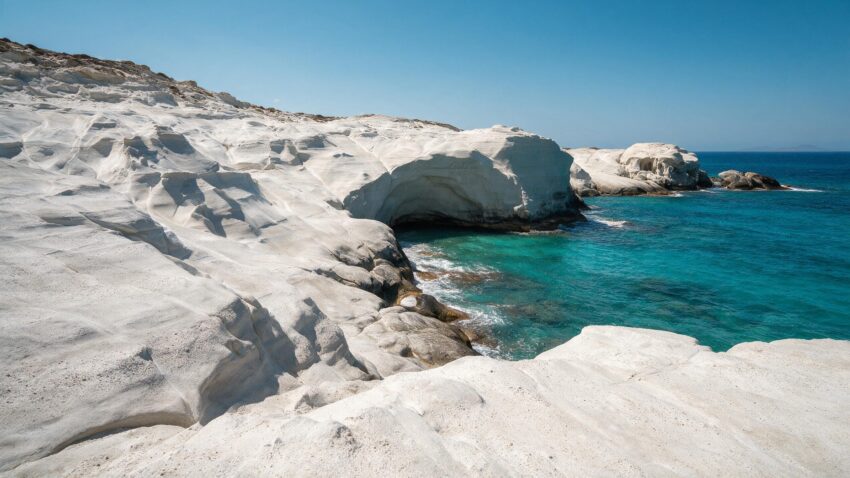
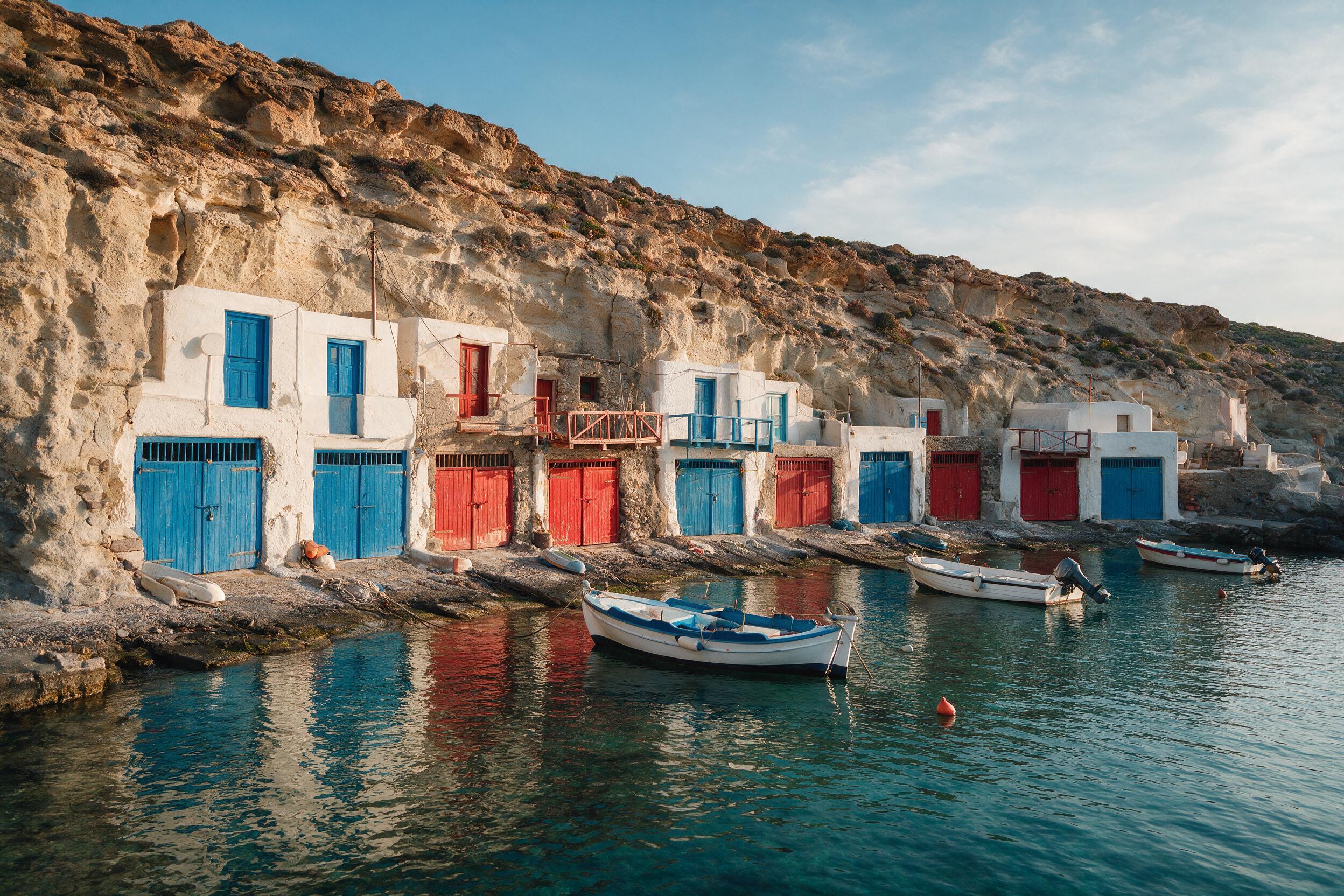
Milos gets a fraction of Santorini’s visitor numbers despite arguably having better beaches — over 70 of them, shaped by the island’s volcanic geology into something that looks more like Utah than the Mediterranean in places. Sarakiniko is the one worth building a morning around: stark white volcanic rock eroded into smooth, otherworldly formations that fall straight into turquoise water, with almost no shade and almost no crowd even in peak season, because most Santorini-bound travelers simply don’t know it exists. Klima, a tiny fishing village on the south coast, is the other stop — a row of brightly painted boathouses (syrmata) built directly into the cliff face at the waterline, still used by working fishermen, not staged for tourists.
Honest caveat: Milos isn’t a nightlife island, and if that’s what you want, this isn’t your stop. It’s a slow-mornings, long-lunches, watch-the-sunset-with-a-glass-of-assyrtiko kind of place. That’s precisely the appeal for a lot of our clients, and precisely the reason to skip it if you’re after Mykonos-style energy.
Folegandros: The Clifftop Chora Nobody Rushes To
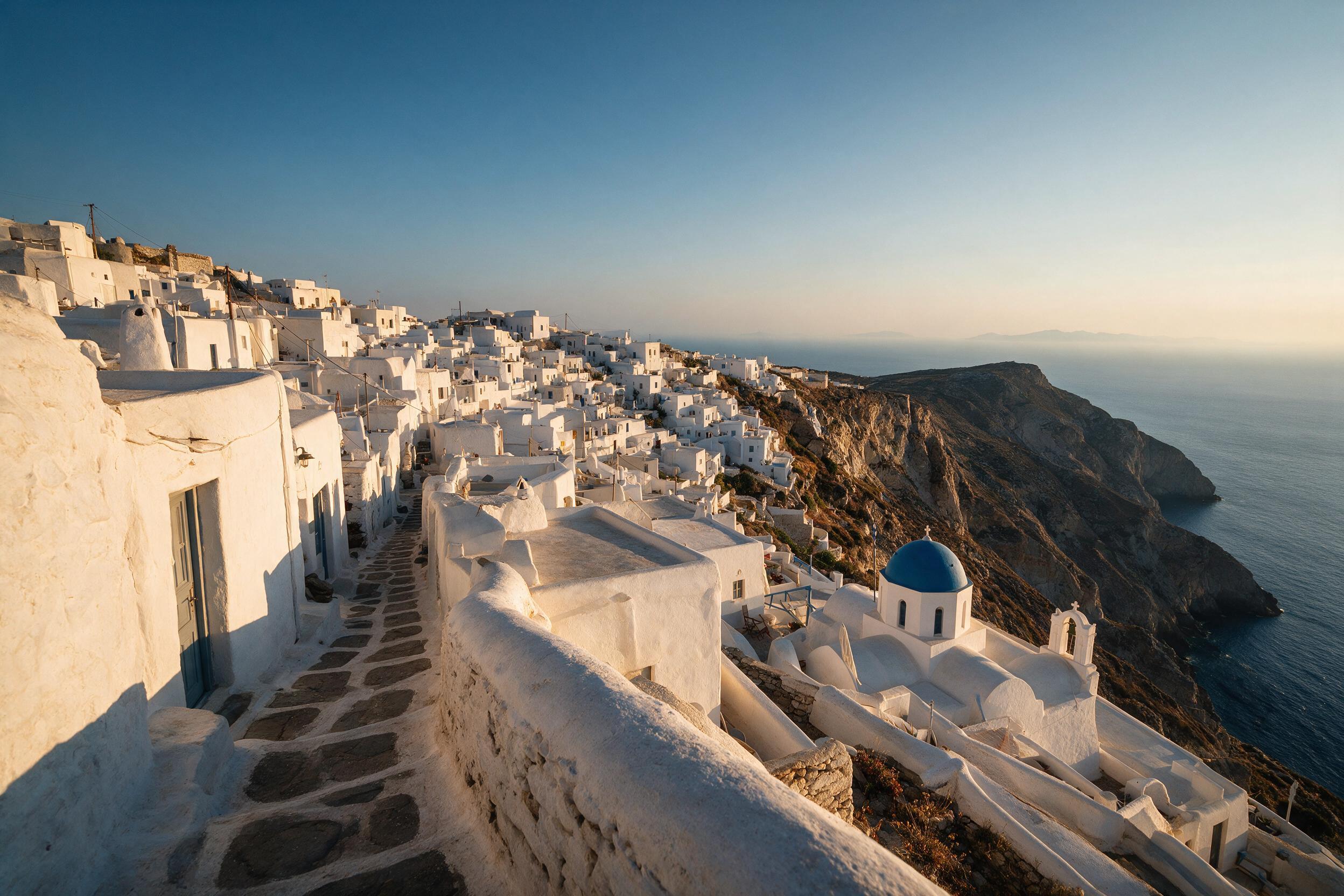
Folegandros is the smallest and quietest of the three, and its Chora (main town) sits on a clifftop so dramatic it makes Oia’s famous view look almost tame — except here you’ll share the sunset with maybe two dozen people rather than two thousand. The town itself is a maze of whitewashed lanes, three small connected squares, and a scattering of family-run tavernas that haven’t changed their menus in decades because there’s been no commercial pressure to. It doesn’t have Milos’s beach variety or Naxos’s scale, and that’s the point — Folegandros rewards travelers who want two unhurried days rather than a checklist of sights.
Naxos: The Island With Actual Mountains
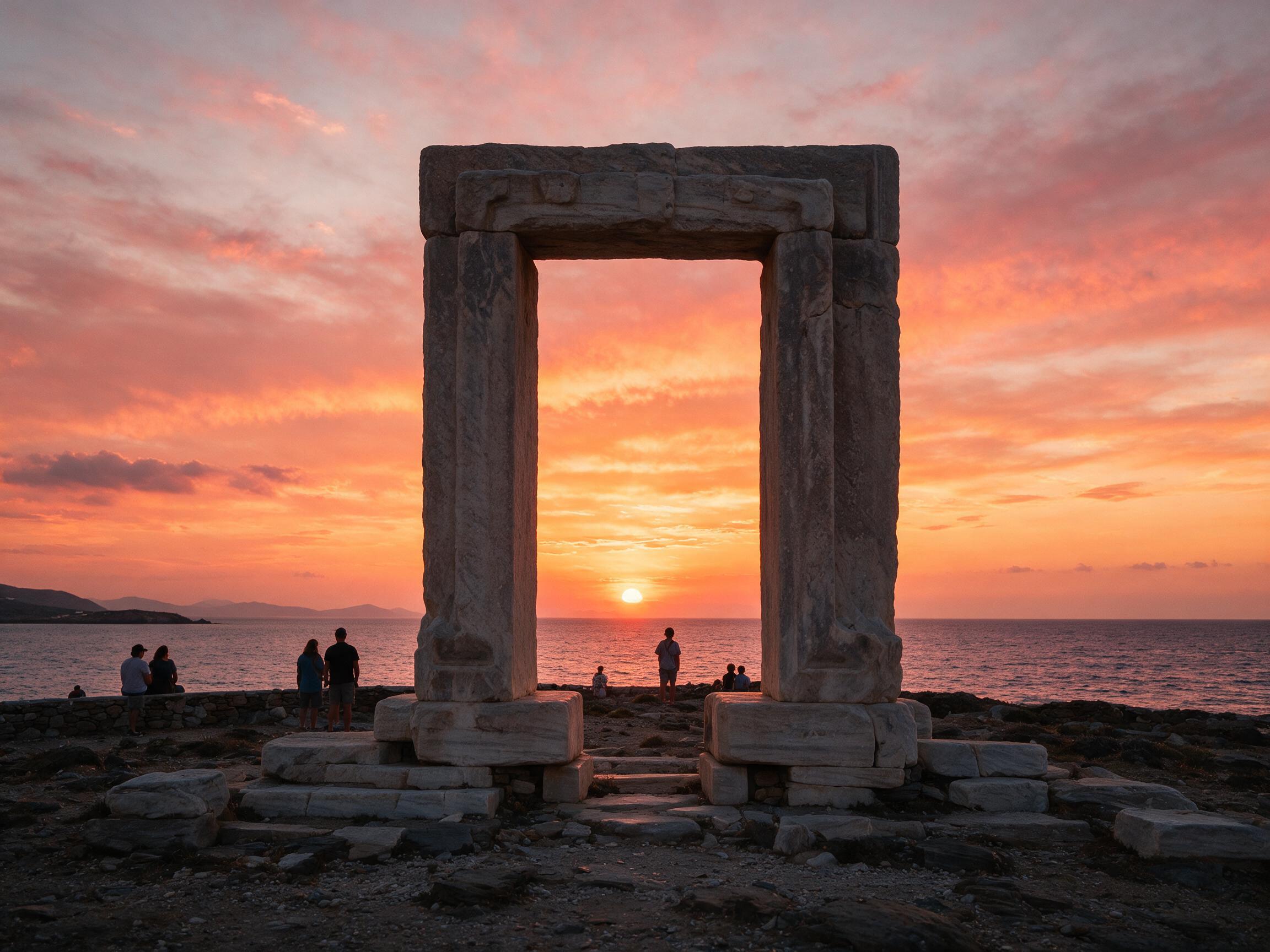
Naxos is the largest island in the Cyclades and the most agriculturally self-sufficient, which shows up on every menu — the potatoes, cheese, and wine are almost entirely local, and it tastes like it. Beyond the beaches (Plaka and Agios Prokopios are both excellent and far less crowded than anything comparable on Mykonos), Naxos has real mountain villages in its interior — Halki and Apiranthos, both built from local marble, both essentially untouched by the coastal tourism economy — connected by a rental-car-friendly road network that most Cyclades islands simply don’t have room for. The Portara, a massive freestanding marble doorway from an unfinished 6th-century BC temple, sits right at the harbor entrance and is the island’s best free sunset spot, a five-minute walk from the ferry dock. Rent a car for a day if you’re staying more than two nights — Naxos is the one Cyclades island in this trio where a scenic drive genuinely earns its place on the itinerary, winding up through olive groves and marble-quarry villages that most beach-focused visitors never see.
Where to Stay
Skip generic beach-resort chains here — the better stays on all three islands are small, family-run boutique properties, often 10-20 rooms, built into the same whitewashed cliffside architecture as everything around them. On Milos, look toward Plaka or Pollonia for boutique options with caldera-style views at a fraction of Santorini’s rates. On Folegandros, a handful of design-forward small hotels sit right in or near the Chora — book directly with the property where possible, since availability is genuinely limited. Naxos has the widest range, including proper five-star beachfront resorts around Agios Prokopios if you want more amenities alongside the quiet.
Food and Money
Greece uses the euro, and cards are accepted at the vast majority of restaurants and hotels on all three islands, though smaller tavernas and beach kiosks — especially on Folegandros — still run cash-preferred. Bring enough euros to cover a few days on the smaller islands, since ATMs can be limited to one or two machines in the main town. Food-wise, skip the touristy “Greek salad and moussaka” combo plate near any harbor and ask instead for whatever the taverna is serving that specific day — on islands this small, the good places genuinely cook around what came in on the boat that morning, not a fixed laminated menu.
Internet, Packing, and a Photography Tip
An eSIM covers all three islands reliably in the main towns, though signal thins out on the more remote beaches and mountain villages — Apiranthos on Naxos, in particular, has patchy coverage, which is arguably part of its appeal. Pack for genuine sun: the Cyclades in September and October still deliver strong midday UV even as the air temperature cools, and the volcanic terrain on Milos offers close to zero natural shade, so a proper hat and reef-safe sunscreen matter more here than they would on a shaded Mediterranean coastline.
For photography, skip the obvious blue-dome shot everyone already has from Oia and go for texture instead — Milos’s Sarakiniko rock formations photograph best in the hour after sunrise, when the white stone holds a soft pink light and you’ll likely have the entire cove to yourself; the fishing boathouses at Klima work better in late afternoon, when the low sun catches the painted doors face-on.
Safety and Practical Notes
All three islands are low-risk in the standard travel-safety sense — petty crime is rare even in peak season. The real practical risk is the meltemi, a strong seasonal wind that can suspend ferry sailings with little notice, typically in July-August but occasionally into September. It’s another reason the October end of our recommended window tends to run smoother for island-hopping than early September does. Check ferry status the evening before each crossing rather than assuming the printed schedule is final.
A Mistake to Avoid
Don’t try to cram all three islands into a rushed 5-day trip. Ferry schedules on the smaller Cyclades routes aren’t as frequent as the ones connecting the big tourist islands, and a missed or cancelled sailing (which does happen, particularly if the meltemi wind picks up) can eat an entire day of a tight itinerary. Give yourself a minimum of 8-9 days for a two-island trip, and build in one buffer day before your international flight home in case a ferry runs late.
A Fun Fact
Milos is the island where the Venus de Milo — now in the Louvre — was discovered by a farmer in 1820, buried in a field near the ancient theater. Depending on the season, the island’s small archaeological museum has a replica; the arms, notably, were already missing when it was found.
Who This Trip Suits
For couples, Folegandros’s clifftop sunset and Milos’s slower pace make for one of the more genuinely romantic Greek itineraries available right now, without Santorini’s crowd-management stress. For photographers, Milos’s Sarakiniko coastline and Naxos’s Portara are both distinct enough from the standard blue-dome shot to be worth the extra ferry leg on their own. For families, Naxos is the clear pick of the three — its beaches are shallow and calm, its mountain villages give older kids something to do besides swim, and its size means you’re not stuck on a single small harbor for a week.
FAQs
Is there a direct flight from India to Greece?
Yes, as of January 2026. IndiGo flies non-stop from both Delhi and Mumbai to Athens, three times weekly on each route, using the Airbus A321XLR — the first direct India-Greece air connectivity any carrier has offered.
Do Indians need a visa for Greece?
Yes. Greece is part of the Schengen Area, so Indian passport holders need a Schengen visa before travel, with standard processing around 15 working days.
How do you get from Athens to Milos, Folegandros, or Naxos?
By ferry from Piraeus, Athens’s port. High-speed ferries reach Milos in as little as 2 hours 40 minutes; Folegandros and Naxos are reachable directly or via a short additional hop from Milos.
Is Milos better than Santorini?
“Better” depends on what you want. Milos has more varied, less crowded beaches and lower prices; Santorini has the iconic caldera view and a livelier restaurant and nightlife scene. Many travelers do both — Santorini for a night or two, Milos or Folegandros for the slower, less-crowded stretch of the trip.
What’s the best time of year to island-hop in the Cyclades?
Late September through mid-October: warm enough to swim, dramatically fewer crowds than summer, and lower accommodation prices on the smaller islands.
How many days should I spend island-hopping in Greece?
A minimum of 8-9 days for two islands plus Athens, to allow buffer time for ferry schedules that can shift with weather.
Plan the Route With Get Tripped
Island-hopping logistics — which ferry, which order, which island for which two nights — is exactly the kind of planning that turns a good idea into a frustrating spreadsheet if you do it alone. Get Tripped builds Cyclades itineraries around the new direct Athens connectivity, sequencing the islands so you’re not losing a travel day to a ferry that runs twice a week. If Santorini’s crowds have been the thing holding you back from a Greece trip, this is the itinerary that solves for that.