
One Day in Athens: A Sunrise-to-Sunset Story From the Acropolis to Anafiotika
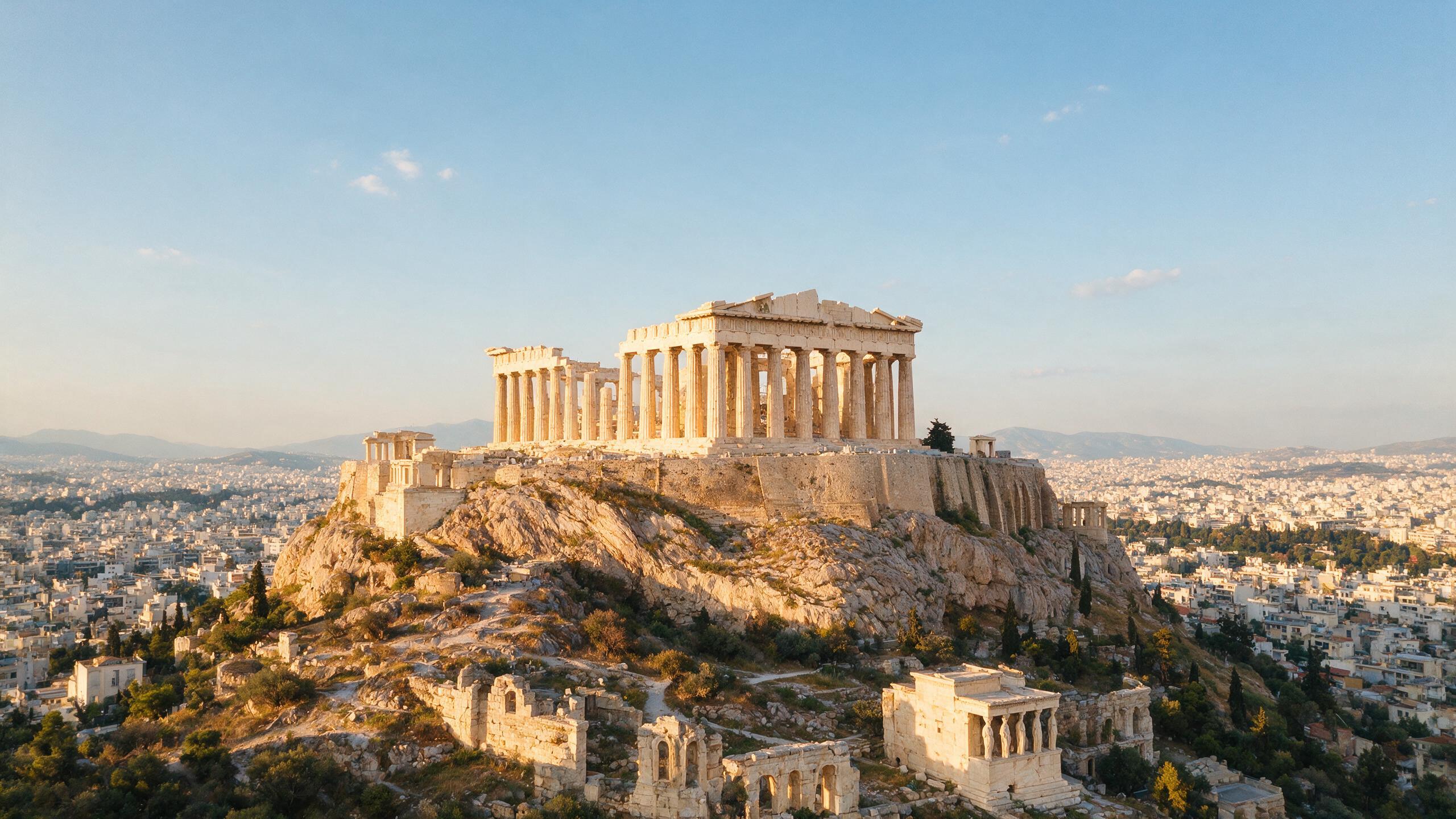
At 8:04 in the morning, the marble underfoot on the Acropolis is still cool from the night before, and the only sound is wind moving through the eleven standing columns of the Parthenon’s east front. Give it twenty minutes. By 8:30, the first coach groups are climbing the switchback path from the ticket gate, guides holding up laminated flags, and that particular kind of silence is gone for the day. This is the entire logic behind a good one day in Athens itinerary: get to the big thing early, then let the rest of the day happen at walking pace through neighborhoods that don’t care what time your flight leaves tonight.
This is the day we send Get Tripped travelers on when they’ve got 24 hours in Athens — whether that’s a standalone city break, a stopover before the islands, or the first day of a longer Greece trip that starts, for the first time ever, with a direct flight from India.
Table of Contents
- Getting to the Acropolis Before the Tour Buses Do
- Wandering Plaka and Anafiotika, Athens’ Cycladic Secret
- The Food Trail: Souvlaki, Loukoumades, and a Proper Greek Coffee
- Afternoon: The Acropolis Museum or a Rooftop Escape From the Heat
- Sunset on Areopagus Hill
- If You Have More Than One Day in Athens
- Getting There: India’s First Direct Flights to Athens
- Visa and Practical Info for Indian Travelers
- Where to Stay in Athens
- FAQs: One Day in Athens
Getting to the Acropolis Before the Tour Buses Do
Here’s the honest version, because a lot of blogs promise an “Acropolis sunrise” that isn’t quite what happens: the site doesn’t open before dawn. In summer (April to October) it opens at 8:00 a.m. and closes at 7:30 p.m., with last entry at 7:00 p.m.; in winter it’s 8:00 a.m. to 5:00 p.m. The sun in Athens is already well up by 8 a.m. most of the year. What you’re actually chasing isn’t the sunrise itself — it’s the first hour of light and the empty site, which is arguably better. Cooler air, soft gold light on the marble, and roughly a twenty-minute window before the cruise-ship and coach crowds arrive from Piraeus and the big hotels.
Buy your ticket online in advance through the official Acropolis ticketing system and select the earliest time slot. A standard adult ticket is €30 in high season (April–October) and €15 in low season (November–March); reduced tickets (non-EU students, ages 6–25) run €15 and €8 respectively, and EU citizens under 25 enter free with ID. If you’re also doing the Ancient Agora, Roman Agora, Hadrian’s Library, Kerameikos, the Temple of Olympian Zeus, or Aristotle’s Lyceum, the combined ticket at €36 covers all seven sites and stays valid for five days — genuinely better value if you’re spreading sightseeing across your stay.
The walk up is steeper than it looks in photos, and the marble steps get slippery when wet, so skip the sandals with no grip — this is the single most common regret we hear from travelers who packed for “a city trip” and forgot they’d be scrambling up a 2,500-year-old hill. Once you’re at the top, the Parthenon dominates, obviously, but don’t rush past the Erechtheion and its six Caryatid columns on the north side — most of the coach groups beeline straight for the Parthenon photo and skip it, so it stays quieter longer.
If you want a guide narrating the history while you’re up there before the crowds, look at a “first access” or early-entry guided tour — a handful of licensed operators run small groups that meet right at opening, which gets you both the empty site and the context. Worth it for history buffs; skippable if you’d rather just stand there and take it in.
Wandering Plaka and Anafiotika, Athens’ Cycladic Secret
Coming down from the Acropolis, most people funnel straight into Plaka’s main tourist strip along Adrianou and Kydathineon streets — souvenir shops, restaurant hosts waving laminated menus, the works. Walk through it, don’t linger, and head instead for Tripodon Street, one of the oldest continuously inhabited streets in the city, where the cafés are smaller and nobody’s trying to seat you.
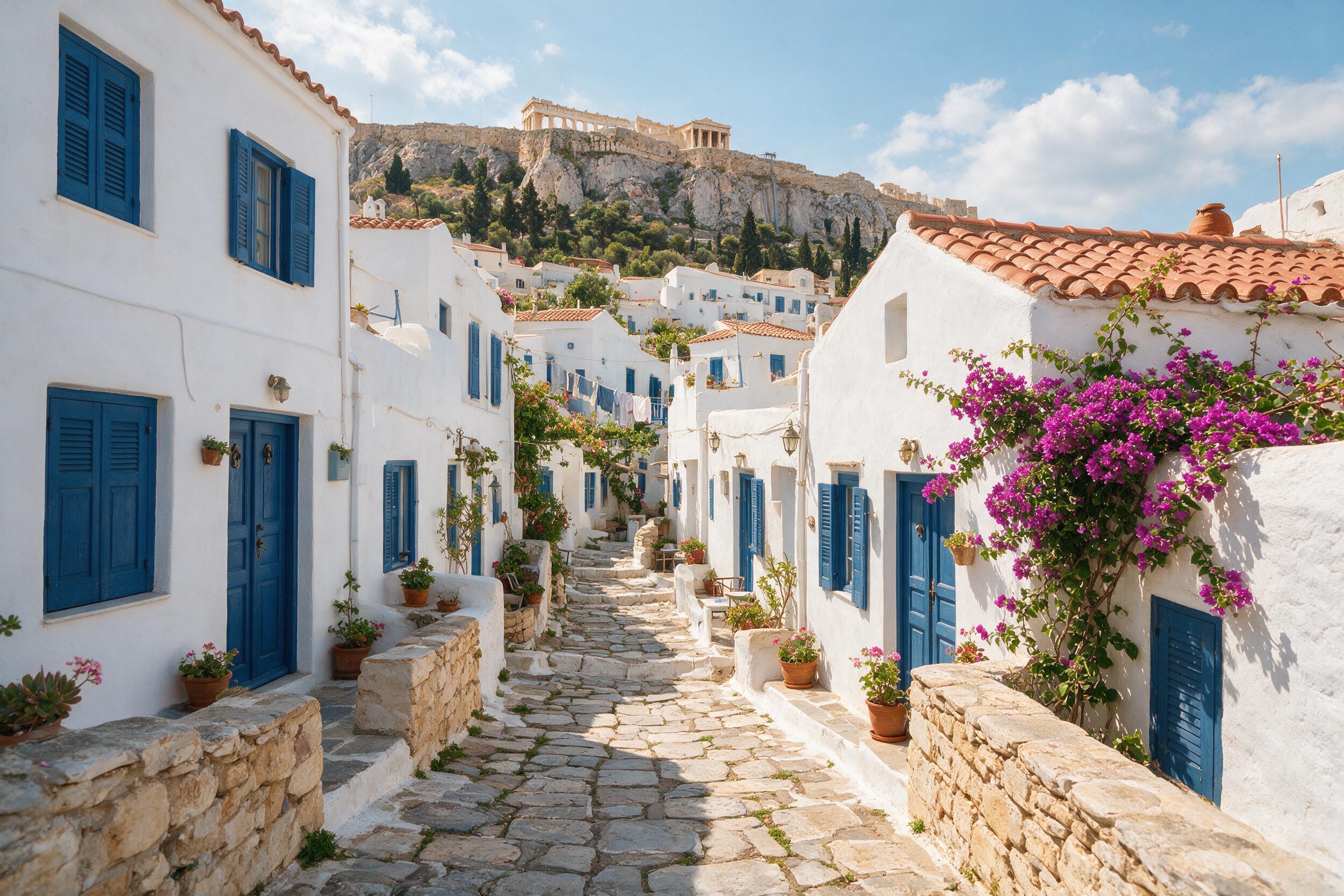
Then climb. Follow the signs (or just walk uphill, toward the rock) toward Anafiotika, and the city changes completely in about thirty steps. This is a pocket of whitewashed, low-slung Cycladic houses built directly into the northeast slope of the Acropolis rock — not a themed café district, an actual historic neighborhood. In the 1800s, King Otto brought in stonemasons from the small Aegean island of Anafi to build his new palace, and those workers built themselves homes in the island style they knew, illegally, on royal land, on the only hillside close enough to walk to work. The city eventually let it stand. Narrow stepped alleys, bougainvillea against blue shutters, cats asleep on doorsteps, laundry lines strung between houses — it looks like a Cycladic island stitched onto mainland Athens, because that’s essentially what it is. There’s a doll-sized whitewashed chapel wedged between two houses that’s easy to miss if you’re not looking down at eye level for it.
Honest caveat: Anafiotika is tiny, maybe a fifteen-minute wander end to end, and by midday it fills up with people doing exactly what you’re doing. Go through it on the way down from the Acropolis, right after opening, and you’ll mostly have the alleys to yourself. Go at 2 p.m. and you’ll be sharing them with fifty other people holding phones sideways.
From Anafiotika, drop back down into Plaka proper and let yourself get a little lost in the side streets around Kydathineon and Angelikis Hatzimichali — small workshops, an icon painter’s studio, a shop that’s sold worry beads to the same corner for decades. This is the part of the day with no fixed stops. Just walk.
The Food Trail: Souvlaki, Loukoumades, and a Proper Greek Coffee
By late morning you’ve earned lunch, and Athens’ best food trail isn’t a sit-down restaurant — it’s three stops on foot.
Start at O Thanasis, right on Monastiraki Square. It’s been grilling souvlaki and serving it wrapped in pita with tomato, onion, and a thick paprika-dusted fried potato since the 1960s, and it’s still the place locals point to when tourists ask where to eat, not just the place TripAdvisor points to. Order the kalamaki (skewered pork) wrapped, eat it standing at the counter or on a stool outside — that’s how it’s meant to happen, not plated with cutlery. Expect a short line at peak lunch hours; it moves fast.
Next, walk roughly ten minutes to Krinos on Aiolou Street, near the Central Market. It’s been making loukoumades — Greek honey doughnuts, fried to order, drenched in syrup and cinnamon — since 1923, and the shop still looks the part: marble counters, an old till, the smell of hot oil and honey hitting you before you’re through the door. Skip the newer, Instagram-styled loukoumades shops with the rainbow toppings elsewhere in the city if you want the version Athenians actually grew up on.
Finish with a Greek coffee at one of the small kafeneia tucked into Plaka’s back streets — order it metrios (medium sweet) if you want to sound like you’ve done this before, and expect it served in a small cup with the grounds settled at the bottom, alongside a glass of cold water. Don’t stir it after the first minute or you’ll be drinking mud. Mistake to avoid: ordering it “to go” — a Greek coffee is meant to be drunk sitting down, slowly, which is really the whole point of the stop.
Afternoon: The Acropolis Museum or a Rooftop Escape From the Heat
By early afternoon, especially if you’re doing this day between June and August, Athens is properly hot — average highs sit around 32°C in August, and the marble underfoot on the Acropolis and in Plaka’s open squares radiates heat back at you. This is the point in the day to go indoors or find shade, not push through it out of guilt.
The Acropolis Museum, a ten-minute walk from Plaka at the base of the hill, is the better choice if you want context for what you saw at sunrise. It’s a modern glass-and-concrete building with a glass floor over an excavated ancient neighborhood — you’re literally walking above ruins on your way to see more ruins — and the top floor, wrapped entirely in glass at the same alignment as the Parthenon, lets you look straight across at the building the artifacts came from. Adult tickets run €15 in high season (April–October) and €10 in low season, with reduced rates for students and seniors. Budget 90 minutes.
If museums aren’t the mood, this is instead the window to duck into a rooftop for a cold drink with a view and just sit for an hour — Couleur Locale on Normanou Street in Monastiraki has one of the most photogenic framed views of the Parthenon in the city, centered neatly between two buildings, and it’s a genuinely good spot to wait out the worst of the afternoon heat with a glass of something cold.
Sunset on Areopagus Hill

This is the moment the whole day has been building toward, and it costs nothing. Areopagus Hill — the smooth, worn rock outcrop just below the Acropolis entrance, where the ancient Athenian high court once sat and where the Apostle Paul is said to have preached — faces west, directly toward the Acropolis on one side and the sprawl of the city and the sea beyond on the other.
Get there about 45 minutes before sunset. The rock is genuinely slippery, worn smooth by a couple of thousand years of feet, so wear shoes with grip and watch your step, especially with kids or after a drink — there’s no railing. Once you’re settled, though, it’s simply the best free seat in Athens: the Parthenon catches the last light and turns a warm gold-pink, the city lights start coming on below, and there’s usually a small crowd of a mix of locals, students, and travelers sitting quietly, not performing for photos. It’s one of the few genuinely unstaged, unticketed moments left in central Athens.
If scrambling onto a rock isn’t your evening — say you’re celebrating an anniversary and want a table and a cocktail instead — A for Athens on Miaouli Street in Monastiraki is the most famous rooftop bar in the city for a reason, with the Acropolis floodlit directly across from the terrace after dark. For something more polished, the GB Roof Garden at the historic Hotel Grande Bretagne, or Tudor Hall at the neighboring King George Hotel, are the two rooftops in the city where “getting dressed up for dinner with a view” actually feels earned — smart-casual dress expected, cocktails in the €18–25 range, and arguably the best formal Acropolis-view dining in Athens for couples or anyone traveling in a more luxury frame of mind.
If You Have More Than One Day in Athens
One day covers the essential Athens story well, but it’s genuinely a shame to fly all the way from India and not go further. Athens works best as the opening chapter of a Greece trip, not the whole book. From here, most Get Tripped travelers either add a day trip to Cape Sounion for the cliffside Temple of Poseidon at sunset, or head straight to the islands — a ferry from Piraeus port puts you on Mykonos, Santorini, or the quieter Cyclades within a few hours. If food and archaeology are the draw, Delphi makes a strong overnight add-on before circling back to Athens for your flight home. We build all of these as full itineraries — this “one perfect day” is just the reliable opening move.
Getting There: India’s First Direct Flights to Athens
Until this year, getting to Athens from India meant a connection through the Gulf or Europe. That changed in January 2026, when IndiGo launched India’s first-ever direct flights to Greece, flying the long-range Airbus A321XLR — the same aircraft type making a lot of these new “thin route” long-haul connections viable across IndiGo’s network.
Mumbai–Athens started January 23, 2026, and Delhi–Athens followed a day later on January 24, 2026. Both routes fly three times a week.
| Route | Flight | Departure | Arrival |
|---|---|---|---|
| Mumbai → Athens | 6E 1903 | 09:50 | 14:15 |
| Athens → Mumbai | 6E 1904 | 15:25 | 02:00 (+1 day) |
| Delhi → Athens | 6E 1901 | 09:10 | 14:25 |
| Athens → Delhi | 6E 1902 | 16:00 | 03:10 (+1 day) |
The aircraft carries 195 passengers in a two-class layout: 12 seats in IndiGoStretch, a business-style 2×2 cabin with a 44-inch seat pitch and 6-inch recline, and 183 in Economy. It’s a genuinely different way to arrive in Athens than routing through Dubai or Istanbul with a layover — you land in the early afternoon, which happens to line up nicely with checking into your hotel and resting before an early Acropolis morning the next day.
Fun fact, if you’re into the aviation side of it: the A321XLR has a range of up to roughly 8,700 km, which is exactly the kind of aircraft that’s quietly opening up direct India–Europe routes that wouldn’t have made commercial sense on a wide-body a few years ago.
Visa and Practical Info for Indian Travelers
Greece is part of the Schengen Area, so Indian passport holders need a standard Schengen visa — there’s no separate Greece-only visa track. As of the current fee schedule (in effect since mid-2024 and unchanged into 2026), the visa fee is €90 for adults and €45 for children aged 6 to 12; children under 6 apply free. Apply through VFS Global, which handles Greek visa applications on behalf of the Greek consulates in India. Standard Schengen processing is meant to take up to 15 calendar days once your application is lodged, though it can extend to 30 or, in some cases, 60 days if extra documentation is requested — so apply at least three to four weeks before you fly, not the week before, especially in peak travel months when appointment slots fill up fast.
A few other practical notes:
- Weather: Since this is going up in August 2026 — average highs around 32°C, with barely any rain — know what you’re walking into if you’re booking for right now. September cools to around 28–29°C and October drops further to the mid-20s, with the crowds thinning noticeably after mid-September. If your dates are flexible, late September into October is genuinely the better window for a comfortable Acropolis morning without the peak-summer heat.
- Currency and cards: Euro. Cards are widely accepted, including contactless, at restaurants and shops; small kafeneia, market stalls, and the loukoumades counter at Krinos are more comfortable with cash, so keep some on hand.
- Getting around: A single metro ticket from Athens airport into the city center costs €9 and takes about 40 minutes to Syntagma. Within the city, a standard 90-minute ticket (covering metro, bus, tram, and trolley) is a little over €1. A fixed-rate airport taxi to central Athens runs €40 during the day (5 a.m.–midnight) and €55 overnight, for a roughly 35–45 minute ride depending on traffic. Stick to the official taxi rank or a licensed ride app — airport taxi overcharging is the one recurring complaint we hear, and it’s avoidable by knowing the fixed rate in advance.
- eSIM: Skip the airport SIM counter queue and set up an eSIM before you land — Airalo and Holafly both offer Greece and EU-wide plans, with Airalo starting from around $4 for a basic data package. Set it up the night before your flight so you land already connected.
- Safety: Central Athens — Plaka, Monastiraki, Syntagma — is well-patrolled and comfortable for solo travelers, including solo women, at all the hours this itinerary covers. The one thing to actually watch for is pickpocketing on the crowded Monastiraki metro platform and around the flea market on weekends — keep bags zipped and in front of you, the same common sense you’d use in any busy tourist center.
Where to Stay in Athens
For this exact itinerary, staying in or right at the edge of Plaka or Monastiraki means you can walk to the Acropolis gate in under fifteen minutes, which matters when your whole plan hinges on being there at opening. Couples and luxury travelers should look at the boutique hotels tucked into Plaka’s quieter streets — several converted neoclassical townhouses here do small, design-forward rooms with rooftop plunge pools and Acropolis views from bed. If you want the grand-hotel version of Athens, the Hotel Grande Bretagne on Syntagma Square (home to GB Roof Garden) is the historic choice for a reason — palatial without feeling stuffy, and walkable to everything in this guide.
FAQs: One Day in Athens
Is one day really enough to see Athens?
Enough to do this exact route well — Acropolis, Plaka, Anafiotika, a proper food trail, and sunset — but Athens rewards a second or third day if you can spare it, especially for the Acropolis Museum and a day trip to Cape Sounion.
What time does the Acropolis actually open?
8:00 a.m. year-round, closing at 7:30 p.m. in high season (April–October) and 5:00 p.m. in low season (November–March). Book the earliest slot online in advance.
Do I need to pre-book Acropolis tickets, or can I buy them at the gate?
Book online in advance. Same-day gate tickets exist but queues can run long in peak season, and popular early time slots sell out days ahead in summer.
Is Athens walkable, or do I need taxis for a day like this?
This entire itinerary is walkable — Acropolis, Plaka, Anafiotika, and Areopagus Hill all sit within roughly a fifteen-minute radius of each other. You won’t need a taxi until you’re heading back to your hotel or the airport.
Do Indian travelers need a visa for Greece?
Yes, a standard Schengen visa, applied for through VFS Global. Current fees are €90 for adults and €45 for children 6–12, with standard processing up to 15 calendar days — apply three to four weeks ahead of travel.
What’s the best time of year to do this Athens itinerary?
Late September through October, when temperatures drop from summer’s 32°C highs into the comfortable mid-to-high 20s and the crowds thin out. If you’re traveling in peak summer, this sunrise-first structure matters even more — you want the Acropolis done before the heat peaks around midday.
Is Athens safe for solo travelers, including solo women?
Yes, particularly in the central zones this itinerary covers — Plaka, Monastiraki, Syntagma. Standard city precautions apply, mainly around pickpocketing in crowded metro stations and market areas.
Can I fly to Athens directly from India now?
Yes — as of January 2026, IndiGo flies direct from Mumbai (from January 23) and Delhi (from January 24) to Athens, three times weekly on each route, using the Airbus A321XLR. It’s the first-ever direct India–Greece air connection.
One Day, One Real Athens Story
What makes a good one day in Athens itinerary isn’t cramming in more stops — it’s sequencing the few that matter around the city’s own rhythm: cool marble at opening, shade and food through the heat of the day, and a rock with a view for the end. Do it in this order and Athens stops feeling like a checklist and starts feeling like a place you actually spent a day in.
If this one day has you wanting the rest of the story — the islands, Delphi, a longer Peloponnese loop, or simply more time in Athens itself — that’s exactly the kind of trip we build at Get Tripped. Tell us your dates and we’ll put together a full Greece itinerary around this new direct Mumbai or Delhi connection, from the first Acropolis morning to the last island sunset.