
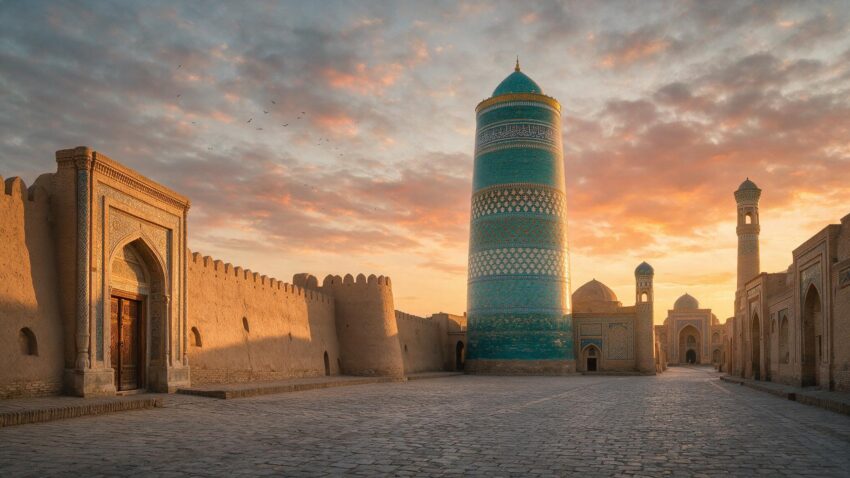
Samarkand’s Registan Square is, without question, one of the most striking sights on the old Silk Road — three towering madrasas facing each other across a single square, tiled in blue and turquoise that still looks improbable in photographs. It’s also, by mid-morning on any given day now, thick with tour groups moving in the same loop, phones up, guides talking over each other in four languages. Uzbekistan has been quietly climbing every “next big Silk Road destination” list for a couple of years, and Samarkand absorbed most of that attention first, which means it’s also absorbing most of the crowding. Bukhara and Khiva, an hour’s flight or a few hours by train further west, are still doing the thing Samarkand did five years ago — except with fewer people between you and the tilework.
In this guide:
- Why Bukhara and Khiva, and not “more Samarkand”
- Getting there from India
- Bukhara: the old town that’s still actually a town
- What to eat in Bukhara, and where the somsa actually taste different
- Khiva: the walled city built for wandering, not touring
- Food in Khiva, and a dish worth seeking out specifically
- A mistake worth avoiding, and a currency quirk worth knowing
- Best time to go
- Who this trip suits
- Frequently Asked Questions
- The honest pitch
Why Bukhara and Khiva, and not “more Samarkand”
This isn’t an anti-Samarkand piece — Registan genuinely deserves the hype, and skipping it entirely would be a mistake. But treating Samarkand as the whole trip, the way most first-time Uzbekistan itineraries do, means missing the two cities that arguably show the Silk Road story more completely. Bukhara is a living old town rather than a monument circuit — people still live, trade, and pray inside the historic core, and its skyline is genuinely dominated by the 46.5-metre Kalyan Minaret, built in 1127 and old enough that Genghis Khan reportedly spared it while destroying much of the rest of the city around it. Khiva, further west and considerably more remote, is something else again — an entire walled old city, Itchan Kala, preserved essentially whole, small enough to walk in a day and atmospheric enough to want two.
Fewer travellers make it this far west largely because it takes more effort — Khiva especially sits far enough from Tashkent that it demands either a domestic flight or a genuinely long train or road journey — and that effort is exactly the filter that keeps both cities from turning into Registan’s crowd levels.
Getting there from India
Uzbekistan Airways runs direct flights between Delhi and Tashkent, roughly four to four and a half hours, with fares typically in the ₹9,000–14,000 one-way range depending on how far ahead you book — genuinely one of the more accessible “exotic” long-haul-feeling destinations from India, given it doesn’t actually require a long haul at all. Mumbai routes generally connect rather than fly direct, usually through Tashkent itself or a Gulf hub.
From Tashkent, the Afrosiyob high-speed train is the way to move between cities, and it’s genuinely one of the better parts of the trip rather than a logistics chore — smooth, fast, and scenic in a flat, steppe-adjacent way. Tashkent to Bukhara runs a little over three and a half hours; onward to Khiva, there’s no direct high-speed line, so most travellers either fly Bukhara–Urgench (Khiva’s nearest airport, about a 40-minute hop) or take a considerably longer overnight or day train. Book train tickets a few days ahead where you can — popular routes and dates do sell out, particularly in shoulder season when the weather is at its best.
Entry itself is straightforward: Indian passport holders apply for an Uzbekistan e-visa online at e-visa.gov.uz, choosing single, double, or multiple entry (USD 20, 35, or 50 respectively), with approval typically landing within two to three working days. Print the approved e-visa — you’ll need the physical copy at immigration, not just a phone screenshot.
Bukhara: the old town that’s still actually a town
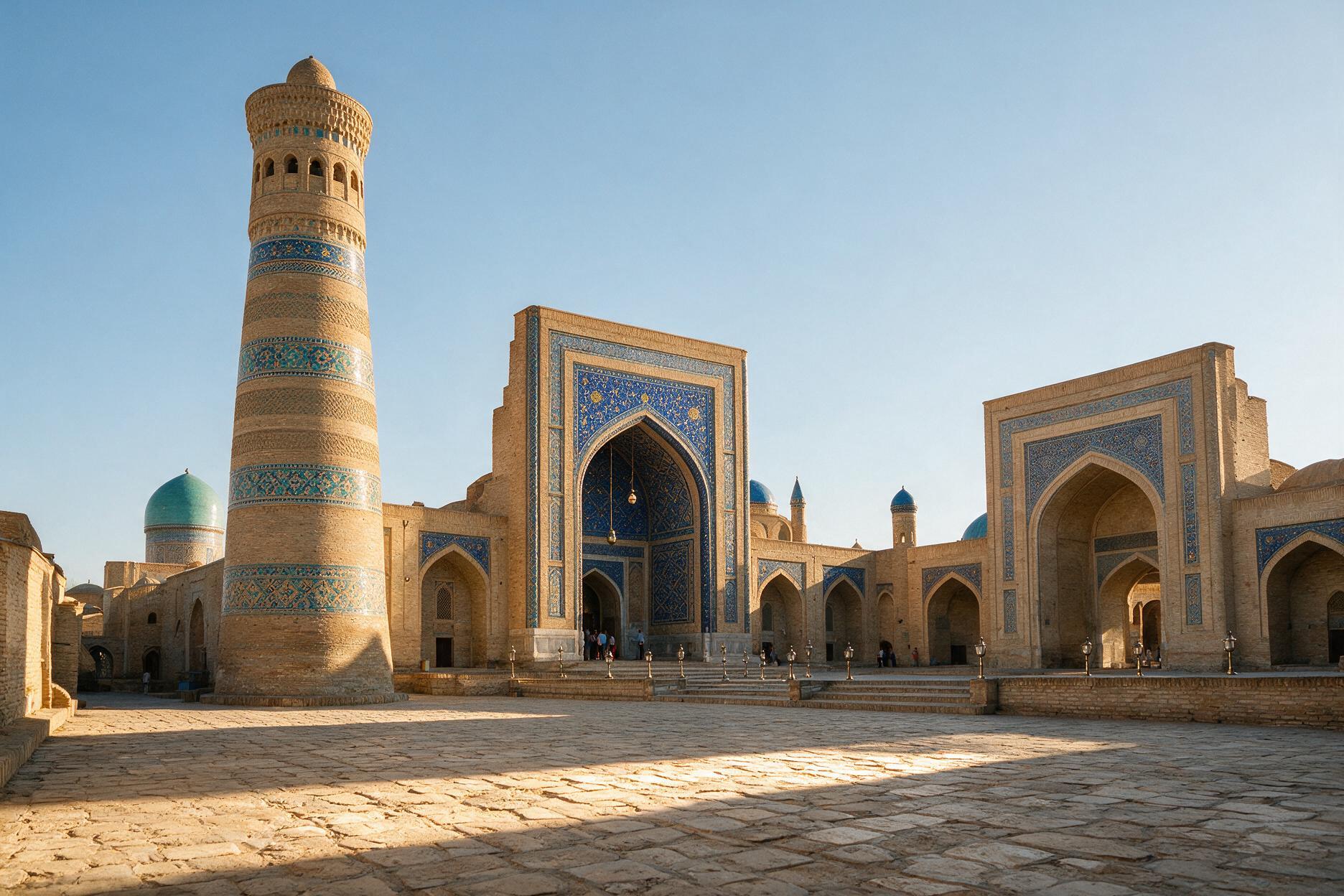
Start at the Poi-Kalyan ensemble in the early morning, before the day-trip buses arrive from Samarkand — the minaret, the Kalyan Mosque, and the Mir-i-Arab Madrasa together form the kind of scene Registan gets photographed for, minus the crowd doing the photographing. From there, the old trading domes — Toqi Zargaron, Toqi Sarrofon, Toqi Telpak Furushon, and Tim Abdulla Khan — are still functioning covered bazaars rather than museum pieces, selling suzani embroidery, jewellery, and carpets in the same stalls that have operated here for centuries, though obviously with modern goods mixed in now too.
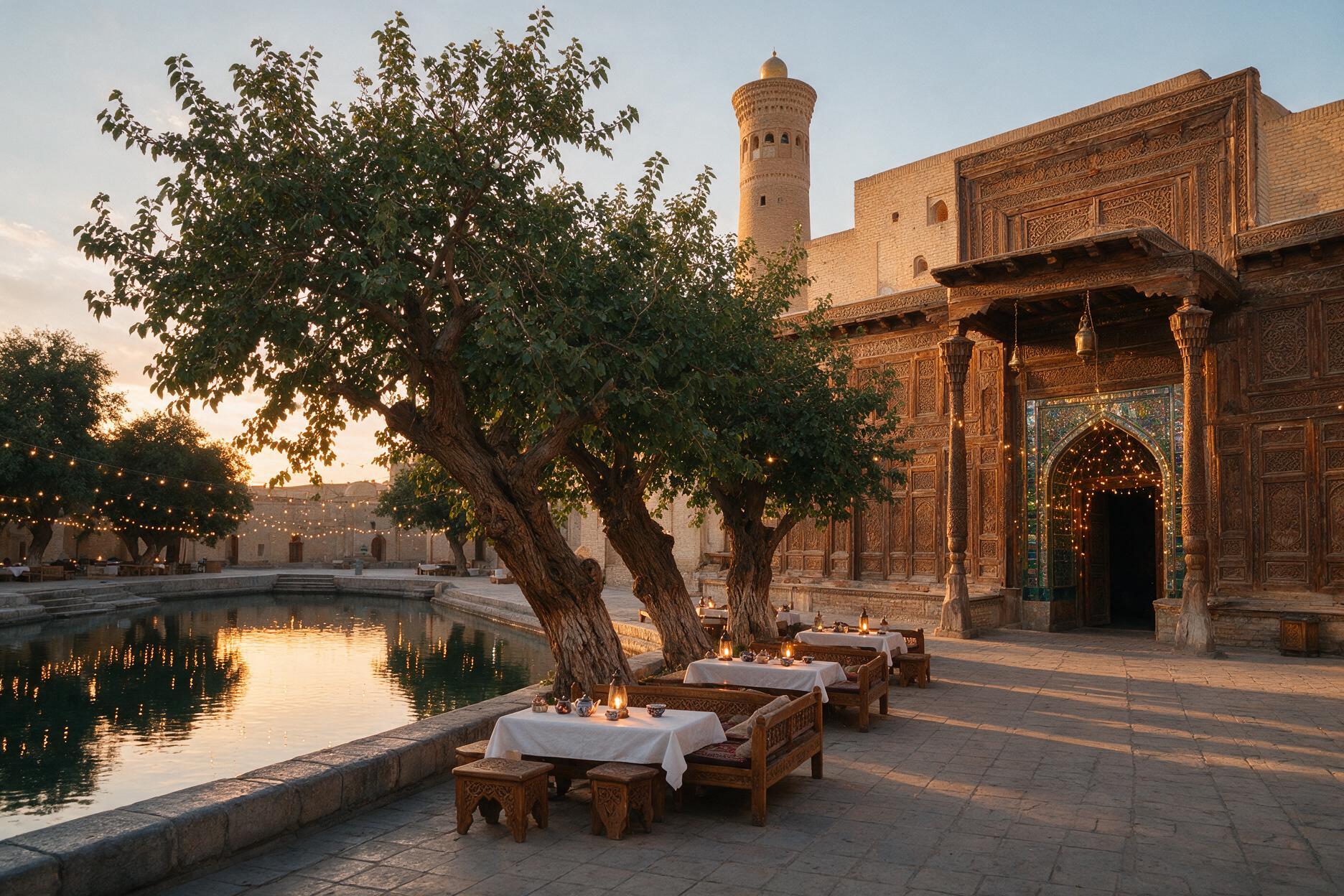
Lyab-i-Hauz, the pond-centred square framed by mulberry trees and the Nadir Divan Begi Madrasah, is where Bukhara actually slows down in the evening — locals and visitors both end up here, and it’s a good spot to sit with tea rather than rush through. For something genuinely few visitors bother with, Chor Bakr, a 16th-century memorial complex about fifteen minutes outside the centre, spreads across several hectares of mausoleums and orchards and tends to be near-empty even in peak season — it’s the kind of stop that separates a rushed one-day Bukhara visit from one that actually breathes.
Chor Minor — four small turquoise-domed towers, each said to represent a different religion — is easy to miss on a map but worth the short detour into the residential lanes around it; it’s a five-minute stop, not a destination in itself, but it’s the sort of thing that rewards wandering rather than checklist-ticking.
What to eat in Bukhara, and where the somsa actually taste different
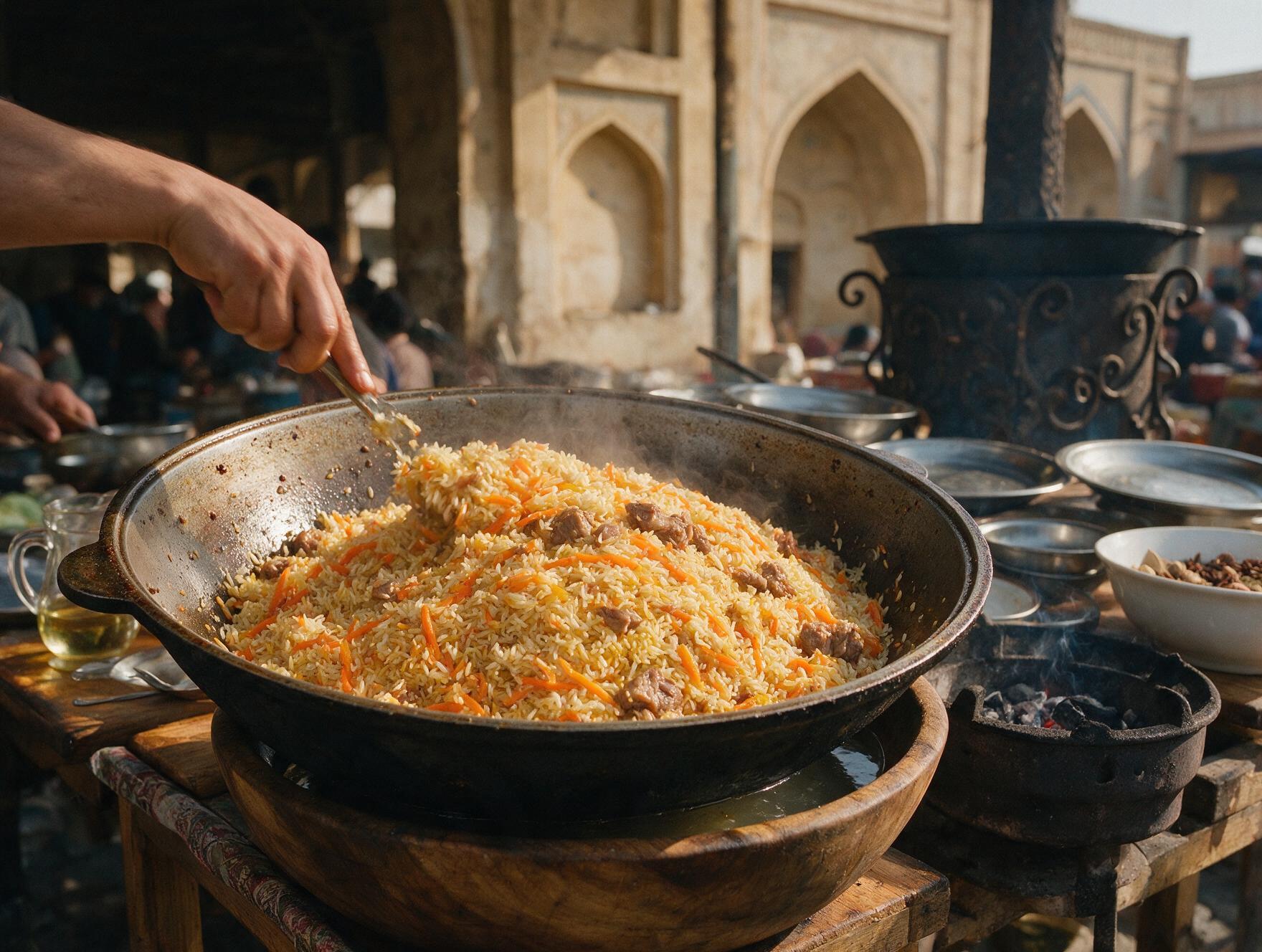
Plov — Uzbekistan’s national rice dish, cooked with meat, carrots, and onions in enormous communal pots — is the dish everyone tells you to eat, and you should, but somsa deserve equal billing. These are baked pastries filled with meat or, less commonly outside Bukhara, pumpkin — and the pumpkin version, when you can find it, is genuinely the better of the two, sweeter and less heavy than the standard meat filling most menus default to. The old Central Market (Kolkhoznyy Rynok) near the centre is a good place to find both dry fruits and fresh nons — the round, stamped bread that shows up at every Uzbek meal — sold by the people who baked them that morning rather than a restaurant kitchen.
For a sit-down meal, Minzifa’s rooftop makes a strong case for itself with genuinely good food to go with the view, while a Bolo Khauz-area chaikhana (teahouse) does reliable shashlik if you want something simpler and cheaper. Reasonable mid-range restaurant meals run around $5 a head; local eateries away from the tourist circuit can be half that.
Khiva: the walled city built for wandering, not touring
Itchan Kala is small enough to be entirely walkable and genuinely does reward two days rather than a rushed single afternoon — the one piece of advice nearly every visitor repeats is to be inside the walls at sunrise or after the day-trip crowds clear out in early evening, when the mudbrick alleys are, as more than one visitor has put it, “devoid of any people.” That’s rare for a UNESCO-listed old town anywhere, let alone one that’s this photogenic.
Kalta Minor, the striking turquoise-tiled “unfinished minaret” that never reached its planned height, anchors most people’s mental image of Khiva, but it’s worth pushing past it into the quieter corners — the Kunha Ark fortress for sunset views over the rooftops, the Juma Mosque with its 218 individually carved wooden columns creating an almost forest-like interior unlike anything else in the old city, and Tash Khauli Palace, whose 150 rooms and vivid orange-red-and-blue tilework tend to get far less attention than the minarets outside despite being, honestly, more visually intricate up close.
The genuine hidden-gem move in Khiva is ducking into the handicraft workshops tucked into side alleys — woodworkers, stone carvers, and tile makers working in small studios rather than storefronts, some open to watching the process rather than just buying the result. None of this makes it onto the standard day-trip itinerary that most Samarkand-based tour groups run through Khiva on, because those groups simply don’t have the time.
Food in Khiva, and a dish worth seeking out specifically
Shivit oshi — green noodles made with dill, served with a meat or vegetable stew — is Khorezm regional cooking (the province Khiva sits in) and genuinely distinct from what you’ll eat in Bukhara or Samarkand; it’s worth actively seeking rather than defaulting to plov again. Terrassa Café, on a rooftop with views over Kunha Ark, does a reliable lamb shashlik alongside sunset views, while Bir Gumbaz, near Kalta Minor, is a simpler teahouse-style spot known for kebabs and dumplings at a fraction of the price.
A mistake worth avoiding, and a currency quirk worth knowing
The mistake: trying to do Khiva as a rushed day trip from Bukhara, which some tour operators still push because of the awkward transport connection between the two. It technically works, but you’ll spend more time travelling than actually inside Itchan Kala, and you’ll miss the empty-alley sunrise and evening light that’s genuinely the best part of visiting. If your schedule allows it, budget one night in Khiva minimum.
On money: the Uzbek som is worth very little per unit — roughly 13,000 UZS to the US dollar at current rates — which means changing even a modest amount of cash can leave you holding a genuinely absurd stack of notes, since exchange counters often hand out 1,000-som bills by default. Cards are now widely accepted at hotels and mid-range restaurants in all three cities, a real change from a few years ago, but keep cash on hand for bazaars, small eateries, and entry tickets, which sometimes still expect it. Daily costs for a comfortable mid-range trip run somewhere around $60–90 a day covering hotel, meals, and local transport, before flights and the intercity train or flight legs.
Best time to go
Spring (April–May) and early autumn (September–October) are genuinely the right windows — comfortable walking temperatures in both Bukhara and Khiva, without the summer heat that makes exploring exposed old-town streets during the day fairly punishing between June and August. If your dates are flexible, autumn also tends to bring slightly softer light for photography than the harsher spring glare.
Who this trip suits
Couples and small groups get the most out of this pace-slower version of Uzbekistan — Khiva especially rewards an unhurried evening walk together more than a rushed group tour ever could. It’s also a strong pick for travellers who’ve done the more obvious international circuits and want somewhere that still feels like a genuine discovery rather than a repeat of somewhere friends have already posted about. Solo travellers will find both cities comfortable and safe to wander, with English spoken reasonably well in tourist-facing hotels and restaurants even if it thins out fast once you’re off that circuit — a few Russian or Uzbek phrases go a long way and are appreciated.
Frequently Asked Questions
Is Bukhara or Khiva better than Samarkand?
Not better, different — and ideally you see all three. Samarkand has Registan, which is genuinely unmissable. Bukhara and Khiva offer the same Silk Road history with far fewer crowds and, in Khiva’s case, a completely walkable walled old city unlike anything Samarkand has.
How many days should I budget for Bukhara and Khiva together?
Two full days in Bukhara and a minimum of one night (ideally two) in Khiva, plus travel time between them. Combined with Samarkand and Tashkent, a full Uzbekistan trip comfortably runs 8–10 days.
Do Indian citizens need a visa for Uzbekistan?
Yes, an e-visa, applied for online at e-visa.gov.uz. It’s a straightforward process — typically approved within two to three working days — and India is on Uzbekistan’s list of eligible countries.
Is Uzbekistan safe for solo and women travellers?
Generally yes — it’s regularly cited as one of the safer countries in the region for solo travel, including for women, with low visible crime in the tourist areas of Bukhara and Khiva. Standard travel precautions apply as anywhere.
What’s the best way to travel between Tashkent, Bukhara, and Khiva?
The Afrosiyob high-speed train for Tashkent–Bukhara, and a short domestic flight (Bukhara–Urgench) or a longer train for the Bukhara–Khiva leg, since there’s no direct high-speed line covering that stretch.
Is English widely spoken?
In hotels, tourist sites, and restaurants that see regular foreign visitors, yes, reasonably well. Away from that circuit it thins out quickly, and a translation app or a few basic Russian phrases help.
The honest pitch
Samarkand will still be there, and you should still see it — Registan really is that good. But if the version of Uzbekistan you’re picturing is crowds, selfie sticks, and a rushed group tour ticking off tile-covered facades, Bukhara and Khiva are the correction: slower, quieter, and closer to what made people fall in love with this stretch of the Silk Road in the first place.
Get Tripped can build a Uzbekistan itinerary that properly weights Bukhara and Khiva rather than treating them as a rushed add-on to Samarkand — get in touch and we’ll work out the right split of days across all three.